Maze Escape: Free Online Maze Game with a New Maze Every Day
Guide a glowing wisp out of mazes of every shape: square, hex, triangle, ring, weave and multi-floor towers, with keys and doors, one-way gates, teleporters and fog. A 120-maze campaign, a Daily Maze and a free-play maze maker.
What is Maze Escape?
Maze Escape is a free online maze game you can play right here on your phone, tablet or computer. You guide a small glowing wisp from its starting spot to the green glow that marks the way out. There is nothing to download and no account to make. Press Play and the first maze is on screen.
It starts gently, with small square mazes and two hints each. Then the shapes change. Rooms become hexagons, then triangles. Mazes curl into rings. Passages duck under bridges, towers stack floor upon floor, and coloured keys, one-way gates, teleporter rings and fog all join in.
There are 120 mazes in the campaign, a fresh Daily Maze every day, and a free-play maker that builds a brand new maze each time you ask. Every maze is made by the game itself, and every one is checked by a solver before you see it, so there is always a way out.
How to play Maze Escape
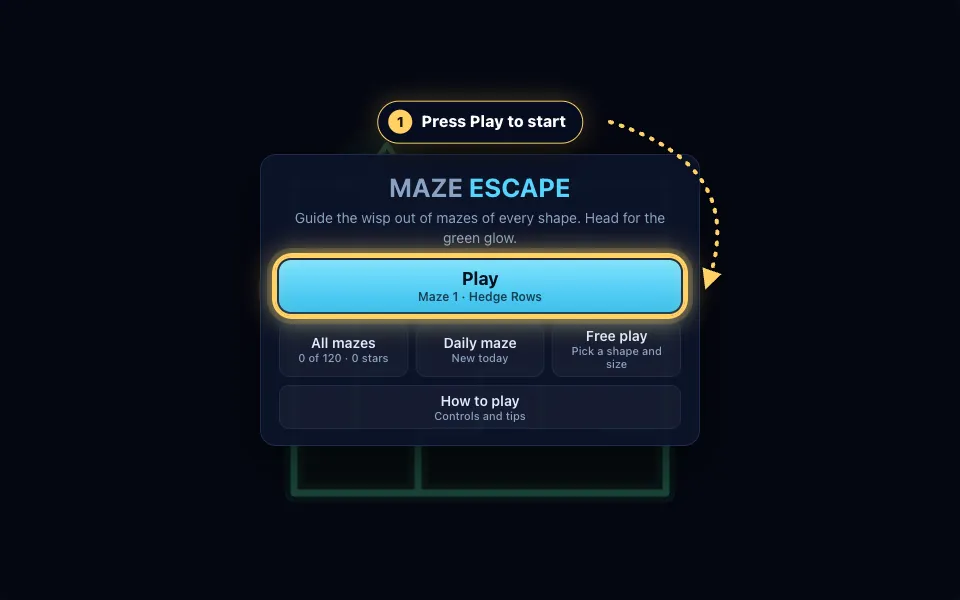
Press Play to start
The big Play button opens the next maze in the campaign, starting with Maze 1 in Hedge Rows. The smaller buttons open the level list, the daily maze, free play and the controls.
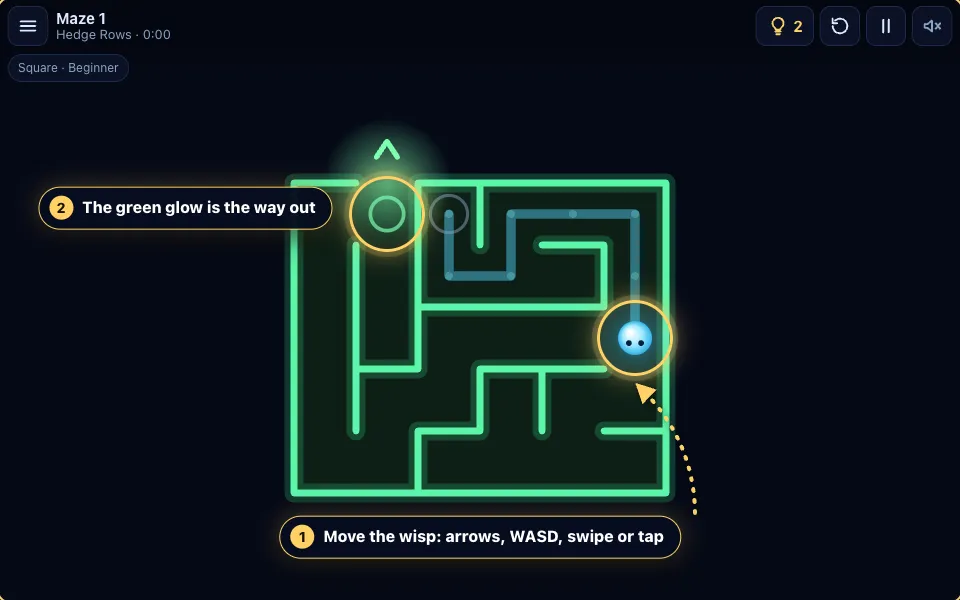
Steer the wisp to the green glow
You are the blue wisp. Move with the arrow keys or WASD, swipe on a phone, tap a corridor to walk there, or drag from the wisp to trace a route. The green glow is the way out.
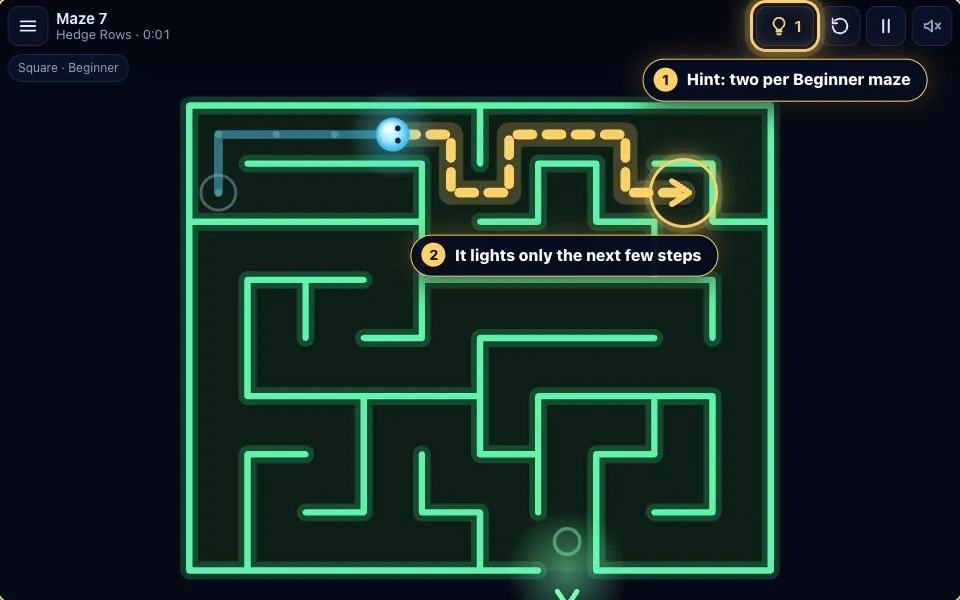
Ask for a hint when you are stuck
Beginner mazes give you two hints each. Press the lamp button or H and the next few steps light up in gold. A hint never shows the whole route, and harder tiers have none.
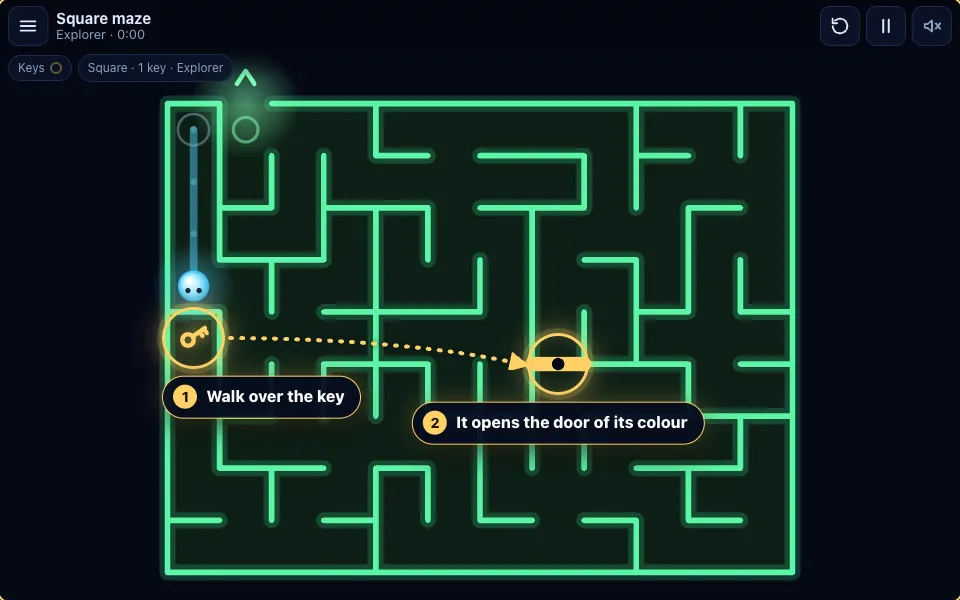
Collect keys to open doors
A coloured bar across a corridor is a locked door. Walk over the key of the same colour first and the door opens as you reach it.
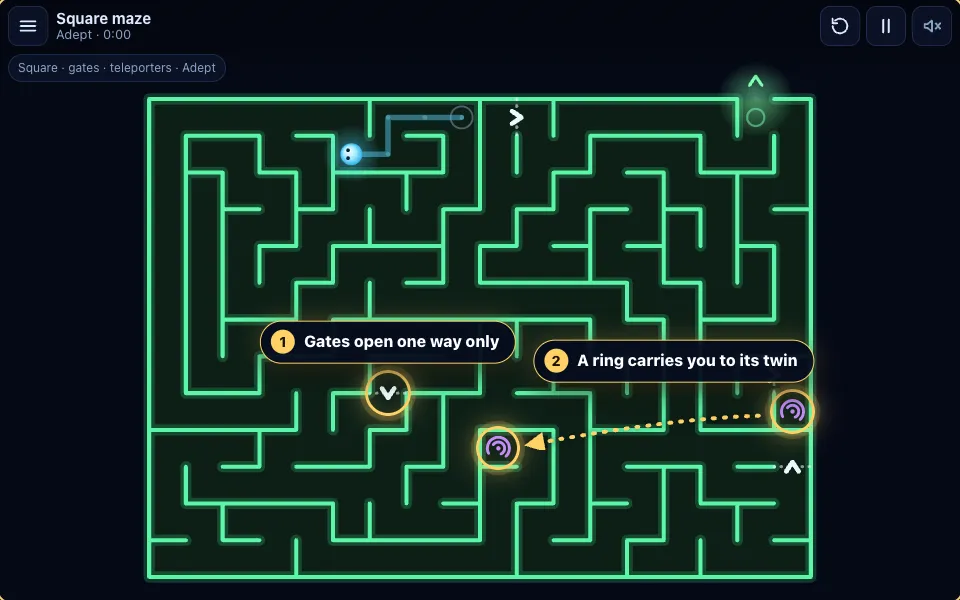
Read gates and teleport rings
A white arrow marks a one-way gate: you can pass the way it points and never back. A glowing ring is a teleporter that carries you to its twin elsewhere in the maze.
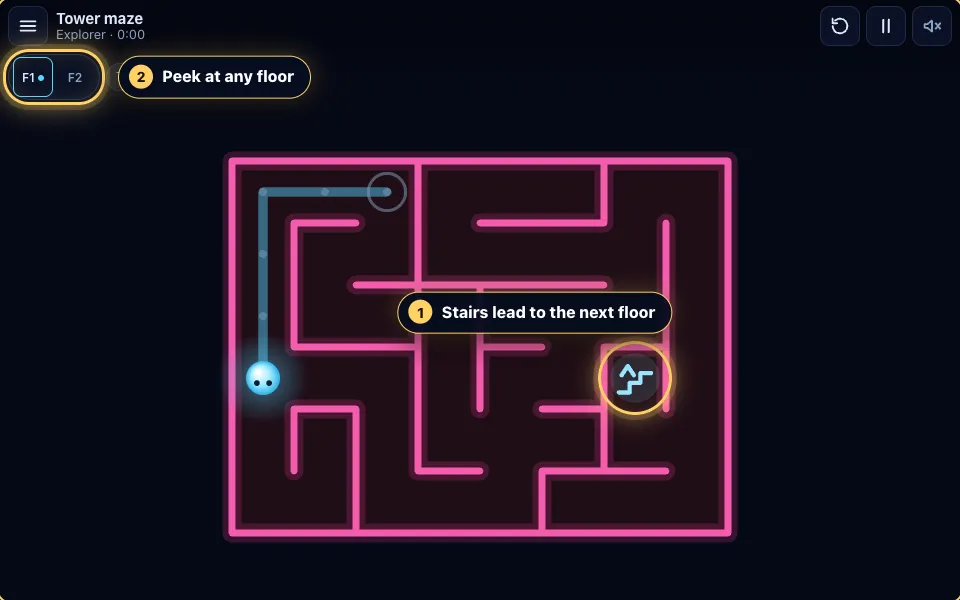
Climb between floors in a tower
Tower mazes stack several floors. Step onto a stair tile to move up or down. The floor buttons at the top left let you peek at any floor without moving.
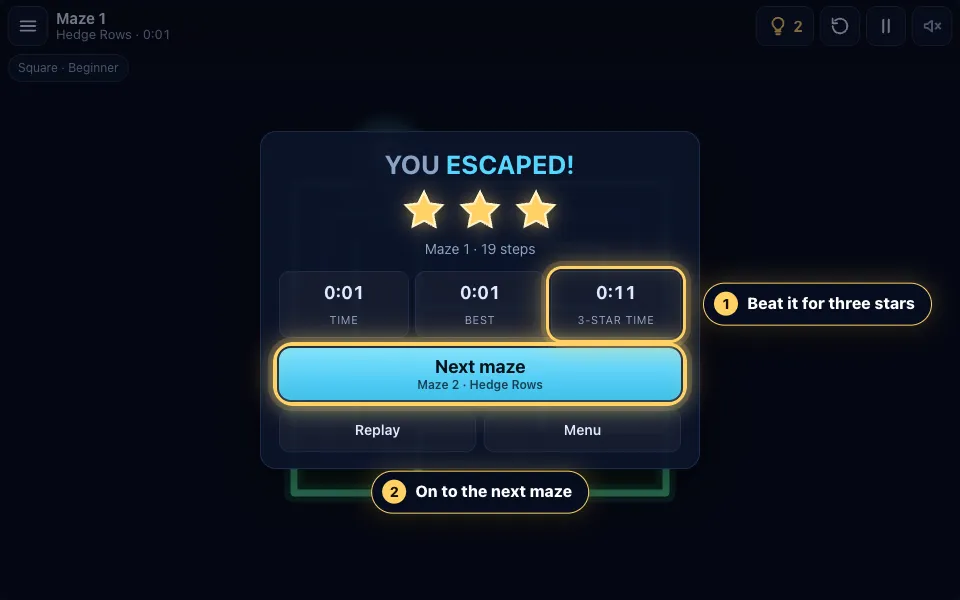
Beat the star time, then move on
Every escape is timed. Finish inside the 3-star time for all three stars, or up to twice as long for two. Next maze takes you straight on, and Replay lets you chase a better time.
The rules in full
- Press Play. The wisp waits at the ringed start and the way out is the green glow in the outer wall.
- Move with the arrow keys or WASD. Each press takes one step, and holding a key keeps the wisp gliding.
- Hold Shift with a direction to run along a corridor until the next junction or turn.
- On a touch screen, swipe to run a corridor, drag from the wisp to trace a path, or tap a spot to walk there. A thumb pad is there too if you like one.
- Your route is drawn behind you as a blue thread, and every room you have stood in keeps a small dot, so you can see where you have already looked.
- Pick up a coloured key by walking over it. It opens the door of the same colour for the rest of the maze.
- A gate with an arrow lets you through only in the direction it points. A spinning ring carries you to its twin, and stairs take you to another floor.
- On big mazes the view follows the wisp and a mini-map appears. Press F or the view button to see the whole maze at once.
- Reach the green glow to escape. A quick escape earns three stars, a slower one earns two or one.
- Stuck on a Beginner maze? Press H for a hint. It lights only the next few steps, and you get two per maze.
Maze Escape tips and strategy
- Look from the exit backwards. The last few turns before the green glow are often easier to read than the first few from the start.
- Dead ends show themselves. If a corridor has no side openings and stops at a wall, do not walk it just to be sure.
- Trust your dots. A junction where every branch already has dots in it is finished, so go back to the last junction with a clean branch.
- In a ring maze, the way out is always on the rim. Any passage that leads outwards is worth more than a long walk around the same ring.
- With keys, plan the order first. Find each door, then find its key, and fetch the key that is on your way rather than the nearest one.
- A one-way gate is a promise you cannot take back. Before you step through, check that you are not leaving a key behind.
- In fog, hug one wall and keep going. Your dots and thread stay lit, so the map fills in as you walk.
- Running saves the most time. Shift on a keyboard or a swipe on a phone takes you to the next junction in one go.
What is Maze Escape?
Maze Escape is a maze game in the oldest sense: there is a start, there is a way out, and there are walls in between. You steer a small glowing wisp, and the only goal is to reach the green glow.
What makes it different is the variety. The game builds six kinds of maze in six sizes, from a starter with 30 rooms to a giant with more than 1,700. It can add keys, gates, teleporters and fog to any of them. No two mazes are the same, and none is drawn by hand.
Six kinds of maze
Square mazes are the classic kind, with four ways to turn. Hex mazes are made of six-sided rooms, so there are six ways out of each one and far more forks. Triangle mazes go the other way: each room has only three walls, which makes long zigzag corridors.
Ring mazes start in the middle and work out through circles of rooms to a gap in the rim. Weave mazes have passages that cross over and under each other on little bridges, so two paths can cross without meeting.
Tower mazes stack two, three or four floors on top of each other. Stairs join the floors, and the exit is always on a different floor from the start. Buttons on screen let you peek at any floor before you climb.
Keys, doors, gates, teleporters and fog
A door is a thick coloured bar across a passage. Walk over the key of the same colour and the door opens. Later mazes hold up to three keys, and one key is often hidden behind the door of another.
A one-way gate shows a small arrow. You can pass with the arrow but never against it. Gates only appear in mazes that have loops, and the solver checks that a gate can never trap you somewhere with no way on.
Teleporters are pairs of spinning rings in matching colours. Step into one and you come out of its twin. In fog you can only see the rooms near your lantern, but everything you have already seen stays on the map.
The campaign: ten chapters, 120 mazes
The campaign is a ladder of ten chapters with twelve mazes each. Hedge Rows teaches the basics on square mazes. Honeycomb and Shard Fields bring in hexagons and triangles. Ring Temple and Bridgeworks add circles and weaves.
The Vault is all about keys and doors, and Spiral Tower is about floors. Gateways mixes one-way gates with teleporters, Lantern Deep turns the lights out, and Grand Escape puts everything together at full size.
Every maze is open from the start, so you can jump to any chapter you fancy. Each one keeps your best time and your best star count, up to 360 stars in all.
The Daily Maze
Each day brings one new maze, and it is the same maze for everyone who plays that day. The kind changes through the week: fog on Sunday, two keys on Monday, hexagons on Tuesday, a ring with a key on Wednesday, a weave on Thursday, triangles with gates on Friday and a tower on Saturday.
The Daily Maze is medium sized and has no hints. Escape it on consecutive days to build a streak. You can replay it as often as you like to chase a faster time.
Free play: a maze maker in your pocket
Free play lets you choose. Pick one of the six shapes, pick a size from Beginner to Super, and switch keys, gates, teleporters or fog on or off. Press Build maze and a fresh one appears.
Under the bonnet the game uses eight different ways of growing a maze. Some make long winding corridors with few branches. Others make short twisty ones with many dead ends. Free play picks one at random, so the same settings never feel the same twice.
Controls on keyboard, mouse and touch
On a keyboard, use the arrow keys or WASD. In hex and triangle mazes, press two keys together to take a slanted passage, or use Q, E, Z and C. Shift runs, H asks for a hint, R restarts, P pauses and M mutes.
With a mouse, click a spot to walk there, or drag from the wisp to trace a route. The wisp will cross rooms you have already explored and a few new ones, but it never solves the maze for you.
On a phone or tablet, swipe to run, tap to walk, drag from the wisp to trace, or use the thumb pad. Pinch to zoom, and press the view button to switch between following the wisp and seeing the whole maze.
Stars, times and saving
The clock starts on your first step, not when the maze appears, so take a moment to look first. Each maze has a three-star time that depends on how long its shortest route is. Beat it for three stars. Take up to twice as long for two.
Progress is saved in your browser as you go. Close the page halfway through a maze and it will be waiting where you left it, with your thread, your keys and the clock exactly as they were.
Maze Escape FAQ
What is Maze Escape?
Maze Escape is a free online maze game. You guide a glowing wisp from the start to the exit of mazes in six shapes: square, hex, triangle, ring, weave and multi-floor tower.
Is Maze Escape free to play?
Yes. It is free, it runs in your browser, and there is nothing to download or sign up for.
How do I move in the maze?
Use the arrow keys or WASD on a keyboard. On a touch screen you can swipe, tap a spot to walk there, drag from the wisp to trace a path, or use the on-screen thumb pad.
How do hints work?
Beginner mazes give you two hints each. A hint lights up only the next few steps of the route, then fades. Mazes above Beginner have no hints.
How do I earn three stars?
Escape within the three-star time shown on the end panel. The time is based on the length of the shortest route. Up to twice that time earns two stars, and any escape earns one.
What is a weave maze?
A weave maze has passages that cross over and under each other. You walk under a bridge and come out on the far side, without meeting the path that runs across the top.
How do keys and doors work?
Walk over a key to pick it up. It opens the door of the same colour and stays with you until the maze ends. Some keys are locked behind other doors, so the order matters.
What does the arrow on a gate mean?
It is a one-way gate. You can go through in the direction the arrow points, but you cannot come back through it.
Can every maze be solved?
Yes. Before a maze is shown, a solver walks it with the same rules you play by, including keys, gates, teleporters and stairs. A maze that fails is thrown away and built again.
Is the Daily Maze the same for everyone?
Yes. Everyone gets the same maze on the same date, and a new one arrives each day. The kind of maze changes with the day of the week.
Does it work on a phone?
Yes. The maze turns to fit a tall screen, big mazes follow the wisp with a mini-map, and you can pinch to zoom. It also works in full screen.
Does the game save my progress?
Yes. Stars, best times and your daily streak are kept in your browser, and an unfinished maze is saved so you can carry on later.
More games
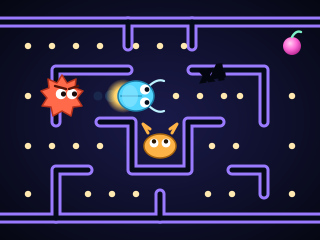
Maze Munch
A maze chase game that never repeats. Every maze is freshly generated, the walls shift, the pack gets smarter, and eating without stopping builds a chain worth up to eight times the points.
PLAY →
Tower of Hanoi
The classic disc puzzle by its real rules: move the whole tower to the last peg, one disc at a time, never a larger disc on a smaller one. 3 to 12 discs, a move counter against the fewest possible, four-peg, scrambled and adjacent modes, a Daily Tower and a watch-it-solved demo.
PLAY →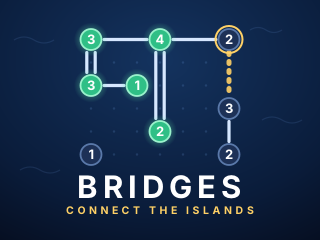
Rocket Bridges
The bridges logic puzzle: link numbered islands into one network. A daily puzzle and unlimited grids from 7×7 to 25×25, Easy to Expert, with explained hints.
PLAY →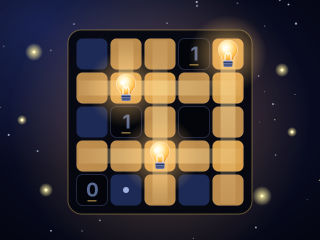
Akari
Akari, the Light Up logic puzzle: place bulbs so every cell glows, keep them out of each other's light and match every number. A Daily Akari, grids from 7×7 to 18×18, four levels and, on Easy, hints that explain each step.
PLAY →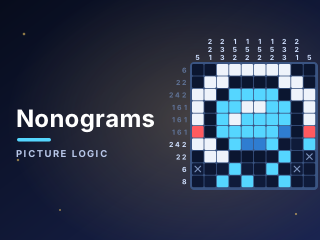
Nonograms
Fill the grid from the number clues to reveal a hidden pixel picture. A daily puzzle, unlimited puzzles from 5×5 to 25×25 and an album of hundreds of pictures.
PLAY →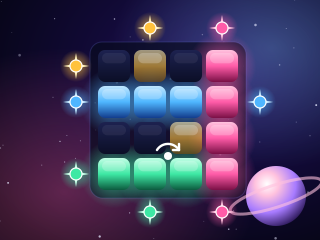
Orbitile
Bring colour to the cosmos: turn any square of four tiles to link each colour's stars and light up a dark, fractured sky. 300 levels across twelve star systems, a Daily Orbit, endless generated skies, Singularity Trials and a universe maker.
PLAY →