Orbitile: Rotate. Connect. Illuminate.
Bring colour to the cosmos: turn any square of four tiles to link each colour's stars and light up a dark, fractured sky. 300 levels across twelve star systems, a Daily Orbit, endless generated skies, Singularity Trials and a universe maker.
What is Orbitile?
Orbitile is a colour puzzle set in a dark, fractured galaxy, free in your browser on phone, tablet and computer. Every sky is a square board of glass tiles, some coloured and some dark, with glowing stars fixed around its edges. Link each colour's two stars with an unbroken line of its tiles and the line lights up, a clear bell rings, and once every colour is linked the whole board shines and a sleeping planet bursts into colour.
There is one move: tap where four tiles meet and those four turn a quarter turn clockwise. Nothing ever disappears and nothing random falls in, so every sky is pure logic. The catch is that a turn moves four tiles at once, so the turn that finishes one colour's line can break another's. The first skies take a single turn; the deepest ones hide a sequence you only see once you stop trying the obvious move.
How to play Orbitile
- The goal: link every colour's stars. A line of touching tiles of one colour, side by side or one above the other (never corner to corner), has to run from each of that colour's stars to the other.
- Tap or click where four tiles meet to turn those four tiles a quarter turn clockwise. Pressing anywhere on a tile picks the corner of it you are nearest to, and the square that will turn is highlighted before you let go.
- Tiles that touch a star of their own colour glow. When a colour's stars are linked, its line flows with light and plays that colour's note.
- A turn always moves four tiles, so it can help one colour and break another. Turning the same square three times turns it a quarter turn back the other way.
- Par is the fewest turns the solver found for the sky. Match it for three stars. Undo, Redo and Restart are free, and a hint shows the next turn of a shortest way from wherever you are.
- Every colour also carries its own symbol (a circle, triangle, square, diamond, hexagon, cross or crescent), so you never need to tell colours apart to play.
- With a keyboard, the arrow keys pick a square and Space turns it.
Orbitile tips and strategy
- Before you turn, look at what the turn will move away, not only what it brings in.
- Work on the colour with the least room first: the one whose stars are farthest apart, or whose tiles are fewest.
- A lit line isn't always finished business. Sometimes the only way forward is to break a line for a few turns and rebuild it.
- Tiles on the outer edge only travel one way around the rim, so a tile that has just passed the spot you need it can take a long way round.
- If you're stuck, undo back to the start and look for a turn that sets up the next one rather than one that lights something right away.
- Three turns of one square equal one turn the other way, so a mistake from long ago is never more than a few turns from undone.
Twelve star systems, 300 skies
The Galaxy Journey runs through twelve star systems, from the blue nebula of First Light to the black hole at Event Horizon, each with its own sky, sun and colours. The first twenty levels take a turn or three and feel effortless. The next hundred teach planning: more colours in each other's way, and fewer turns that do what they seem to. After that, every level is chosen for a sequence that isn't obvious. Each system's levels sit on its orbits, every restored sky wakes a planet, and finishing a system reveals its constellation in your collection.
Built by a puzzle factory, checked by a solver
Every sky starts as a finished picture: stars placed around the rim and a line of colour drawn between each pair. It is then scrambled with turns, so it can always be restored. A search then finds the fewest clockwise turns that solve it, exactly on smaller boards and by a wide beam search on the largest, and a grader throws out boards that are dull: ones a player who always takes the brightest-looking turn walks straight through, near copies, or boards that are mostly busywork. What's left is ordered from gentle to deep.
Daily Orbit, Infinite Cosmos, Trials and your own universes
A new Daily Orbit arrives every day, the same sky for everyone: Monday's is gentle and the week deepens to Sunday's. Restore it to grow your streak, play past days from the calendar and see who used the fewest turns. Infinite Cosmos makes endless new skies at seven depths, from tiny 3×3 Discovery boards to 8×8 Singularity skies, each checked by the solver. The Singularity Trials are the deepest boards the factory has made. In Create a Universe you paint a finished sky, scramble it, and share a link; the solver works out its par before your friends see it.
Orbitile FAQ
Is Orbitile free?
Yes. It's free to play in your browser with no download and no account. Make a free account if you want your stars and daily solves on the leaderboards on every device.
How do I turn tiles?
Tap or click the point where four tiles meet. Those four tiles turn a quarter turn clockwise. The square under your finger is highlighted before you let go, so you can slide to a different one first.
Can I turn a square the other way?
Every turn is clockwise. Three turns of the same square equal one turn anticlockwise, and Undo takes back your last turn at no cost.
What does par mean?
Par is the fewest turns the solver found for the sky. On most skies, including every small one, a complete search proves it is the true fewest; on some of the largest it is the best a very wide search found. Match it for three stars. If you ever beat it, you've found a shorter way than the solver did.
Do I have to solve every level to move on?
No. A level opens when either of the two levels before it is solved, so you can always skip one sky ahead. Infinite Cosmos and the Singularity Trials are open from the start at every depth.
Is it playable if I'm colourblind?
Yes. Every colour has its own symbol on its tiles and stars, so the puzzle never depends on colour alone. You can also turn on calm motion to stop the drifting sky, twinkles and bursts, and the board works fully with a keyboard and a screen reader.
How do hints work?
A hint looks at the board as it is right now and highlights the square to turn next on a shortest way from here. A sky solved with a hint earns up to two stars, and a Daily Orbit solved with a hint doesn't rank on the day's board.
Can I make my own puzzles?
Yes. In Create a Universe, paint a finished sky, place each colour's stars, then scramble it gently, trickily or fiendishly. The solver finds its par, and you get a link to share. Anyone who opens the link plays your sky.
Is my progress saved?
Yes. Your stars, best turns, daily streak, constellations, universes and any unfinished sky are saved in your browser. Leaving the page and coming back picks up where you were.
More games
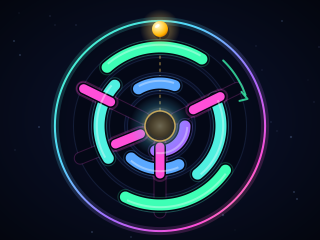
Ringlock
A circular sliding puzzle: turn the curved pieces around their rings, swing the wide ones around two rings at once and slide the straight ones along their spokes until the golden marble can fall into the centre. 500 levels from Beginner to Insane, and a daily board.
PLAY →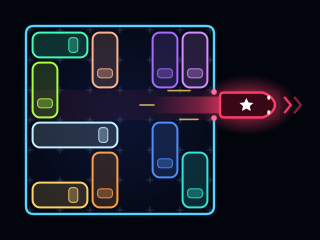
Neon Gridlock
The sliding-car parking lot puzzle: clear a jammed 6×6 lot and drive the red car out the exit. Endless puzzles at four levels, a daily lot, and solver hints.
PLAY →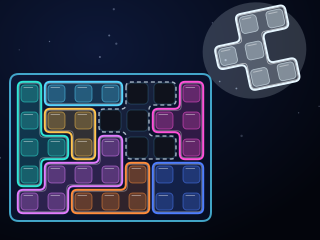
Inlay
A neon block packing puzzle: turn, flip and fit the glowing pieces until every cell of the board is filled. Endless puzzles at four levels, each with exactly one answer, and a daily board.
PLAY →