Akari: The Light Up Logic Puzzle
Akari, the Light Up logic puzzle: place bulbs so every cell glows, keep them out of each other's light and match every number. A Daily Akari, grids from 7×7 to 18×18, four levels and hints that explain each step.
What is Akari?
Akari is the Light Up logic puzzle, free in your browser on phone, tablet and computer. The board is a grid of white cells and black walls. Place light bulbs in the white cells until every one of them is lit: a bulb shines along its row and its column until a wall stops it.
Two rules keep it honest. No bulb may sit in another bulb's light, and a wall with a number needs exactly that many bulbs in the four cells beside it. Every puzzle here has exactly one solution that you can reach by logic alone, so you never need to guess.
Play the Daily Akari, the same puzzle for everyone each day, gentle on Monday and tough by Sunday. Or pick from five sizes and four levels, each puzzle graded by the reasoning it needs. Warm beams of light fill the board as you work, and a hint never just fills in a cell: it shows you the step and tells you why.
How to play Akari
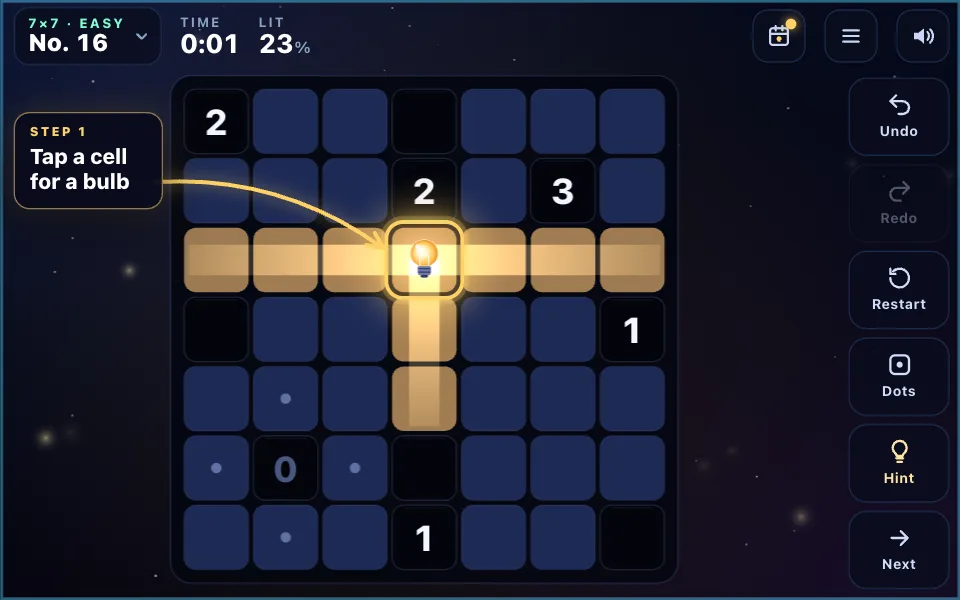
Place a bulb
Tap or click a white cell to place a bulb. Its light runs along the whole row and column until a wall or the edge of the board stops it.
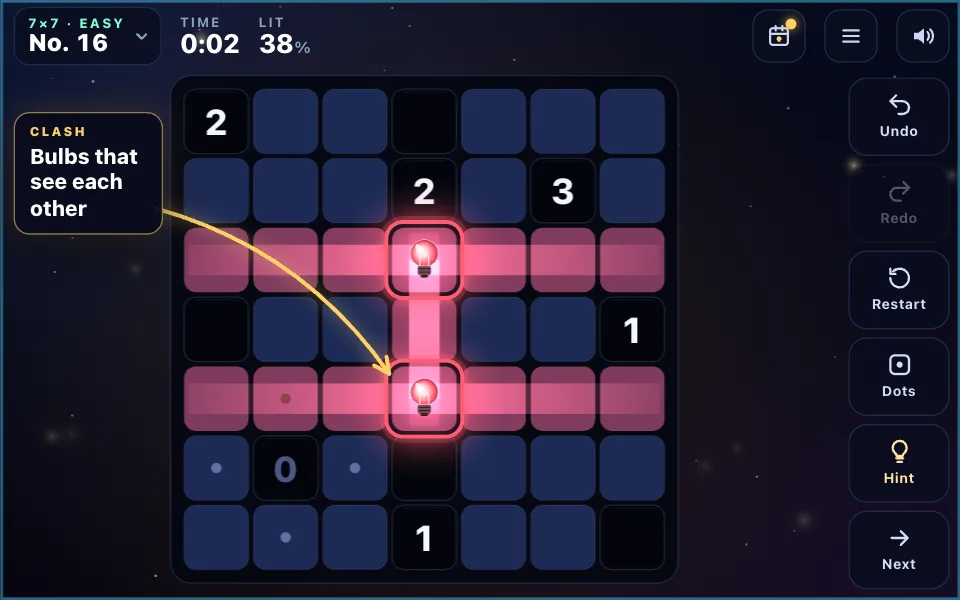
Keep the bulbs apart
Two bulbs may never shine on each other. If they share a row or a column with no wall between them, both glow red until you move one.
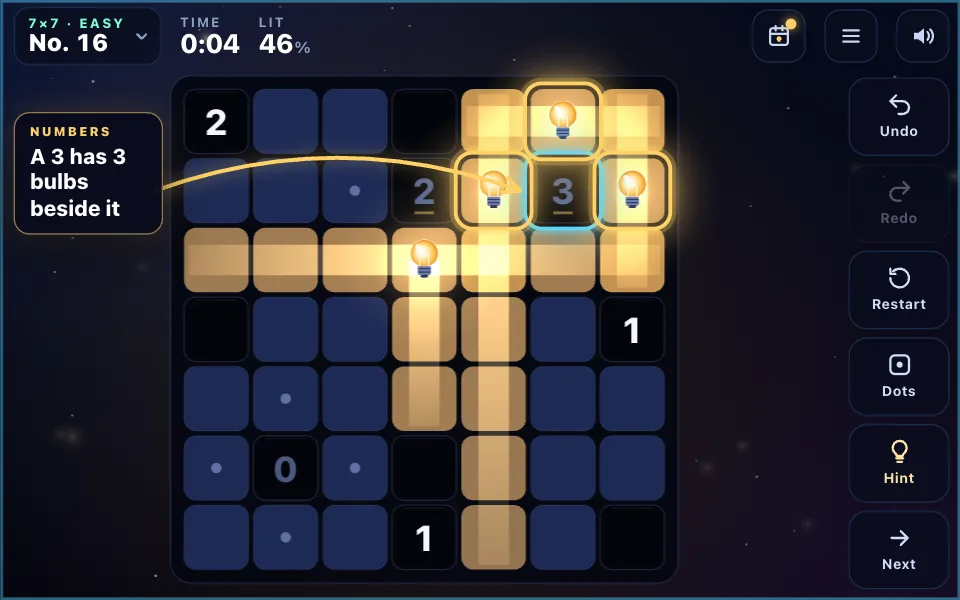
Count around the numbers
A numbered wall needs exactly that many bulbs in the four cells beside it, and diagonals don't count. Once it has them, the number dims.
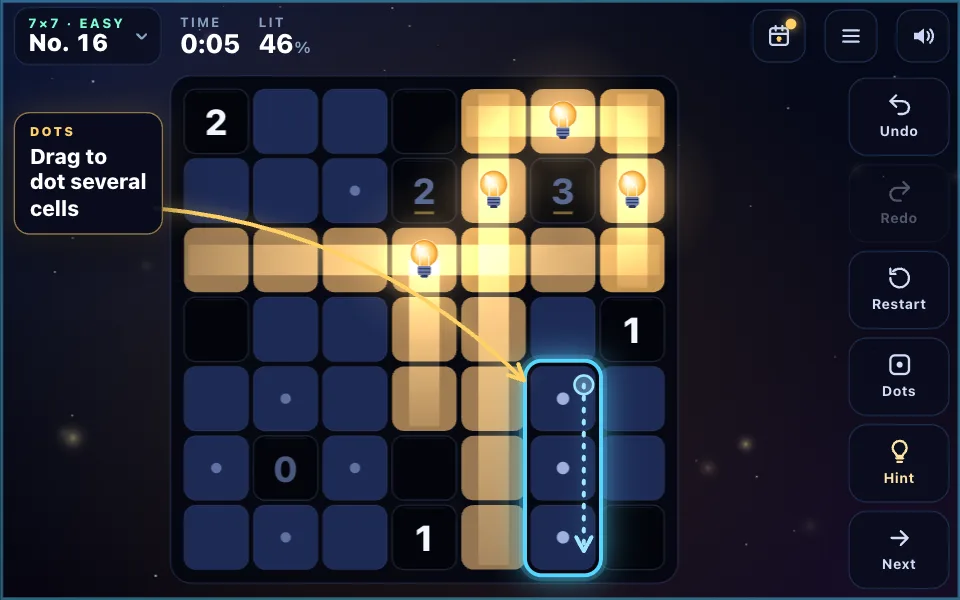
Dot the cells that stay dark
Mark cells that can't hold a bulb with a dot: tap a bulb again, hold a cell, or drag across several. Every dot makes the next step easier to see.
Ask for a hint
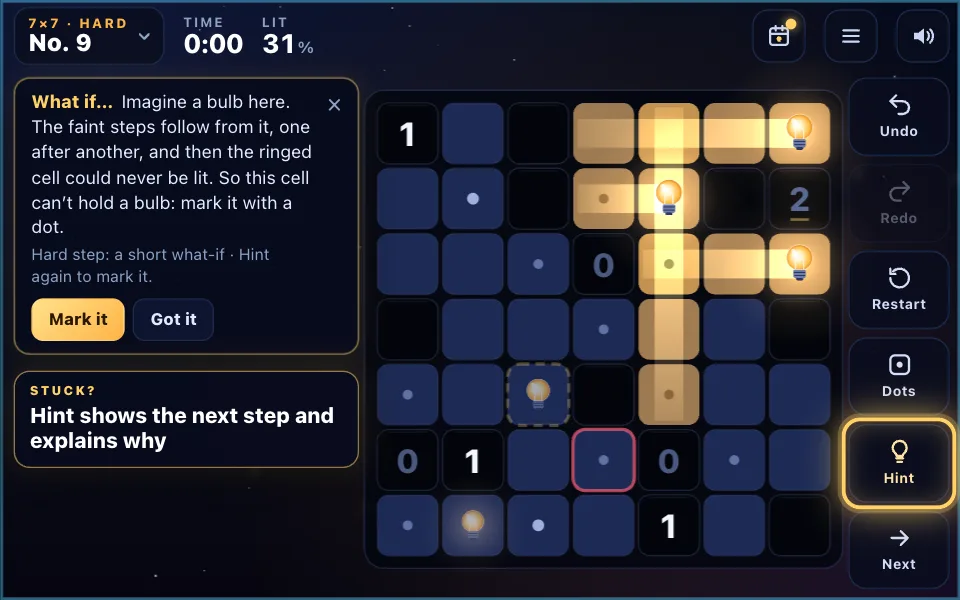
Hint shows the next logical step and explains why, even what-if chains drawn as faint ghost bulbs. Press Hint again and it makes the move.
Light every cell
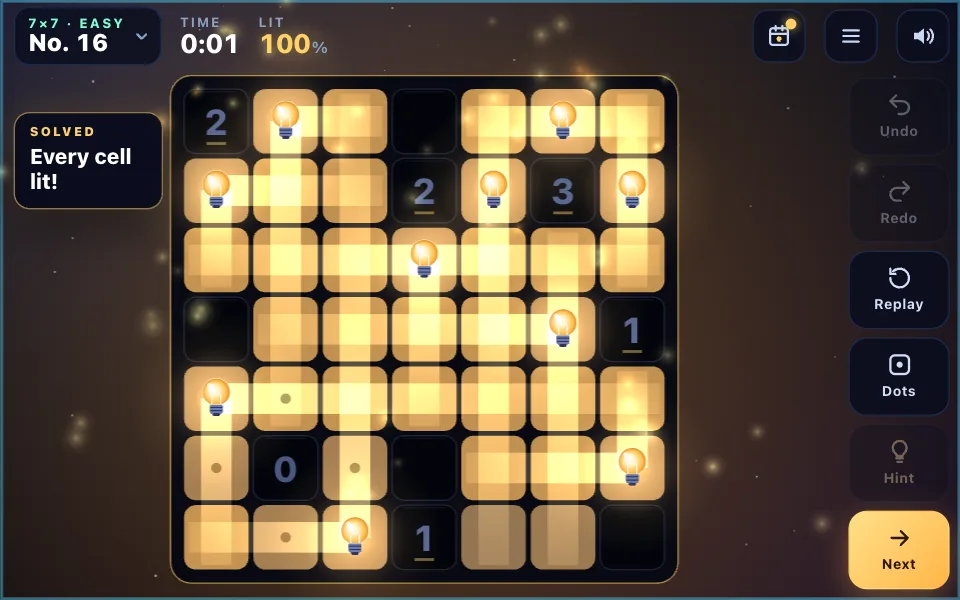
When every white cell is lit, no bulb sees another and every number has its count, the whole board glows and the puzzle is solved.
The rules in full
- The goal: light every white cell. A bulb lights its own cell and every cell in its row and column, until a black wall or the edge of the board stops the light.
- Tap or click a white cell to place a bulb. Its beams spread out along the row and the column, and every cell they reach glows warm.
- Bulbs may never shine on each other. If two bulbs share a row or a column with no wall between them, both turn red until you move one.
- A number on a wall says exactly how many bulbs touch it, counting only the four cells directly above, below, left and right. Diagonal cells don't count.
- Mark cells that can't hold a bulb with a dot: tap a bulb again, hold a cell, right-click, or drag across several cells. Tap a number that has all its bulbs to dot the free cells around it.
- A number dims once it has all its bulbs and turns red if it has too many. The Lit counter at the top shows how much of the board is lit so far.
- The puzzle is solved when every white cell is lit, no bulb shines on another and every number has exactly its count.
- Stuck? Hint highlights the next logical step and explains it, from simple counting to what-if reasoning. Press Hint again and it makes the move for you.
- With a keyboard, the arrow keys move around the board, Space places or removes a bulb, X marks a dot, U undoes and H gives a hint.
Akari tips and strategy
- Start with the numbers. A 4 always has bulbs on all four sides and a 0 never has any, so those cells can be settled at once.
- Look for numbers with exactly enough room: a 3 against the edge of the board, or a 2 tucked into a corner, has no spare cells, so every free cell beside it takes a bulb.
- Dot freely. Every dot shrinks the places a bulb could go, and a dark cell that only one place can still light needs a bulb in that place.
- Check the diagonals around a 3 or a 1. A bulb on a cell that sees two of a number's free cells at once can leave that number short of room.
- A white cell walled in on every side can only be lit by a bulb of its own.
- When you need a what-if, test a cell beside a number or where two long runs of white cells cross. A bulb there changes the most, so any trouble shows up quickly.
- Long open rooms are where the hard puzzles hide. Work from the edges of the room, where walls and numbers give you something to count.
- Undo is free and unlimited, so a dot placed by mistake is as easy to take back as a bulb.
What is Akari? The story of the Light Up puzzle
Akari is a pencil puzzle from Japan, where a puzzle magazine first printed it under the name Bijutsukan, meaning art gallery. The picture behind it is a guarded gallery: post watchmen so that every corner of every room is in view, never let two of them stare straight at each other, and follow the counts written on the walls.
In English it is usually called Light Up, and Akari simply means light. It belongs to the same family as Sudoku and Nonograms: a small set of rules, a grid, and a single solution you reach by reasoning rather than guessing.
The simple rules hide real depth. In 2005 it was proved that solving Light Up puzzles in general is NP-complete, one of the classic hard problems of computer science. That is why a good puzzle has to be built and checked with care, so that it feels like switching on lamps in a dark house, one room at a time.
How this Akari game works: five sizes, four levels
Choose a 7×7 grid for a quick puzzle over coffee, 10×10 or 12×12 for a steady session, 14×14 for a proper challenge, or 18×18 when you want to settle in for a while. Each size comes in Easy, Medium, Hard and Expert, and each puzzle is numbered, so No. 12 of 10×10 Hard is the same board for everyone.
Every puzzle is built by our own generator, and a step-by-step logic solver has to finish it the way a person would, by deduction alone. That proves it has exactly one solution, and the hardest step the solver needs sets the level, so an Expert puzzle really does need deeper reasoning, not just a bigger board.
The first 24 puzzles of every size and level are ready to play straight away, gentlest first. Past those, new puzzles are made on your device in a moment, from the same recipe, so the numbering carries on without end.
Akari strategy: from counting to what-ifs
Easy puzzles fall to counting. A number with exactly as many free cells as it needs bulbs gets a bulb in every one, a number that already has its bulbs gets dots around it, and a dark cell that only one place can light gets a bulb there.
Medium puzzles ask you to look one move ahead. Before you settle a cell, ask what a bulb there would switch on: if its light would cover every cell a nearby number still needs, or every cell that could still light some dark corner, that cell gets a dot.
Hard and Expert puzzles need what-ifs. Suppose a cell holds a bulb, follow the easy steps it forces, and see whether the board falls apart. In Hard puzzles the trouble shows up after one round of steps; in Expert puzzles the chain runs longer. The hint button shows these chains as faint ghost bulbs, so you can follow the reasoning yourself.
The Daily Akari: a new light up puzzle every day
Each day brings one Daily Akari, the same for every player and changing at your local midnight. The week has a shape: Monday is a gentle 10×10 Easy, the middle of the week climbs through Medium and Hard, and Sunday is a 14×14 Expert.
Solve it on the day to grow your streak. The calendar shows every day you have lit, and you can go back and play any past day you missed, at your own pace.
Playing Akari on a phone or tablet
Akari is made for touch. Tap for a bulb, tap again for a dot, hold a cell for a dot straight away, and slide your finger to dot a whole row of cells in one stroke. If you prefer, the Dots button makes every tap place a dot, and Settings can change the order a tap cycles through.
On the bigger boards, pinch to zoom in and use two fingers to move around; a button brings the whole board back. Turn your phone sideways and the tools move to the edge, with hints beside the board rather than above it.
Full screen gives the board every pixel. Your puzzle is saved as you go, so you can put your phone away mid-puzzle and carry on later, right where you stopped.
Akari FAQ
Is Akari free to play?
Yes. Akari is free in your browser with no download and no account needed. There are no ads in the game and no timers forcing you along.
What are the rules of Akari?
Place light bulbs in white cells so that every white cell is lit. A bulb lights its row and column until a wall. No bulb may be lit by another bulb, and a numbered wall must have exactly that many bulbs in the four cells next to it.
Is Akari the same as Light Up?
Yes. Light Up is the usual English name for the puzzle, and Akari is the Japanese word for light. It has also been called Bijutsukan, meaning art gallery.
Does every Akari puzzle have only one solution?
Yes. Every puzzle has to be finished by our logic solver using deduction alone, which proves it has exactly one solution and never needs a guess. The ready-made puzzles are double-checked by a separate exact solver too.
Do diagonal cells count for the numbers?
No. A number only counts bulbs in the four cells directly above, below, left and right of it. Diagonal neighbours never count, although they often matter for working out where the bulbs can go.
Can light pass through a wall?
No. Light stops at the first wall in each direction, numbered or not, and at the edge of the board. That is why two bulbs in the same row are fine as long as a wall stands between them.
What are the dots for?
A dot marks a cell you have worked out cannot hold a bulb. Dots don't affect the solution, but they make the next deductions much easier to see. With Auto-dots on, the game dots the free cells around a number as soon as it has all its bulbs.
How do the hints work?
A hint looks at your board and shows the easiest next step, with a short explanation: a number with exactly enough room, a cell that only one place can light, or a what-if that runs into trouble. If a bulb or a dot is wrong, the hint points that out first. Press Hint again to make the move.
How are the difficulty levels decided?
By the reasoning a puzzle needs, not just its size. Easy puzzles need only counting, Medium ones need a look one move ahead, Hard ones need a short what-if, and Expert ones need longer what-if chains.
When does the Daily Akari change?
At midnight on your own device's clock. Everyone gets the same puzzle for the same date, Monday's is gentle and Sunday's is the toughest, and you can play any past day from the calendar.
Can I play Akari on my phone?
Yes. The game works on phones and tablets as well as computers. Tap for bulbs, hold or drag for dots, and pinch to zoom in on the bigger boards. The Full screen button gives the board even more room.
Is my progress saved?
Yes. Your solved puzzles, best times, daily streak and any puzzle you have started are saved in your browser, so you can leave and pick up where you were.
More games
Rocket Bridges
The bridges logic puzzle: link numbered islands into one network. A daily puzzle and unlimited grids from 7×7 to 25×25, Easy to Expert, with explained hints.
PLAY →
Rocket Kakuro
Kakuro cross sums: a daily puzzle and unlimited grids from 6×6 to 14×14, Easy to Expert. A combination helper, notes, explained hints and undo.
PLAY →
Nonograms
Fill the grid from the number clues to reveal a hidden pixel picture. A daily puzzle, unlimited puzzles from 5×5 to 25×25 and an album of hundreds of pictures.
PLAY →