Match 3: Jewel Matching Puzzle Game
Swap two jewels, line up three and watch the board cascade: 160 levels, a Daily Puzzle, Blitz and Zen, with no lives and no waiting.
What is Match 3?
Match 3 is the jewel-swapping puzzle at its purest. Slide a jewel into the square next door to line up three or more of a kind. They pop, everything above drops, new jewels pour in from the top, and with a little luck the falling pieces match again by themselves, ringing their way up the scale as they go.
This version is built around a 160-level journey through eight chapters, with glass tiles, crates, golden relics, ice, chains and creeping vines along the way. You forge three special jewels, the Beam, the Nova and the Prism, and swap them into each other for the biggest blasts in the game.
There are no lives, no energy bar and nothing to buy. Lose a level and you retry it at once. Every level was played hundreds of times by a test bot before it went in, so none of them needs a booster or a miracle.
For a change of pace, the Daily Puzzle gives everyone the same board and 25 moves, Blitz is two frantic minutes against the clock, and Zen never ends and never hurries you. It all works on a phone or a desktop.
How to play Match 3
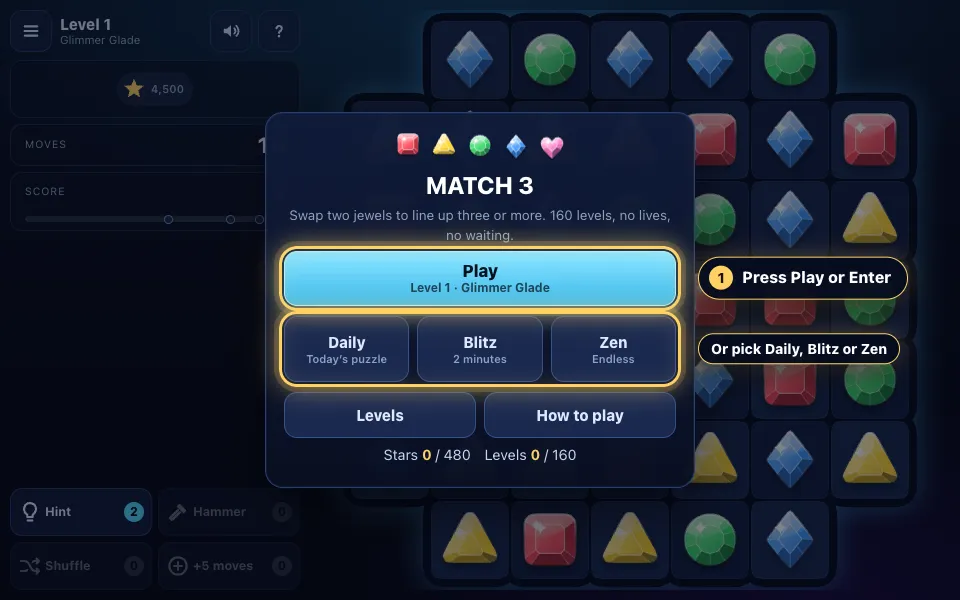
Press Play
The home panel opens over a live board. Press Play, or hit Enter, to start the journey at level 1. Daily, Blitz and Zen sit on the same panel.
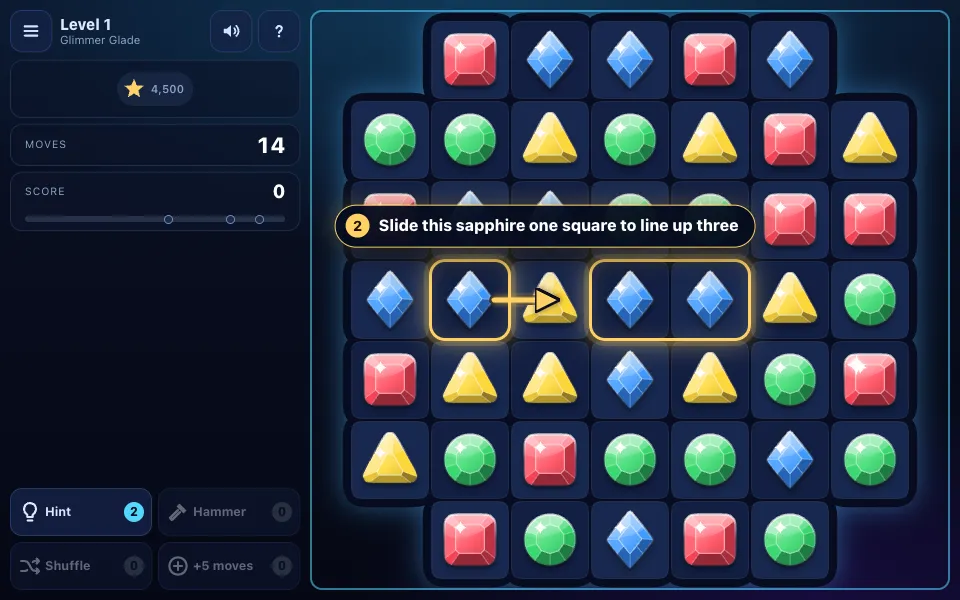
Slide a jewel to line up three
Swipe or drag a jewel one square, or tap it and then its neighbour. Here the ringed sapphire slides right to join the two waiting past the gap. A swap that matches nothing slides back for free.
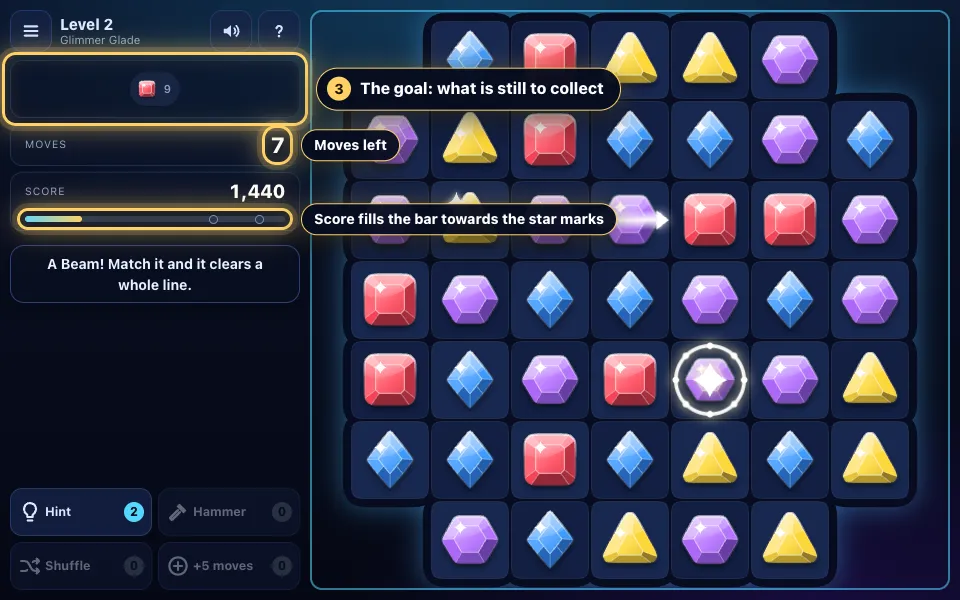
Read the goal, the moves and the stars
The goal sits at the top of the side panel: here, nine rubies still to collect. Under it are the moves you have left and the score bar with its star marks.
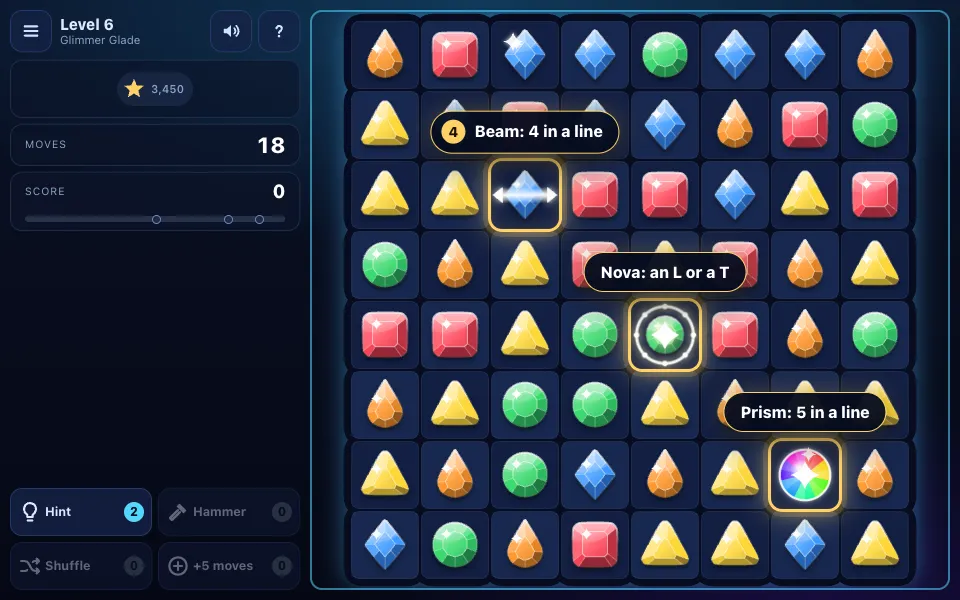
Forge the three special jewels
Four in a line makes a Beam, an L or a T makes a Nova, and five in a line makes a Prism. A Beam clears a line, a Nova bursts the squares around it and a Prism clears a colour.
Swap two specials together
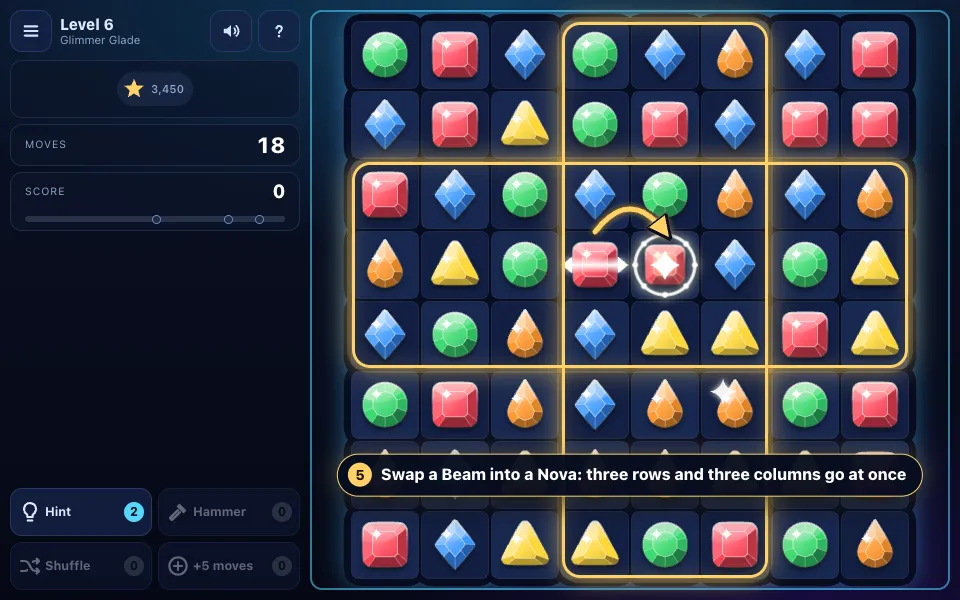
Slide one special straight into another for a combination. A Beam swapped into a Nova clears three rows and three columns in one go, the area marked by the rings.
Learn what stands in your way
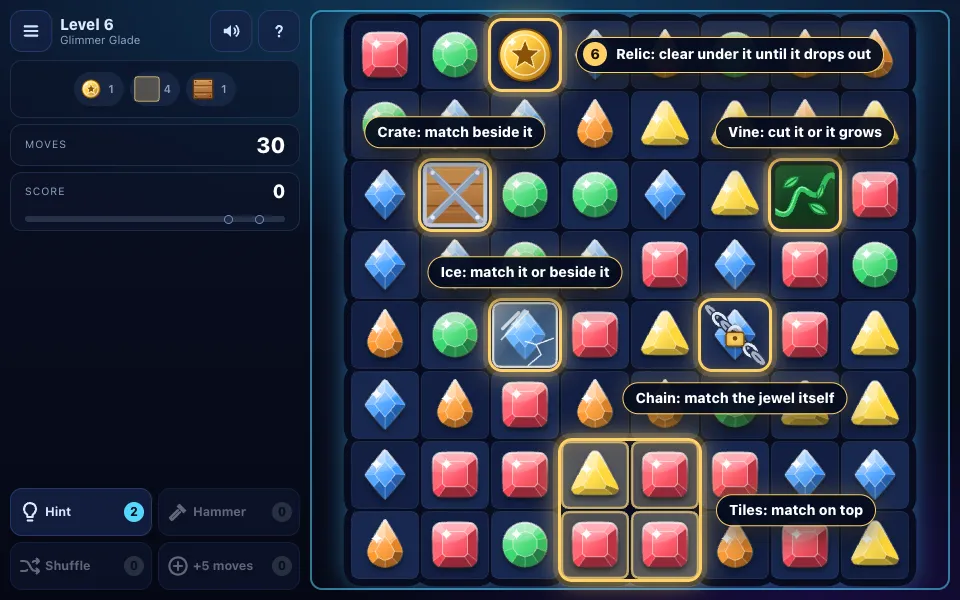
Crates crack and ice thaws when you match beside them. A chain only snaps when its own jewel is matched. Vines must be cut back, tiles break under a match, and a relic has to sink off the bottom.
Finish for stars, then go again
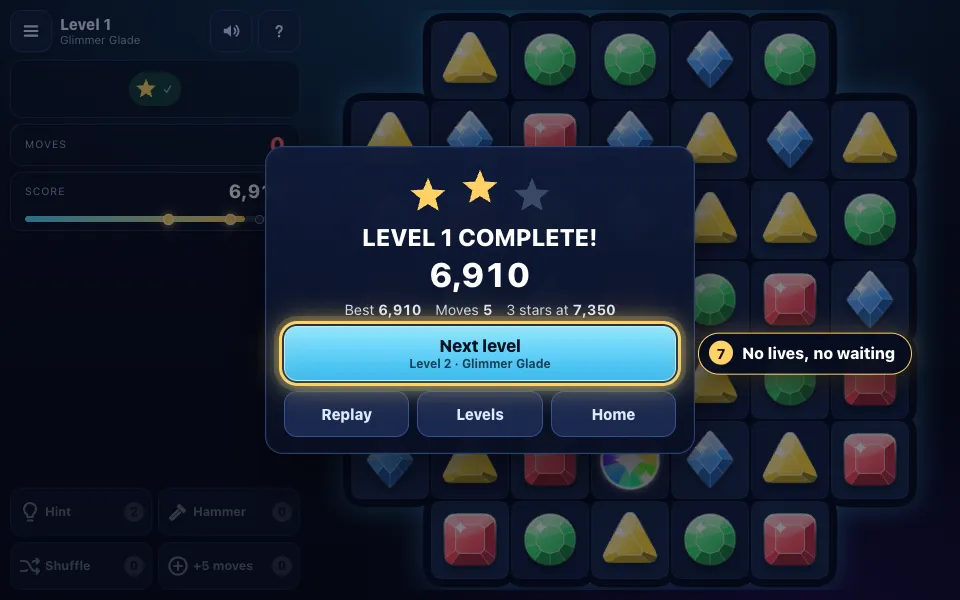
Meet the goal before the moves run out and the spare moves burst into a finale. Then press Next level: there are no lives to lose and nothing to wait for.
The rules in full
- Swap two jewels that sit side by side or one above the other: swipe or drag a jewel towards its neighbour, or tap one and then the other. The swap only stands if it lines up three or more of the same jewel in a row or column. Otherwise the two slide back and no move is spent.
- Matched jewels vanish, the ones above fall into the gaps and new ones drop in from the top. If the fall lines up another match, that clears too, and each step of the cascade is worth more than the last.
- Every level shows its goal beside the board: reach a score, collect certain jewels, break every tile, smash every crate, sink the relics, thaw the ice, snap the chains or clear the vines. Some levels ask for two or three at once.
- Most levels give you a fixed number of moves. Meet the goal before they run out and you win. Four levels in the journey use a clock instead, which only starts when you make your first move.
- Line up four jewels to forge a Beam. Match it later and it clears a whole row or column, along the line that made it.
- Match five or more jewels in an L, a T or a plus shape to forge a Nova, which bursts the squares around it. Line up five in one straight line to forge a Prism: swap it with any jewel to clear that whole colour.
- Swap two specials straight into each other for a combination. Two Beams fire a cross, a Beam and a Nova clear three rows and three columns, two Novas burst a five-by-five block, a Prism copies a Beam or Nova onto every jewel of that colour, and two Prisms clear the board.
- Finishing the goal earns one star, and spare moves burst into a finale for extra points. Pass the two marks on the score bar for the second and third star.
- If the board ever has no move left it reshuffles itself and charges you nothing, so you cannot get stuck.
- On a keyboard, the arrow keys move a cursor, Space or Enter picks a jewel up and an arrow then swaps it. H asks for a hint where hints are allowed, P pauses and M mutes.
Match 3 tips and strategy
- Work low when you can. A match near the bottom shifts more of the board, so it is more likely to start a cascade than one in the top row.
- Look for four before you take three. On tile and crate levels one Beam does the work of several ordinary matches, and it fires along the line that made it, so build it facing what you need to hit.
- Save specials for each other. A Beam swapped into a Nova clears three rows and three columns, more than half of an eight-by-eight board.
- Spend a Prism on the colour you need. On a collecting level, swap it with the jewel you are collecting; elsewhere, swap it with a Beam or a Nova to copy that special all over the board.
- Cut a vine every move. Vines only grow after a move that cuts none, so one match beside any vine holds the whole lot back.
- Chains need the jewel itself. Ice thaws when you match beside it, but a chained jewel only comes free as part of a match or in a blast.
- Finish early for stars. Each spare move turns a jewel into a special in the finale and adds 100 points before it even goes off.
- In Blitz, speed beats size. The heat bar fills with every move and drains while you think, so keep making quick, simple matches and let the cascades build the big shapes.
What is a match 3 game?
A match 3 game is a puzzle played on a grid of coloured pieces. You swap two neighbours to make a line of three or more of the same kind, the line clears, the pieces above fall and new ones arrive. You can learn it in a single move.
The depth comes from what a move does next. Falling pieces match by themselves, bigger shapes leave special pieces behind, and a goal turns a pleasant shuffle into a small plan: which colour, which corner, which special first.
Seven jewels you can tell apart by shape
Every jewel has its own outline as well as its own colour: a square-cut red ruby, an orange amber teardrop, a yellow topaz triangle, a round green emerald, a blue diamond-shaped sapphire, a purple amethyst hexagon and a pink rose heart. If blue and purple, or red and green, are hard for you to separate, play by shape alone.
The journey opens with four kinds of jewel, which makes matches easy to spot. Most levels use five, the harder ones six, and a few boards in the last chapter use all seven. Fewer kinds means more lucky cascades, so the game gets harder without changing a rule.
Special jewels and combinations: Beam, Nova and Prism
A Beam comes from four in a line and clears a full row or column. A Nova comes from an L, a T or a plus shape and bursts the eight squares around it. A Prism comes from five in a straight line and clears a whole colour. A special caught in another blast goes off as well, so one move can travel a long way.
The real power is in swapping two specials into each other. Two Beams fire a row and a column together. Beam with Nova clears three rows and three columns. Two Novas burst a five-by-five block. A Prism turns every jewel of one colour into the Beam or Nova it was swapped with, and two Prisms clear the board.
The 160-level journey: tiles, crates, relics, ice, chains and vines
The journey has eight chapters of twenty levels: Glimmer Glade, Tile Terrace, Crate Canyon, Relic Rapids, Frost Hollow, Chain Citadel, Vine Vault and Crown Peak. Boards run from seven-by-seven up to nine-by-nine, with notches, rings, cut corners and gaps that the jewels fall through.
New pieces arrive one at a time. Glass tiles appear at level 5 and break when you match on top of them. Crates arrive at level 26 and crack when you match beside them. Golden relics, from level 46, have to sink to the bottom. Ice, from level 66, freezes a jewel until you match it or match next to it.
Chains, from level 86, lock a jewel until it is matched itself. Vines, from level 106, fight back: after any move that cuts none, they grow by a square. Each level keeps your best score and up to three stars, 480 in all.
Match 3 with no lives, no waiting and levels proven winnable
Many jewel games ration how much you can play and then sell the time back. This one does not. There are no lives, no timers between attempts and no shop. Lose a level three times and it quietly adds three moves and offers to let you skip ahead.
Every level was tuned with a test bot that plays 300 fresh boards and makes the occasional careless move, much as a person does. It wins about 97 boards in 100 in the first chapter and about 59 in the last, and no level falls below 45. None of those wins used a booster.
Boosters exist, but you win them by playing: a Hammer that smashes one square, a Shuffle, and five extra moves for a level that ends just short.
Daily Puzzle, two-minute Blitz and endless Zen
The Daily Puzzle is one board a day, built from the date so that every player gets the same layout and the same jewels. You have 25 moves, no boosters, and one aim: the highest score. Your first finish of the day counts; after that the board is there for practice.
Blitz is two minutes on an open eight-by-eight board, and the clock starts on your first move. Every move heats the multiplier, up to five times the points, and it cools whenever you stop to think. When time runs out, a last volley of specials goes off.
Zen is the opposite: no moves to count, no clock and no way to lose. The score climbs through stages, the backdrop changes colour as you go, and the run is saved so you can come back to the same board.
Hints, scoring and how the three stars work
Hints are for learning. In the first chapter you get two per level, and in Zen two per stage. A hint makes one available swap shimmer, and one is only ever spent when you press the Hint button. Everywhere else there are none.
A matched jewel is worth 10 points on the first step of a cascade, 20 on the second and so on up to 80. Forging a Beam adds 40, a Nova 60 and a Prism 100. A tile layer scores 30 and a relic brought home 300.
One star is for finishing the goal. The second and third are score marks set from the test bot's winning runs: the third sits where only its best quarter of wins reached, so three stars takes a properly good game.
Play Match 3 on a phone, a tablet or a desktop
The board is drawn to fit your screen. On a phone held upright it fills the width with the goal above it; on a wide screen the goal, score and boosters sit beside the board.
You never have to wait for the board. Swipe while jewels are still falling and the move is queued: the animation hurries up and your swap happens as soon as the board settles. Progress is saved in your browser after every move, including a level left half way.
Match 3 FAQ
Is this Match 3 game free?
Yes. It is free to play in your browser with no download, and there is nothing to buy inside the game: lives, moves and boosters are never sold.
How many levels does Match 3 have?
The journey has 160 levels in eight chapters of twenty. There is also a new Daily Puzzle every day, a two-minute Blitz mode and an endless Zen mode.
Do I lose lives when I fail a level?
No. There are no lives or energy at all. Retry a level as often as you like; after three losses it gives you three extra moves and the option to skip it for now.
How do I make a Beam, a Nova and a Prism?
Line up four jewels for a Beam, match five or more in an L, a T or a plus shape for a Nova, and line up five in one straight line for a Prism.
What happens when I swap two special jewels?
They combine into a bigger blast. A Beam and a Nova clear three rows and three columns, two Novas burst a five-by-five block, and two Prisms clear the whole board.
What if there are no moves left on the board?
The board reshuffles itself straight away and it does not cost you a move. A level is only lost by running out of moves or time, never by a dead board.
How does the Daily Puzzle work?
Everyone gets the same board each day and 25 moves to score as many points as possible. Your first finished attempt is your score for the day; later attempts are practice.
Can I play Match 3 on my phone?
Yes. It runs in a modern mobile browser and suits one-thumb play: swipe a jewel towards its neighbour, or tap two jewels in turn. Progress is saved on the device.
Can colour-blind players tell the jewels apart?
Each of the seven jewels has a different shape as well as a different colour: square, teardrop, triangle, round, diamond, hexagon and heart. The game can be played by shape alone.
How do I get three stars on a level?
Finish the goal for one star, then pass the two score marks on the bar. Finishing with moves in hand helps most: every spare move becomes a special jewel and 100 bonus points.
More games
Prism Pop
A glowing bubble shooter: aim, bank off the walls, match three to pop and drop whole clusters. 60 levels with stars, Endless, a daily puzzle and versus against the computer, a friend or a player online.
PLAY →
Mahjong Solitaire
Match free tiles to clear all 144 from six classic layouts. Every deal can be won, with hints, undo, solvable shuffles and a saved game.
PLAY →
2048
The original open-source 2048, hosted here with no ads. Slide tiles, merge pairs, reach 2048 and keep going.
PLAY →
Orbitile
Bring colour to the cosmos: turn any square of four tiles to link each colour's stars and light up a dark, fractured sky. 300 levels across twelve star systems, a Daily Orbit, endless generated skies, Singularity Trials and a universe maker.
PLAY →
Jigsaw Puzzles
Real-feeling jigsaw puzzles in your browser: classic tab-and-blank pieces that click together, a 276-level Journey through 92 original pictures, any picture at 12 to 500 pieces, a Daily Jigsaw, a sorting tray, your own photos and every puzzle saved as you go.
PLAY →