Texas Hold'em: make the best five-card hand from your two cards and the five on the table. Use the Fold, Check, Call and Bet buttons when it is your turn.
Texas Hold'em Poker Online: Free Tournaments
No-limit Texas Hold'em tournaments at a six-seat table. Practise against computer players with play chips, or sign in and enter coin tournaments.
What is Texas Hold'em?
Texas Hold'em is the game most people mean when they say poker. You get two cards of your own, five more are turned face up for everyone, and the best five-card hand takes the pot, unless a well-timed bet makes everybody else fold first.
This version is a no-limit tournament table. Everyone starts with 1,500 chips, the blinds keep rising, and play goes on until one player holds every chip. Take on computer players at a six-seat Sit & Go or in a heads-up duel, right in your browser, with no download and no account.
For something riding on it, sign in and enter a coin tournament: six seats, a buy-in of 5, 10 or 25 coins, and the top three share the pool. Coins are free. You earn them by playing games on this site, they cannot be bought, and there is no real-money play here.
The table reads at a glance on an upright phone or a wide monitor, and a label names the hand you hold, so you learn the rankings as you play.
How to play Texas Hold'em
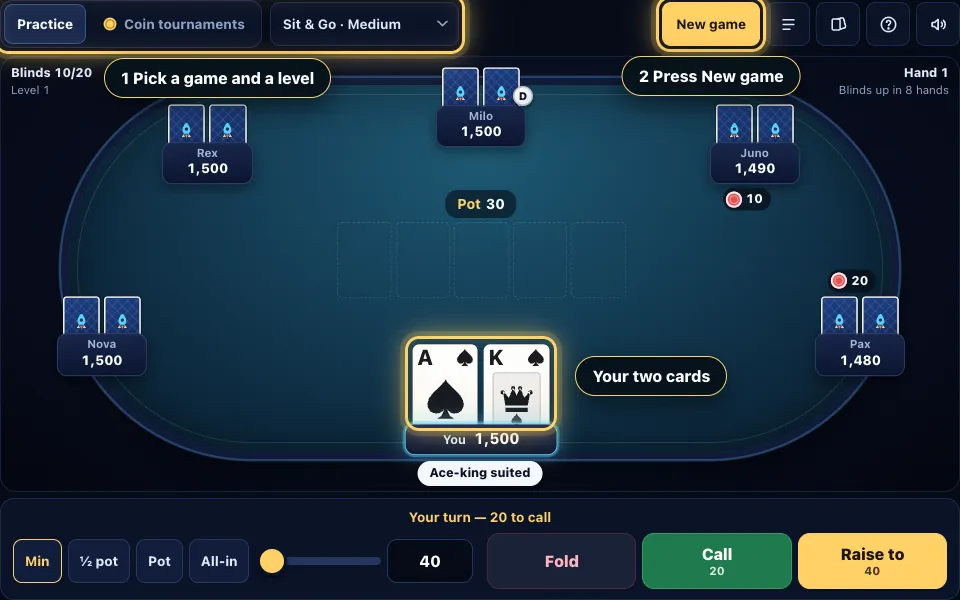
Pick a table and start
Stay on Practice and choose a game and a level from the list: Sit & Go seats six, Heads-up seats two. Press New game. Your two cards are dealt face up, and everyone else's stay hidden.
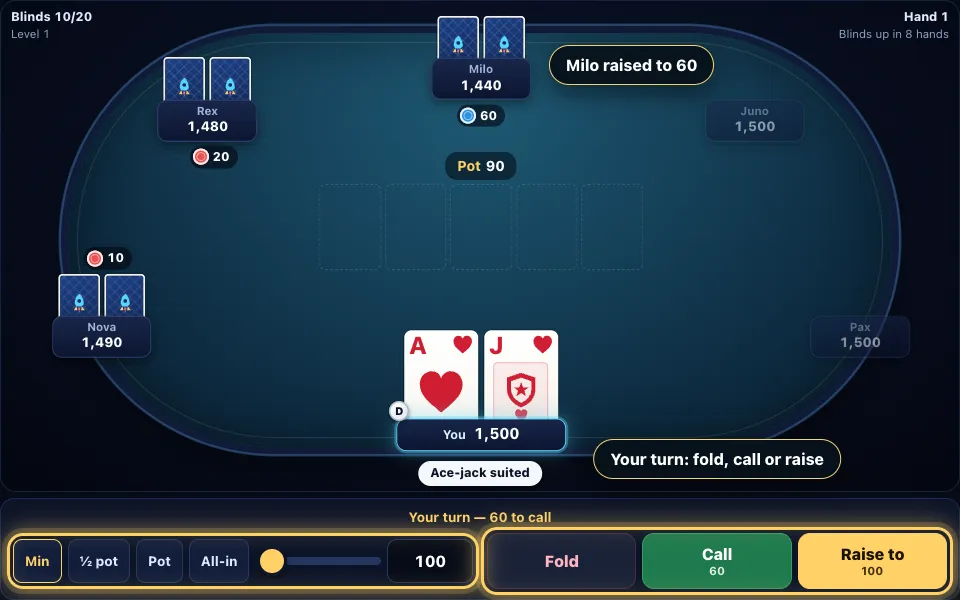
Your turn: fold, call or raise
When the buttons light up, it is your turn. Here Milo has raised to 60. Fold, call 60 to see the flop, or raise: the slider and the box beside it set the size.
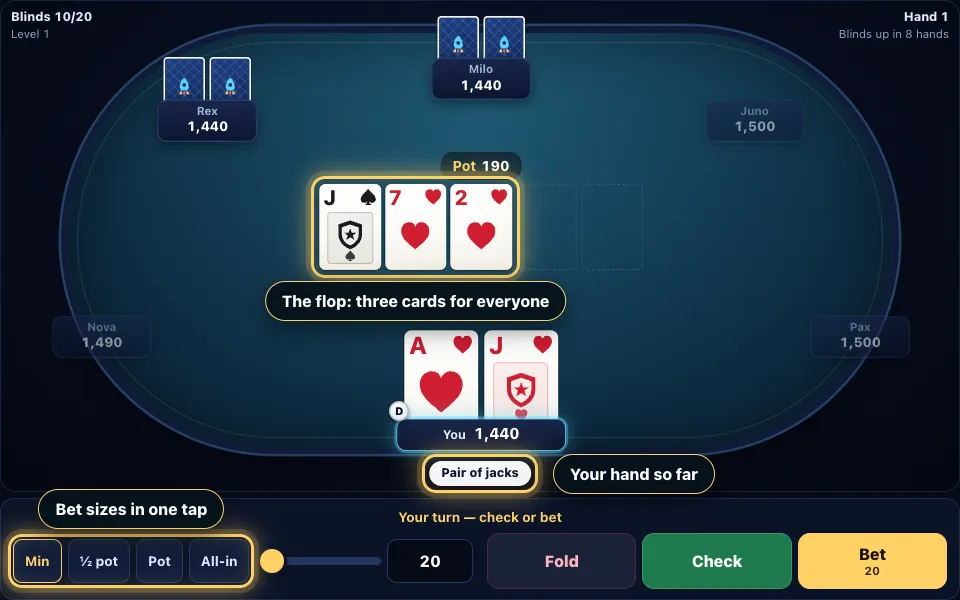
The flop: read your hand
Three community cards land in the middle for everyone. The label under your cards names your best hand so far, here a pair of jacks. Nobody has bet, so check or bet; Min, ½ pot, Pot and All-in set a size in one tap.
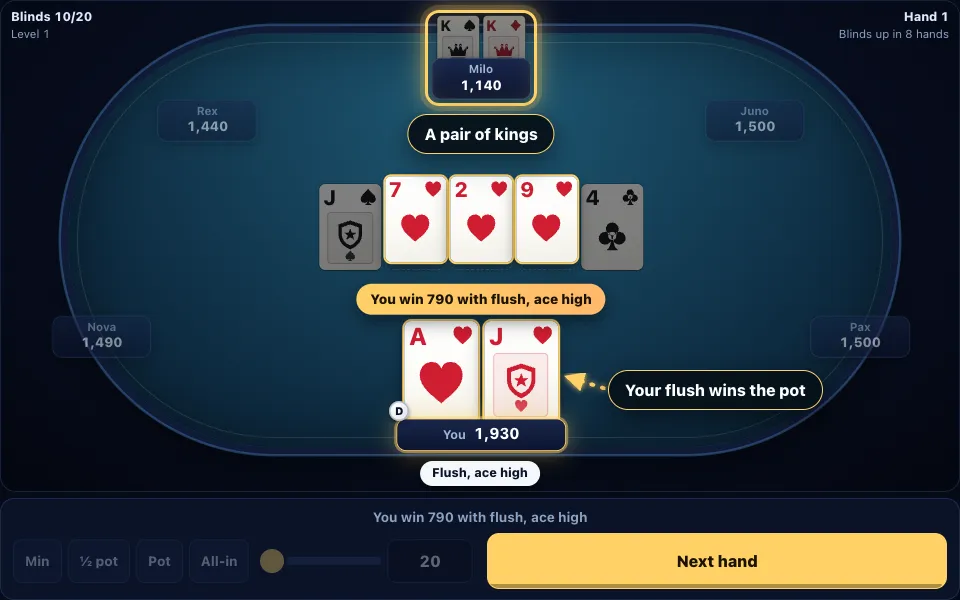
Showdown: the best five cards win
After the river, the players still in turn their cards up, and the winning five are lit. Your ace-high flush beats Milo's pair of kings and takes the pot. The next hand follows in a few seconds, or press Next hand.
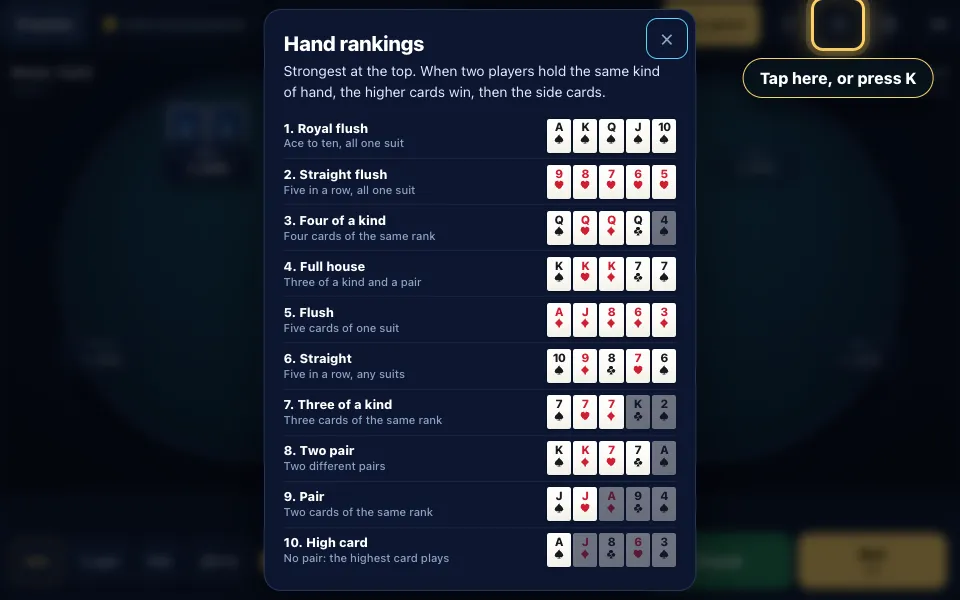
Check the hand rankings any time
Not sure what beats what? Tap the cards button at the top, or press K, for the full list from royal flush down to high card. Close it and carry on with your hand.

Enter a coin tournament
Sign in and switch to Coin tournaments. Pick a buy-in of 5, 10 or 25 coins and press Sit down. The buy-in is taken when the tournament starts, and the top three share the prize pool.
The rules in full
- Every player is dealt two cards face down, the hole cards. Five community cards are then dealt face up in the middle in three stages, and everyone may use them.
- Before the deal, the two players left of the dealer button post the small blind and the big blind, forced bets that start the pot. The button moves one seat clockwise after every hand.
- There are four betting rounds: before the flop, after the flop (three community cards), after the turn (a fourth) and after the river (the fifth).
- On your turn you can fold (give up the hand), check (pass, when nobody has bet), call (match the bet), or bet or raise. A round ends when everyone still in has put in the same amount or is all-in.
- The game is no-limit: you may bet any amount up to all your chips. A bet must be at least the big blind, and a raise must add at least as much as the last bet or raise did.
- If you cannot cover a bet you can call all-in with what you have. You then play for the main pot, the part you matched from each player, and the others play on for a side pot.
- If everyone but one player folds, that player wins the pot without showing. Otherwise the players left show their cards after the river, and the best five-card hand made from any mix of hole cards and community cards wins.
- Hands rank, best to worst: straight flush, four of a kind, full house, flush, straight, three of a kind, two pair, one pair, high card. Equal hands split the pot.
- The blinds rise through the tournament. A player with no chips left is out and takes the next finishing place, and the last player with chips wins.
Texas Hold'em tips and strategy
- Fold most starting hands. At a six-seat table, big pairs, two high cards and suited aces earn their keep; seven-two and its cousins only cost you chips.
- Position is worth chips. Acting last, on or near the button, lets you see what everyone does before you decide, so play more hands there and fewer from the blinds.
- Enter a pot before the flop with a raise rather than a call. A raise can win the blinds on the spot, and it tells you more about the hands that stay.
- Size bets against the pot, not your stack. Half the pot to the whole pot is a sound bet after the flop, and the ½ pot and Pot buttons set those in one tap.
- Compare the price of a call with your chance of winning. A flush draw on the flop gets there about one time in three by the river, so call a small bet and fold to a huge one.
- Watch the blinds. With fewer than about ten big blinds, stop calling: pick a decent hand and move all-in first, while a fold from everyone else still adds something to your stack.
- Open the hand history after a big pot. Seeing what was shown, and how each player bet along the way, is the quickest way to learn how the others think.
How to play Texas Hold'em: the rules in full
A hand starts with the dealer button, a disc marked D that shows who acts last. The player on its left posts the small blind and the next player posts the big blind, twice the size. From the fifth level every player also pays a small ante. When only two players are left, the button posts the small blind and acts first before the flop.
Before the flop, the betting starts with the player left of the big blind. After the flop, the turn and the river it starts with the first player left of the button. A short player may go all-in for less than a full raise, which does not reopen the betting for those who have already acted.
At the showdown the last player to bet or raise on the river shows first; if the river was checked, the first seat left of the button does. Any part of a bet that nobody called goes straight back to the bettor.
Poker hand rankings from best to worst
A poker hand is always five cards. In Hold'em you make it from any combination of your two hole cards and the five on the board: both of yours, one, or none at all if the board itself is the best hand.
From the top: a straight flush is five cards in sequence in one suit, and ace down to ten is the royal flush. Then come four of a kind, a full house (three of one rank and two of another), a flush (five of one suit), a straight (five in sequence), three of a kind, two pair, one pair and high card.
Within a category the higher ranks win, and spare cards, called kickers, break ties: ace-king beats ace-queen when both pair the ace. An ace can also sit below a two to make the five-high straight. The Hand rankings button shows the whole list with examples at any time.
All-in and side pots explained
You can never be forced out of a hand because you cannot afford a bet. Put in what you have and you are all-in: you stay in to the showdown, but you can win from each opponent only as much as you put in yourself.
Anything bet beyond that goes into a side pot, which only the players who paid into it can win. Each pot is awarded on its own, so the best hand may take the main pot while the second best takes a side pot. The table does the arithmetic and lists each pot.
Practice tables: Sit & Go and heads-up against the computer
Practice is the full game with play chips, and it runs entirely in your browser. Choose a six-player Sit & Go or a two-player heads-up match, then a level for the computer players: Easy, Medium or Hard.
Each computer player has a style of its own. Some wait for strong cards, some play a lot of hands, some bet hard and some set traps. They see only their own two cards, exactly as you do. Easy opponents make plain mistakes; Hard ones weigh position, pot odds and stack sizes, and they will bluff.
Blinds start at 10 and 20 and go up every 8 hands at the Sit & Go, every 6 heads-up, so a game fills a coffee break, not an evening. An unfinished game is saved on your device and is waiting when you come back.
Coin tournaments: buy-ins, prizes and table rules
Coin tournaments are six-seat Sit & Go games for signed-in players, with a buy-in of 5, 10 or 25 coins. The prize pool is always six buy-ins and pays the top three: half to the winner, 30% to second and 20% to third. At the 10-coin table that is 30, 18 and 12 coins.
Your buy-in is taken at the moment the tournament starts, never while you wait, and leaving before the start costs nothing. Seats still empty after a short wait are filled by computer players. The blinds rise every two minutes, and you have 20 seconds for each decision.
Prizes are paid the moment a place is decided. You can play 6 coin tournaments a day, and the count resets at midnight UTC. If a table ever cannot be finished, the buy-ins are returned.
Run out of time twice and your seat sits out: it checks or folds for you and keeps paying blinds until you press I'm back. A seat that sits out 12 hands in a row is given up. Leave table folds your hand and settles your place when that hand ends, and the buy-in is not returned.
Controls on phone, tablet and keyboard
On a phone, hold it upright and tap. Fold, Check or Call, and Bet or Raise sit along the bottom, under your thumb. Drag the slider to size a bet, type an exact amount, or tap Min, ½ pot, Pot or All-in.
On a keyboard, F folds, C checks or calls and R bets or raises. The arrow keys change the size, 1 to 4 pick Min, ½ pot, Pot and All-in, and Enter deals the next hand. H opens the how-to-play notes, K the hand rankings and L the history of your last 20 hands.
Texas Hold'em strategy for beginners
Count your outs. An out is a card that completes your hand. Multiply your outs by four on the flop, or by two on the turn, for a rough percentage: nine outs for a flush draw is about 36% with two cards to come.
Tournaments add one more idea. Chips you lose hurt more than chips you win help, because you cannot buy back in. Avoid coin-flip all-ins against big stacks when a few more folds would move you up a prize place.
Where Texas Hold'em comes from
Hold'em grew up in Texas in the early 1900s, and the state legislature has named the town of Robstown as its birthplace. It reached Las Vegas in the 1960s, and within a few years the best players had made no-limit Hold'em the game that decides their championship.
Television did the rest. Once small cameras began showing viewers the hidden cards around the turn of this century, millions took the game up at home and online, and it has been the most widely played form of poker ever since.
Texas Hold'em FAQ
Is this Texas Hold'em game free?
Yes. Practice tables are free and need no account or download. Coin tournaments use the site's coins, which are free too: you earn them by playing games here, and they cannot be bought.
Can I win real money?
No. There is no real-money play here. Coins have no cash value; they are a score you can put up and win at the coin tables.
Can I play Texas Hold'em on my phone?
Yes. The table is laid out for an upright phone, with large buttons and a bet slider, and it plays the same on tablets and computers.
What beats what in Texas Hold'em?
From best to worst: straight flush, four of a kind, full house, flush, straight, three of a kind, two pair, one pair, high card. A flush beats a straight, and three of a kind beats two pair.
What does no-limit mean?
On your turn you may bet any amount, from the size of the big blind up to every chip in front of you. One all-in can end your tournament or double your stack.
What happens when two players have the same hand?
The pot is split equally between them. Suits never break a tie. If a chip is left over, it goes to the first of the winners left of the button.
Are the cards dealt fairly?
Yes. Every hand uses a freshly shuffled 52-card deck, and the computer players see only their own cards. At coin tables the server shuffles and deals, and each player is sent only their own two cards.
What if I lose my connection in a coin tournament?
Your seat stays yours: come back to the page and you are returned to the table. While you are away your hand is checked or folded for you, and a seat that sits out 12 hands in a row is given up.
More games

Moonshot Hearts
Pass three cards, duck the queen of spades and maybe shoot the moon. Classic four-player Hearts against the computer, friends online or on one screen.
PLAY →
Bidstar Spades
Bid your tricks, team up with your partner and make your contract. Classic partnership Spades with nil bids and bags, to 500, against the computer or friends.
PLAY →
Gin Rummy
The classic two-player card game of melds and deadwood. Draw, discard, knock or go gin against an Easy, Medium or Hard computer, with Oklahoma rules, a daily deal and full match scoring.
PLAY →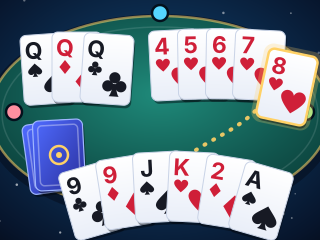
Rummy
The classic draw-and-discard card game for 2 to 4 players. Meld sets and runs on the table, lay off on anyone's melds and be first to go out, against computer players, on one device or at an online table.
PLAY →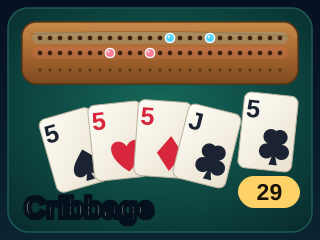
Cribbage
The classic six-card game to 121 on an animated pegboard: play the computer, a friend on one screen or an online table.
PLAY →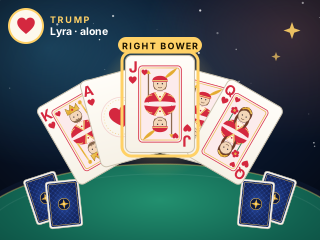
Euchre
Order up, call trump and go alone: the classic four-player trick-taking game with you and a computer partner against two computer players. Three levels, a Daily Deal, house rules you can switch on and full stats.
PLAY →