Gin Rummy: Play Free Online Against the Computer
The classic two-player card game of melds and deadwood. Draw, discard, knock or go gin against an Easy, Medium or Hard computer, with Oklahoma rules, a daily deal and full match scoring.
What is Gin Rummy?
Gin Rummy is the classic two-player card game of melds and deadwood, free to play online here against a computer opponent on your phone, tablet or computer. Draw and discard to build sets and runs until your loose cards add up to 10 or less, then knock, or hold out for gin and its 25-point bonus.
Your hand arranges itself into its best melds as you play, with a live deadwood count, so you can think about the decisions that matter: which discard to pick up, what to throw away and when to knock. The Knock button only appears when knocking is legal, and the end of every hand lays out both hands, the layoffs and the score line by line.
Choose an Easy, Medium or Hard computer. Hard remembers every discard and every card you pick up, avoids feeding your melds and weighs each knock against the risk of an undercut. Play matches to 100 with line and game bonuses, switch on Oklahoma rules, or try the daily deal: one hand, the same cards for everyone.
How to play Gin Rummy
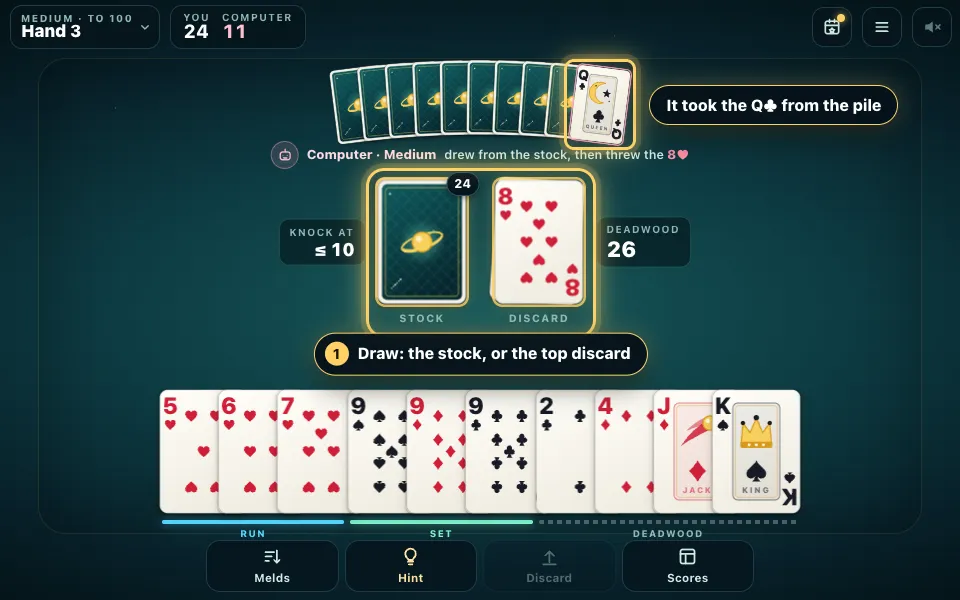
Draw a card
Start each turn by tapping the stock or the top card of the discard pile. Any card the computer takes from the pile stays face up in its hand.
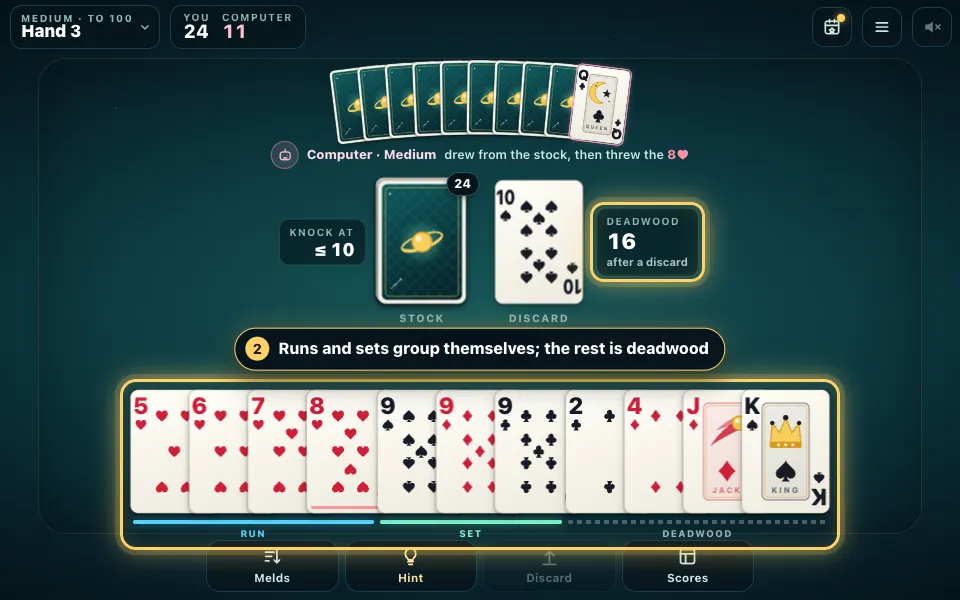
Build melds
Your hand sorts itself into runs and sets, with everything else marked as deadwood. The deadwood count updates as you play.
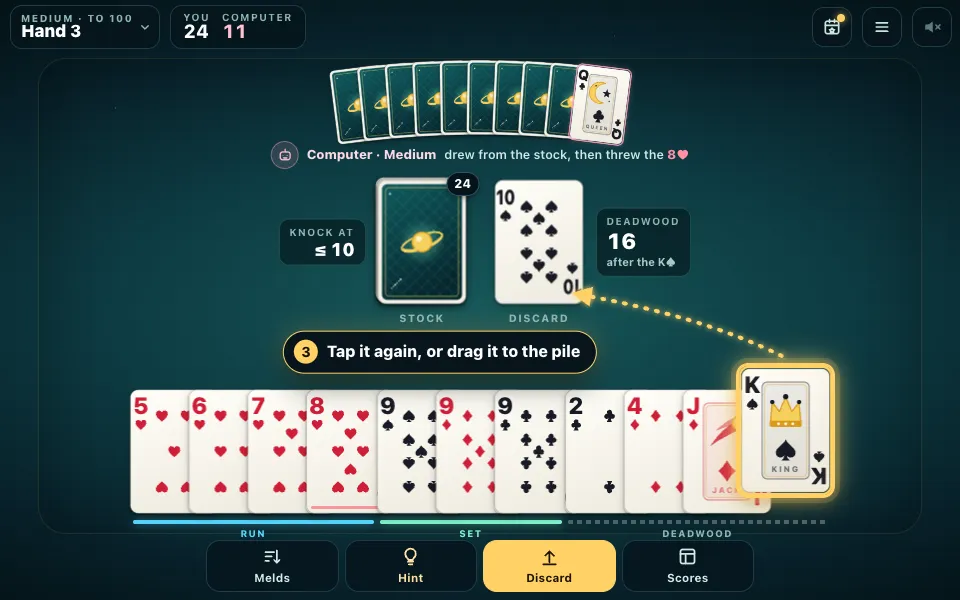
Discard one card
Tap a card to raise it, then tap it again or drag it to the pile to throw it away. High cards that fit nothing are usually the first to go.
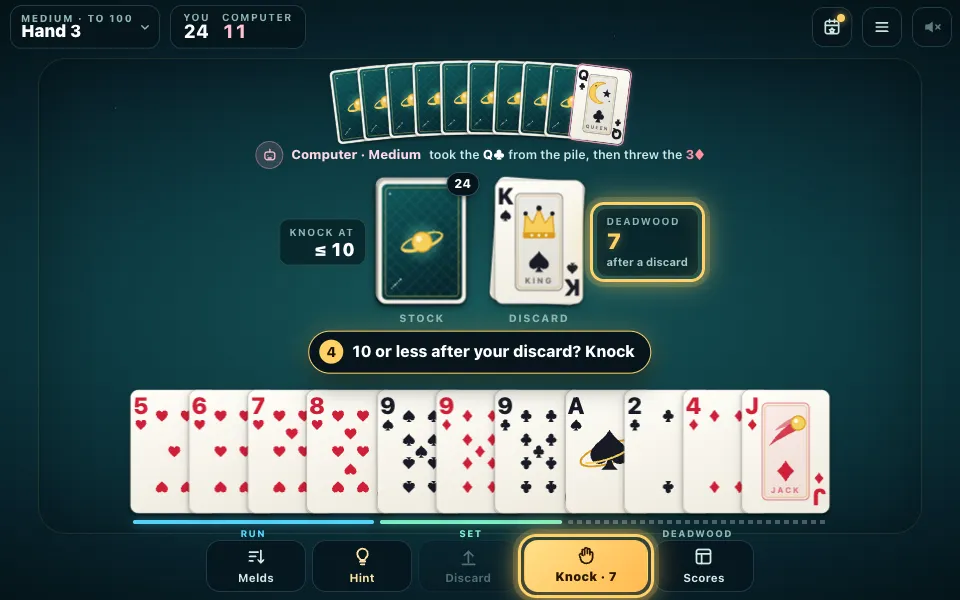
Knock or go gin
When your deadwood after discarding is 10 or less, the Knock button appears. With no deadwood at all it becomes Gin.
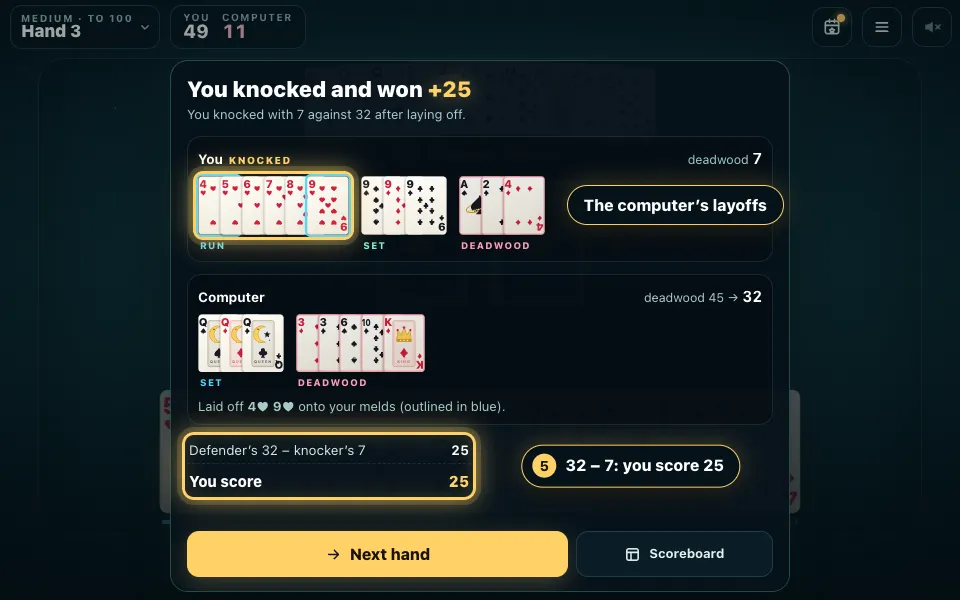
Lay off and score
Both hands are laid out and the defender lays off any cards that fit the knocker's melds. The lower count scores the difference, plus a bonus for an undercut.
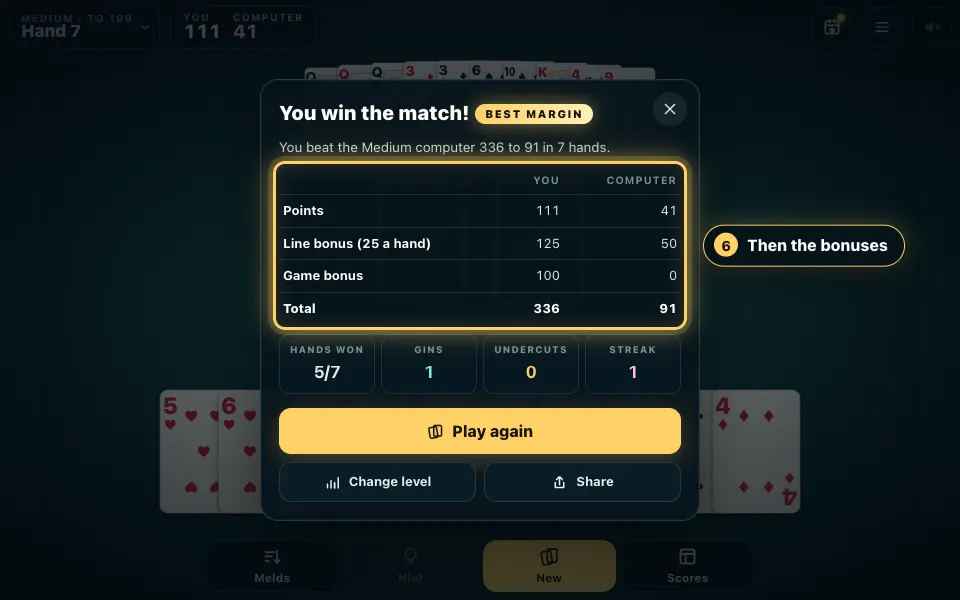
Win the match
The first to 100 wins. Then each hand won adds a 25-point line bonus and the winner adds the 100-point game bonus.
The rules in full
- Each player is dealt ten cards. The next card is turned face up to start the discard pile, and the rest of the deck is the stock.
- On the first turn the non-dealer may take the upcard or pass, and then the dealer gets the same choice. If both pass, the non-dealer draws from the stock.
- On every turn, draw one card, from the top of the stock or the top of the discard pile, then discard one card face up. You can't throw back a card you have just taken from the pile.
- Build melds: runs of three or more cards of one suit in sequence (the ace is low, so A-2-3 is a run and Q-K-A is not), and sets of three or four cards of the same rank. Each card can be in only one meld.
- Cards that aren't in a meld are deadwood. Aces count 1, number cards their face value, and jacks, queens and kings count 10.
- When your deadwood is 10 or less after your discard, you may knock. Both hands are shown, the defender lays off any loose cards that fit your melds, and you score the difference between the two deadwood counts.
- If the defender's deadwood is equal to or lower than yours, that's an undercut: they score the difference plus a 25-point bonus. Knock with no deadwood at all and it's gin, worth 25 points plus the defender's deadwood, with no laying off.
- If only two cards are left in the stock and nobody knocks, the hand is a draw. The first player to reach 100 points wins the match, and then 25 points for each hand won and a 100-point game bonus are added.
Gin Rummy tips and strategy
- Throw away high deadwood early. A king you can't use costs you 10 points if the computer knocks first.
- Only take a discard when it completes or clearly strengthens a meld. Every card you pick up tells your opponent what you're collecting.
- Watch what the computer picks up and avoid feeding it. A card of the same rank, or next to its pickup in the same suit, is exactly what it wants.
- Pairs and split runs (like the 5 and 7 of hearts) are worth keeping early on, but break them up once the stock is running low.
- Knock as soon as you sensibly can. The longer a hand goes on, the more time the defender has to trim their deadwood and undercut you.
- Hold out for gin only when plenty of unseen cards would complete it and the stock is still deep.
- Low cards make good deadwood. A hand left with an ace and a two can still knock with 3.
- Use Sort to see your hand by rank or by suit when you're hunting for the card that would complete a set or run, and drag cards into any order you like.
Gin Rummy rules and options
This version follows the standard rules of Gin Rummy: ten cards each, the upcard offered first to the non-dealer, one draw and one discard a turn, and a knock at 10 or less. Gin scores a 25-point bonus, an undercut 25, and big gin, where all eleven cards meld after a draw, scores 31 without a discard.
The defender lays off on the knocker's melds after a knock, but never after gin, and the hand is a draw when only two cards remain in the stock. The lower card in the cut deals the first hand, the winner of each hand deals the next, and after a draw the same dealer deals again.
Before a match you can set the target score (50, 100, 150 or 250), the undercut bonus (10, 20 or 25) and Oklahoma Gin, where the first upcard sets the knock limit for the hand and a spade upcard doubles the score.
Play Gin Rummy against the computer: Easy, Medium and Hard
Easy is relaxed: it misses melds, forgets what has been thrown and usually knocks as soon as it can. It is a good way to learn the flow of a hand. Medium plays a sound game, keeping its options open and knocking as soon as it is allowed.
Hard remembers the whole discard pile and every card you take, steers clear of discards that would complete your melds, and decides each knock by weighing the likely score against the chance of an undercut. Every level plays only legal moves and sees only its own cards and what has been played face up.
When the computer takes a card from the discard pile, it says so and that card stays face up in its hand, just as you would remember it at a real table.
Gin Rummy scoring: knocks, gin, undercuts and bonuses
A knock scores the difference in deadwood after layoffs. If you knock with 4 and the computer is left with 19, you score 15. If the computer could get down to 4 or less, it would undercut you and score the difference plus the undercut bonus instead.
Gin is worth 25 plus the other hand's deadwood, and big gin 31 plus the deadwood. When someone reaches the target, each player adds a line bonus of 25 for every hand they won, and the winner adds the 100-point game bonus, doubled to 200 for a shutout when the loser never scored.
With Oklahoma rules, a spade upcard doubles the whole hand, bonuses included. The scoreboard lists every hand of the match, who won it and how, with the running totals.
The daily Gin Rummy deal: one hand, the same cards for everyone
Every day there's a new daily deal: a single hand of Gin Rummy, dealt the same for every player, against the Hard computer. You get the first look at the upcard, and the computer plays the same way every time, so the result is down to your choices.
Win the hand to score its points, then share your result with friends who played the same cards. Only your first finish of each deal counts, and finishing it on its own day keeps your streak going. The calendar lets you go back and play the deals you missed.
A short history of Gin Rummy
Gin Rummy grew out of the rummy family of draw-and-discard card games. It is usually credited to Elwood T. Baker and his son Graham in New York around 1910, as a quicker two-player rummy, and the name is said to be a joke on rummy: one drink swapped for another.
It became a craze in Hollywood and across the United States in the late 1930s and 1940s, and its American scoring, with gin bonuses, undercuts and box bonuses for each hand won, settled into the form most people play today. Oklahoma Gin, where the first upcard sets the knock limit, is one of its best known variations.
Free Gin Rummy on your phone, tablet or computer
The game works in any modern browser with no download or account. On a phone, tap the stock or the discard pile to draw, tap a card twice or drag it to the pile to discard, and drag cards along your hand to put them in any order you like.
With a keyboard, the arrow keys and number keys choose cards and single keys draw, take, knock, sort and ask for a hint. Your match is saved as you play, so you can close the page and pick it up later exactly where you left off.
Gin Rummy FAQ
Is this Gin Rummy free?
Yes. Gin Rummy is free to play in your browser with no download, no account and no ads in the game. Make a free account if you want your results on the leaderboards on every device.
How do I play Gin Rummy against the computer?
Choose Easy, Medium or Hard and deal. On your turn, tap the stock or the discard pile to draw, then tap a card twice (or drag it to the pile) to discard. When your deadwood is 10 or less, the Knock button appears.
How many cards does each player get in Gin Rummy?
Ten. The dealer gives ten cards each, one at a time, turns the next card face up to start the discard pile and leaves the other 31 cards face down as the stock.
What is the difference between knocking and gin?
You can knock when your unmatched cards add up to 10 or less; the defender then lays off cards on your melds and may undercut you. Gin means every card is in a meld: it scores a 25-point bonus, the defender can't lay off, and it can't be undercut.
What is an undercut in Gin Rummy?
If the player who knocks has as much deadwood as the defender, or more, after layoffs, the defender undercuts them. The defender scores the difference plus the undercut bonus, which is 25 points here unless you change it to 10 or 20.
How many points is gin worth?
Gin is worth 25 points plus the other player's deadwood. Big gin, when all eleven cards are melded after you draw, is worth 31 plus the deadwood.
Is the ace high or low in Gin Rummy?
The ace is low. It counts 1 point as deadwood and runs from A-2-3, but Q-K-A is not a run.
What happens when the stock runs out?
When only two cards are left in the stock and the player who drew last discards without knocking, the hand is a draw. Nobody scores and the same dealer deals again.
What is Oklahoma Gin?
In Oklahoma Gin the first upcard sets the knock limit for the hand: a 7 means you need 7 or less, a picture card 10, and an ace means only gin will do. If that upcard is a spade, the hand counts double. Matches are usually played to 150.
Does the computer cheat?
No. Every computer player sees only its own cards and the cards played face up, and makes only legal moves. The Hard computer is strong because it remembers the discards and the cards you take, not because it peeks.
Is my match saved?
Yes. Your match, the daily deal in progress, your stats and your settings are saved in your browser as you play, so you can leave and come back to the same hand.
Can I play Gin Rummy with a keyboard?
Yes. Use the left and right arrows or the number keys to choose a card, Enter to discard, D to draw from the stock, T to take the discard, K to knock, S to sort and H for a hint.
More games

Moonshot Hearts
Pass three cards, duck the queen of spades and maybe shoot the moon. Classic four-player Hearts against the computer, friends online or on one screen.
PLAY →
Bidstar Spades
Bid your tricks, team up with your partner and make your contract. Classic partnership Spades with nil bids and bags, to 500, against the computer or friends.
PLAY →
Dragonrun Tiến Lên
Shed your cards first in the Vietnamese climbing game. Beat each play with a higher one, chop the twos with bombs and race to go out, against the computer or friends.
PLAY →