Roll Rush: Free Alley Roller Arcade Game
Flick a ball up the lane, hop it off the ramp and drop it into moving rings for streaks, trick shots and three-ball multiball.
What is Roll Rush?
Roll Rush is a free alley roller arcade game you play in your browser. Flick a ball up the lane, let it hop off the ramp, and watch it drop into one of the scoring rings on the board beyond.
The rings do not sit still. Some slide from side to side, one is always lit for double points, and every third ring in a row lifts your multiplier. Land enough lit rings and your next roll becomes a three-ball multiball.
There are five ways to play: a classic nine-ball game, a 60-second Rush, a Tour of six themed lanes, a pass-and-play party for two to four people, and a match against a computer roller at four skill levels.
It works with a mouse, a finger or a keyboard and starts with one press of Play. Every game pays tickets, and tickets buy new ball skins from the prize shelf.
How to play Roll Rush
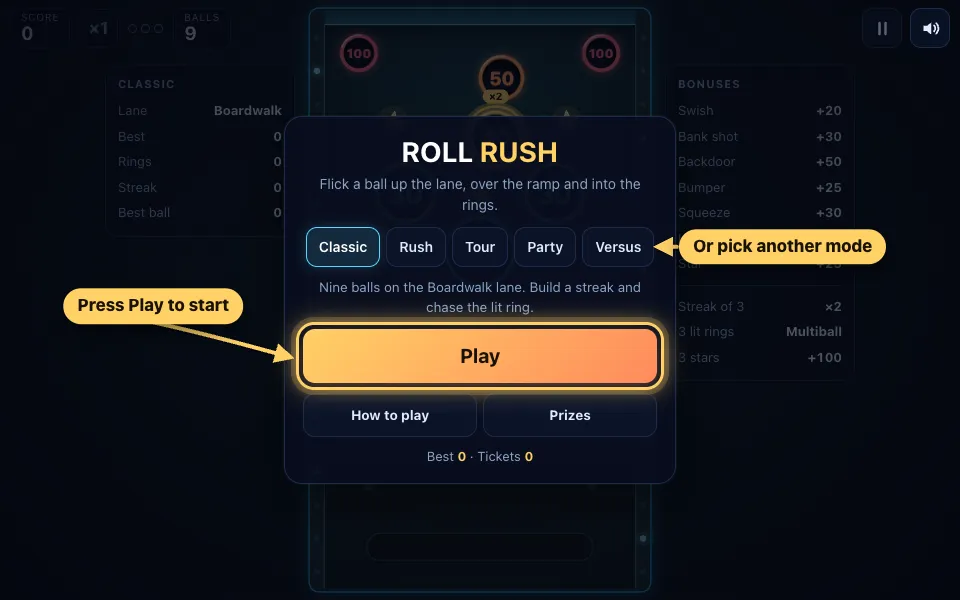
Press Play to start
The game opens ready to go. Press Play, or hit Enter, for a classic nine-ball game. The row above it switches to Rush, Tour, Party or Versus.
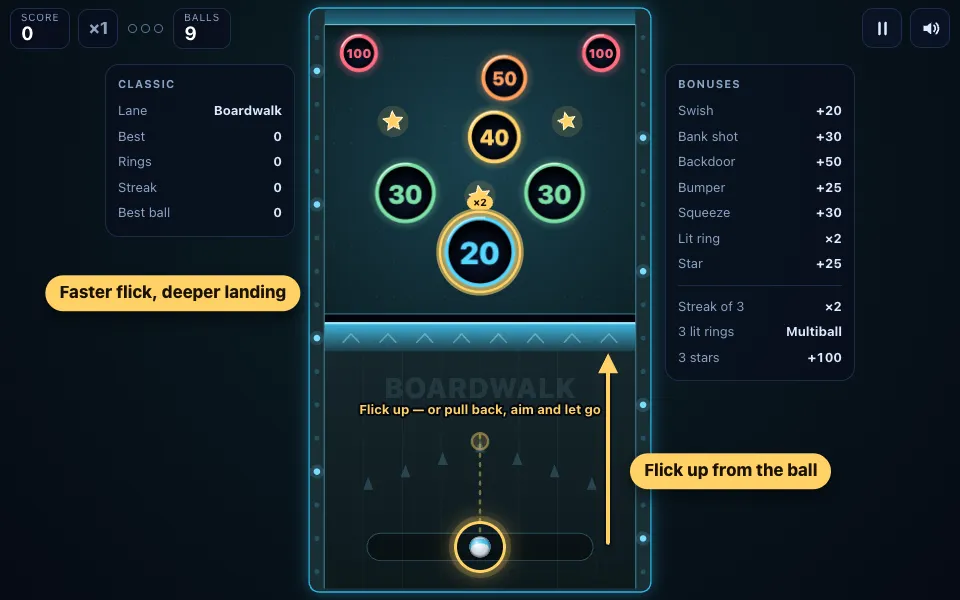
Flick the ball up the lane
Press on the ball and flick upward. The faster your hand is moving when you let go, the deeper the ball lands on the board.
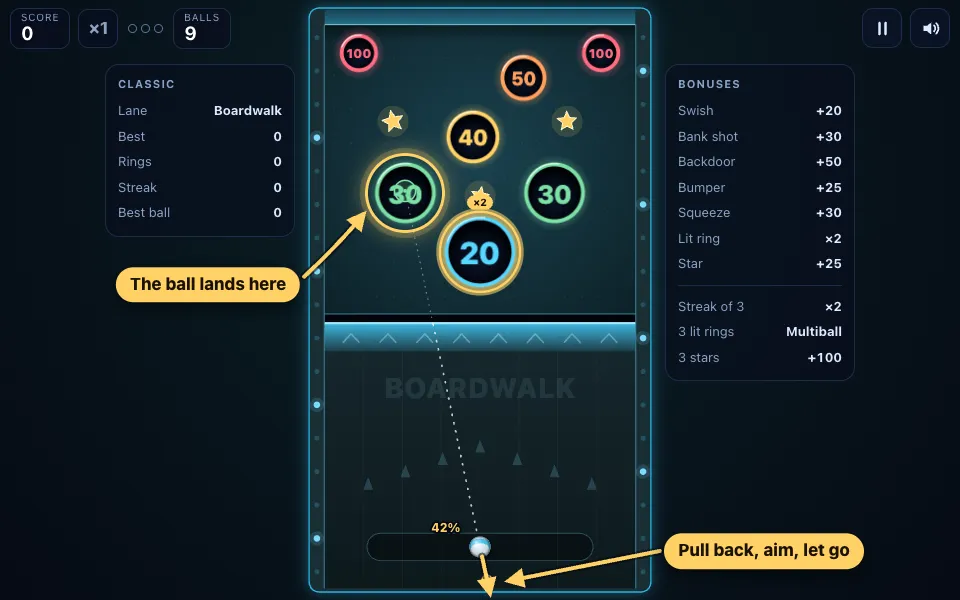
Pull back to line up a shot
Pull back from the ball like a slingshot and the game draws the path and the landing spot. Move to adjust, then let go to roll.
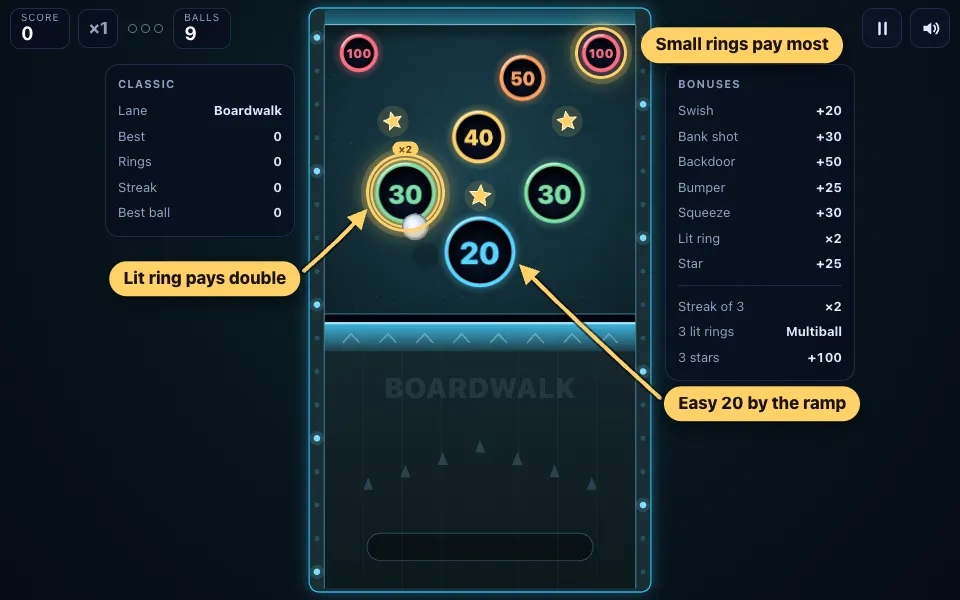
Land in the rings
Small rings far from the ramp pay the most. The glowing ring pays double and gives you a spark, so it is usually the one to aim at.
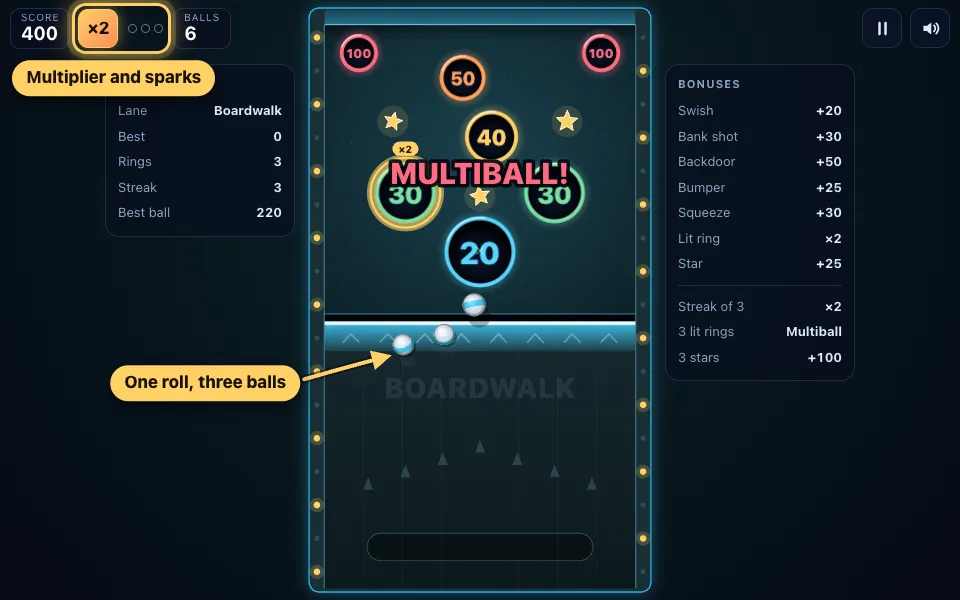
Build a streak and load multiball
Rings in a row raise the multiplier to as much as ×5. Three sparks from lit rings load a multiball: one roll, three balls.
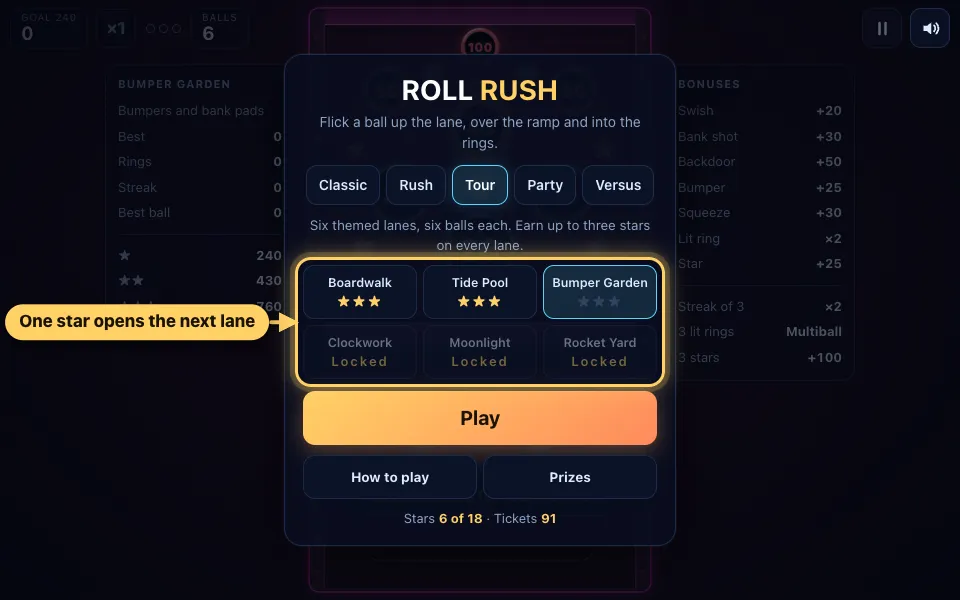
Tour the six lanes
Each Tour lane adds a trick: drifting rings, bumpers, orbiting rings, breathing rings and a moving gate. Earn one star to open the next lane.
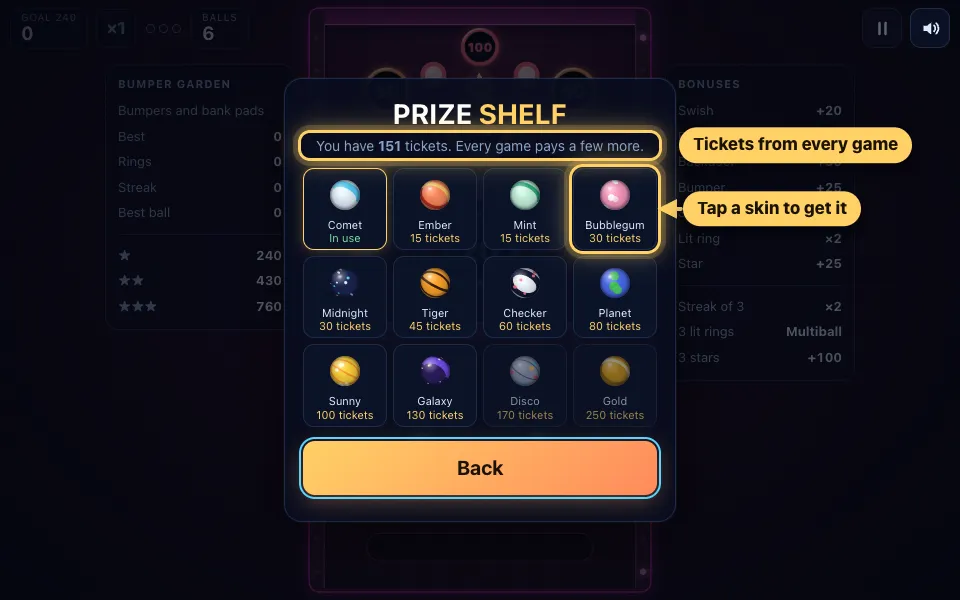
Spend tickets on the prize shelf
Every game pays tickets. Open Prizes to trade them for new ball skins, then tap a skin you own to roll with it.
The rules in full
- Press Play, or hit Enter, to start a classic nine-ball game on the Boardwalk lane. The buttons under Play switch to Rush, Tour, Party or Versus.
- Put your pointer or finger on the ball and flick up the lane. The ball leaves at the speed your hand was moving when you let go.
- A faster flick lands deeper on the board. A gentle one reaches the big 20 ring by the ramp; a hard one reaches the small 100 rings in the far corners.
- Flick at an angle to aim left or right. Curl the end of the flick to put spin on the ball and bend its path.
- For a careful shot, press on the ball and pull back like a slingshot instead. A preview shows where the ball will land; let go to roll.
- On a keyboard, aim with the left and right arrows, slide the ball with A and D, add curve with Q and E, then hold Space to charge and release to roll.
- Each ring pays the number shown in it: 20, 30, 40, 50 or 100. A ball that misses every ring rolls into the gutter and pays 10.
- The glowing ring pays double and earns a spark. Three sparks load a multiball, and your next roll sends three balls up the lane at once.
- Land rings back to back to build a streak. Every third ring in a row raises the multiplier by one, up to ×5. A gutter ball resets it.
- Roll through all three star targets for 100 points and a bonus ball. In Rush the set adds five seconds to the clock instead.
- When the balls or the clock run out, the results panel shows your score, your best and the tickets you earned.
Roll Rush tips and strategy
- Find one flick speed that lands in a ring every time and repeat it. A steady streak at ×3 beats one lucky 100 followed by a gutter ball.
- Chase the lit ring when it is one you can hit reliably. Double points plus a spark is worth more than a risky shot at the corners.
- When multiball is loaded, send the roll down the middle. The three balls fan out, and a stray multiball never breaks your streak.
- The 100 rings are small and sit in the far corners. Try a bank off the side cushion or a touch of curve rather than a straight flick at full power.
- A slightly long roll beats a short one. A ball that hits the back wall can still drop into a ring on the way down, and that backdoor pays an extra 50.
- Watch a sliding ring for a full pass before you roll, then aim where the ring will be when the ball arrives.
- In Rush, roll again the moment the next ball is on the pad, and sweep up the star targets early for extra seconds.
- In party and versus games the last frame decides it. Behind? Go for the lit ring. Ahead? Take the safe 20s and 30s.
How to play Roll Rush: the rules
Every game is a set of rolls. You send a ball up the lane, the ramp kicks it into the air, and it lands on a tilted board dotted with rings. Whichever ring it drops into pays its value.
Small rings far from the ramp pay the most. On the Boardwalk lane the large ring nearest the ramp pays 20, the middle rings pay 30, 40 and 50, and the two small corner rings pay 100. A ball that finds no ring rolls back down into the gutter and still pays 10.
A classic game is nine balls. Rush is as many balls as you can roll in 60 seconds. Tour gives you six balls on each lane, and party and versus games are three frames of three balls for each roller.
Scoring: lit rings, streaks, multipliers and trick shots
One ring on the board is always lit. Land in it and it pays double, you bank a spark, and the light jumps to another ring.
Three sparks load a multiball. Your next roll sends three balls up the lane together, and each one scores on its own.
Streaks reward steady rolling. Every third ring in a row raises your multiplier by one, to a top of ×5 after twelve rings. Only a gutter ball breaks the streak.
Trick shots add a bonus on top: 20 for a swish that drops in clean, 30 for a bank off a side cushion, 50 for a backdoor off the back wall, 25 off a bumper and 30 for squeezing into a ring that has shrunk.
Controls: mouse, touch screen and keyboard
With a mouse or a finger, press on the ball and flick up the lane. Speed sets the distance, direction sets the aim, and a curl at the end of the flick adds spin.
Prefer to line a shot up? Press on the ball and pull back toward yourself. The game draws the path and the landing spot, and the ball rolls when you let go.
On a keyboard, the left and right arrows aim, A and D slide the ball across the lane, and Q and E add curve. Hold Space to charge the power and release to roll. P or Esc pauses and M mutes the sound.
Game modes and difficulty levels
Classic is the pure game: nine balls on the Boardwalk lane, one score, one best to beat.
Rush gives you 60 seconds and no ball limit. Fast, accurate flicking wins, and each full set of star targets adds five seconds.
Party is pass-and-play for two to four people on one screen. Each roller gets three frames of three balls on a lane you choose, and the highest total wins.
Versus puts you against a computer roller over the same three frames. Rookie misses a lot, Regular is a fair first match, Sharp punishes gutter balls, and Ace rarely leaves the high rings.
The Tour: six themed lanes
The Tour is a run of six lanes, each with its own colours and its own trick. You get six balls per lane and earn up to three stars for your score, 18 in all. One star opens the next lane.
Boardwalk has two sliding rings. Tide Pool sets every ring drifting. Bumper Garden plants bumpers on the board and two round pads on the lane that bounce a careless roll off line.
Clockwork sends its rings around in orbit and swaps their values as they go. On Moonlight the rings breathe in and out, so timing matters as much as aim. Rocket Yard puts a moving gate in front of the ramp.
Strategy for beginners and high scorers
Start with the rings that stay put. On the Boardwalk the big 20 and the two 30s never move, so a flick at a repeatable speed scores every time and builds the streak.
Once the multiplier reaches ×3, every ring is worth protecting. A 30 at ×4 is 120 points; a missed 100 is 10 points and a reset.
High scores come from stacking things: a lit ring during a streak, with a trick bonus on top. Pick up the star targets early, because their bonus ball is rolled with whatever multiplier you have built by then.
Tickets and the prize shelf
Every finished game pays tickets, with a few extra for star targets, wins and new best scores.
The prize shelf holds twelve ball skins, from the plain Comet you start with to Tiger, Planet, Galaxy, Disco and a solid Gold ball. Skins change how the ball looks and nothing else, and there is nothing to buy with money.
A short history of alley roller games
The alley roller is one of the oldest arcade games still played. The idea dates from the early 1900s: a short bowling-style lane that ends in a ramp, with a target board of rings behind it.
It spread through seaside boardwalks, amusement piers and fairgrounds, and later became a fixture of family arcades that pay out prize tickets. Anyone can roll a ball, and almost nobody can roll nine good ones in a row.
Roll Rush keeps that core and adds moving rings, trick lanes, multiball and a computer rival.
Alley roller glossary
Lane: the flat run before the ramp. Ramp: the lip that hops the ball onto the board. Gutter: the trough at the foot of the board that catches every miss.
Lit ring: the glowing ring that pays double. Spark: what a lit ring gives you; three load a multiball. Streak: rings in a row without a gutter ball.
Swish: a clean drop. Bank: a shot off a side cushion. Backdoor: a ball that comes back off the far wall into a ring. Frame: one turn of three balls in party and versus games.
Roll Rush FAQ
Is Roll Rush free to play?
Yes. Roll Rush is free in your browser with no download and no sign-up. Ball skins cost tickets you earn by playing, never money.
How do you play an alley roller game?
You roll a ball up a lane so it jumps off a ramp and lands in a scoring ring. Smaller, farther rings pay more, and the highest total after your balls are used wins.
How do I roll the ball in Roll Rush?
Press on the ball and flick up the lane with a mouse or finger, or pull back like a slingshot to see where it will land. On a keyboard, aim with the arrow keys and hold Space to set the power.
Which ring scores the most?
The two small corner rings pay 100 each. The lit ring pays double whatever its number is, so a lit corner ring is worth 200 before your multiplier.
How does the multiplier work?
Every third ring in a row adds one to the multiplier, up to ×5 after twelve rings. A ball in the gutter sets it back to ×1.
How do I get multiball?
Land in the glowing ring three times to collect three sparks. Your next roll then launches three balls at once.
Can I play Roll Rush on my phone?
Yes. It is built for touch: flick the ball with your thumb, in portrait or landscape. It also runs full screen on tablets and desktops.
Can two players play Roll Rush?
Yes. Party mode is pass-and-play for two, three or four rollers on one screen, with three frames of three balls each.
How good is the computer roller?
There are four levels. Rookie is easy to beat, Regular and Sharp get steadily more accurate, and Ace lands high rings almost every ball.
Does Roll Rush save my progress?
Yes. Best scores, Tour stars, tickets, ball skins and an unfinished game are saved on your device, ready when you return in the same browser.
More games
Rocket Pinball
A full pinball game that flies from Mercury to the heart of the galaxy: 18 levels on four tables, 54 missions, a black hole, multiball and real-time lighting, free in your browser.
PLAY →
Whack Rush
Critters pop up, you bop them fast: build a combo, spare the friends, start a Rush.
PLAY →
Rollwave
Steer a glowing ball down a winding synthwave track where nothing turns for you: take every bend, dodge blocks, lasers and spinners, launch off ramps and race computer balls, a friend or people online. 120 levels, an endless run and a daily run.
PLAY →
Prism Pop
A glowing bubble shooter: aim, bank off the walls, match three to pop and drop whole clusters. 60 levels with stars, Endless, a daily puzzle and versus against the computer, a friend or a player online.
PLAY →
Sky Tower
Drop sliding blocks to build a tower into the sky and far beyond it: a journey past the stars into psychedelic skies, endless and daily towers, 70 challenges with 14 bosses, two-player races and skins to unlock.
PLAY →
Jetster
Fly a jet whose belly rocket fires down to push you up. Hold to thrust, release to fall, and survive the narrowing tunnel.
PLAY →