Pyramid Solitaire: Pair to 13, Clear the Pyramid
Classic Pyramid solitaire: pair cards that add up to 13 and clear the pyramid. Winnable deals, solver hints, a Daily Deal, five-pyramid runs and your own rules. Free, no account.
What is Pyramid Solitaire?
Pyramid Solitaire is the patience game where you clear a pyramid of 28 cards by removing pairs that add up to 13. Play it free in your browser on a phone, tablet or computer, with no download and no account. An ace counts 1, a jack 11, a queen 12 and a king 13, so a king goes on its own and every other card needs a partner: a 6 with a 7, a 4 with a 9, a queen with an ace.
Only free cards can pair, the ones with nothing overlapping them from the row below. The other 24 cards wait in the stock, and you turn them onto the waste one at a time (or three at a time) to find the partners the pyramid needs. When the stock runs out, the waste turns over for another pass, as many times as your rules allow.
Every new deal is checked by a solver before you see it, so you're only ever given games that can be won (you can switch this off). The same solver powers the hints: it shows the next move of a winning line, or how many moves to undo when there's no way through. There's also a Daily Deal with a streak and a calendar, Pyramid Run for five pyramids back to back, and rules of your own: draw 1 or 3, none, two or unlimited redeals, and the strict goal of clearing every card.
How to play Pyramid Solitaire
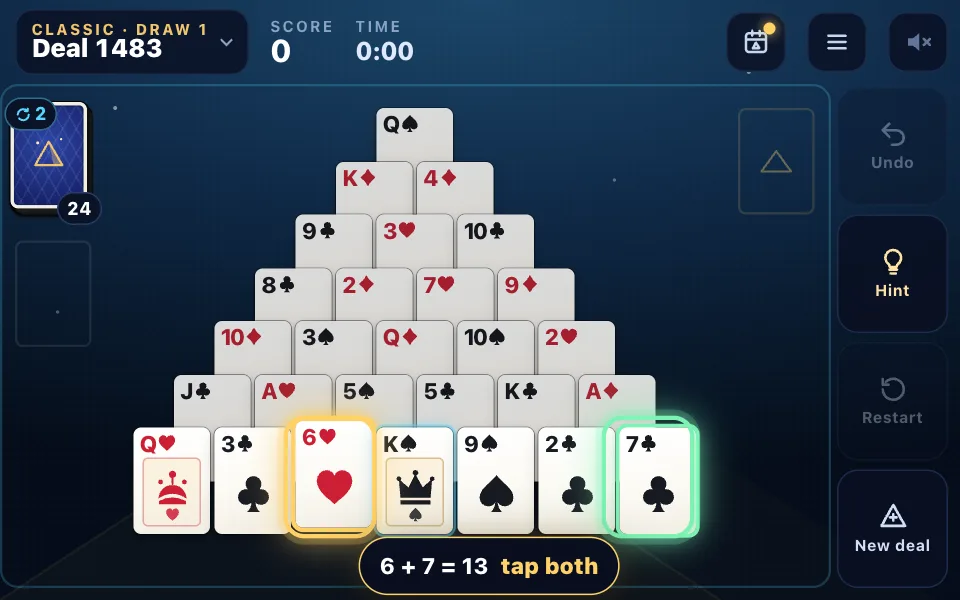
Pair two cards that make 13
Tap a free card, then its partner, or drag one onto the other. A free card has nothing overlapping it from below, and a picked card's partners light up green.
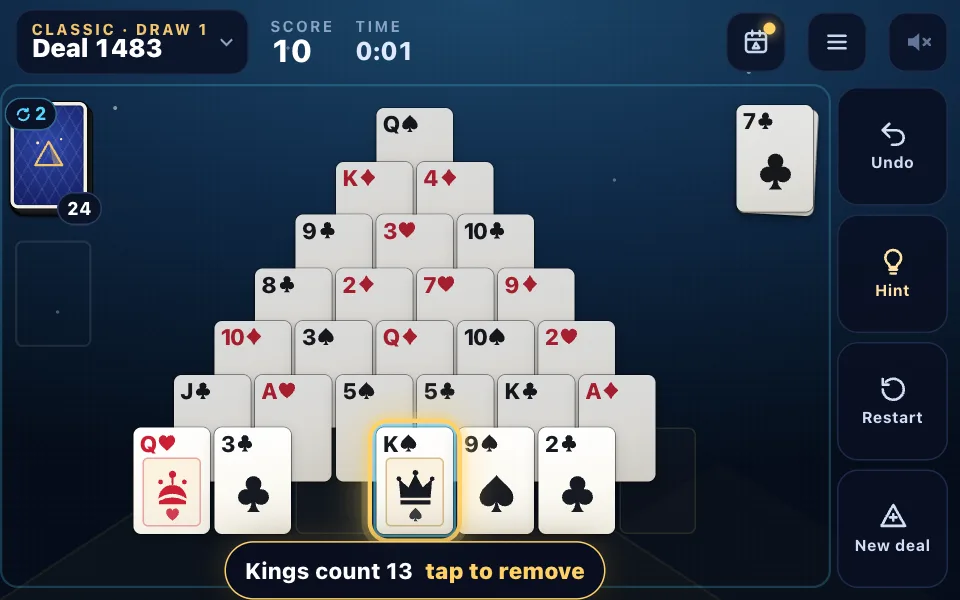
Kings go on their own
A king counts 13 by itself, so a free king goes with a single tap. With Remove kings by themselves switched on in Settings, as it is to start with, it goes the moment it comes free.
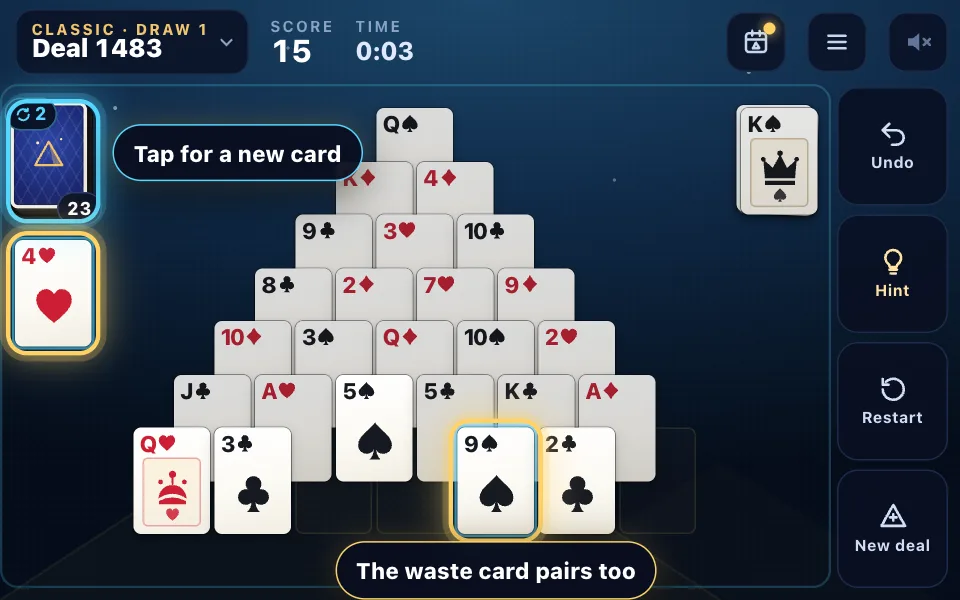
Turn the stock for more cards
Tap the stock to turn a card onto the waste. The top card of the waste is free too, so it can pair with a free card in the pyramid.
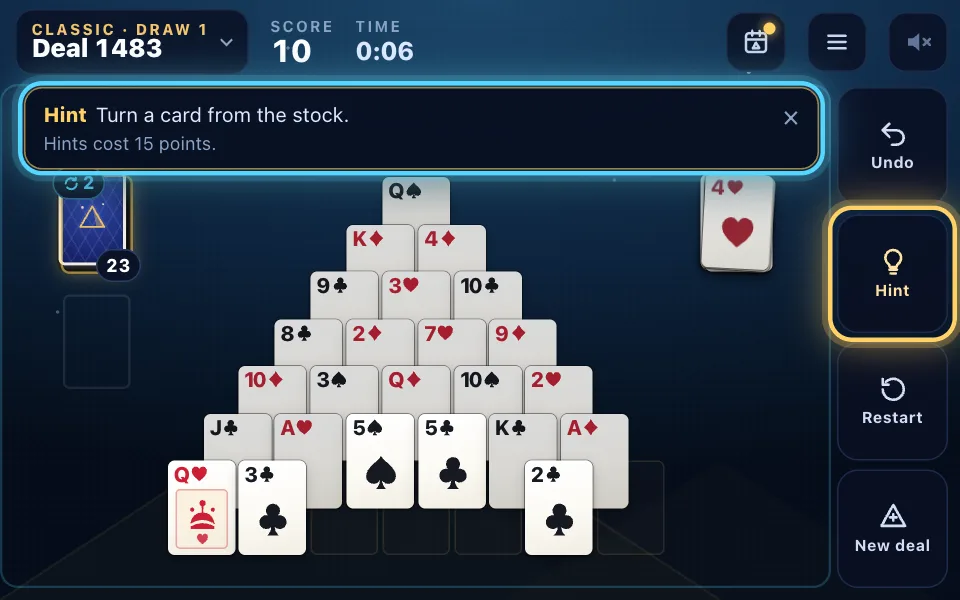
Stuck? Ask for a hint
A hint asks the solver for the next move of a winning line. If there is no way through any more, it tells you how many moves to undo.
Clear the peak to win
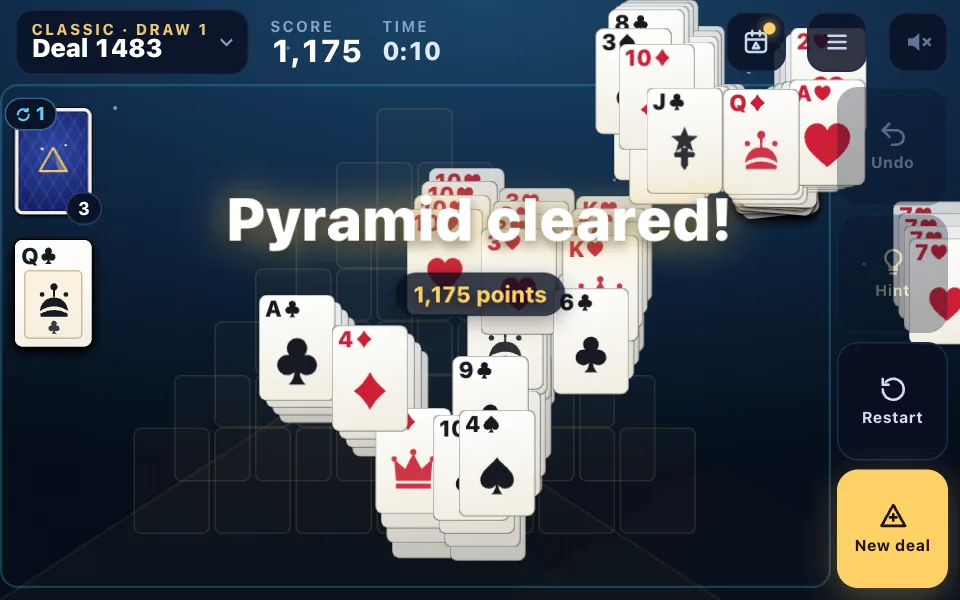
Remove the last card at the top and the pyramid is cleared: the cards cascade off the table and your score adds up the pairs, the rows, the pyramid bonus and a time bonus.
Come back for the Daily Deal
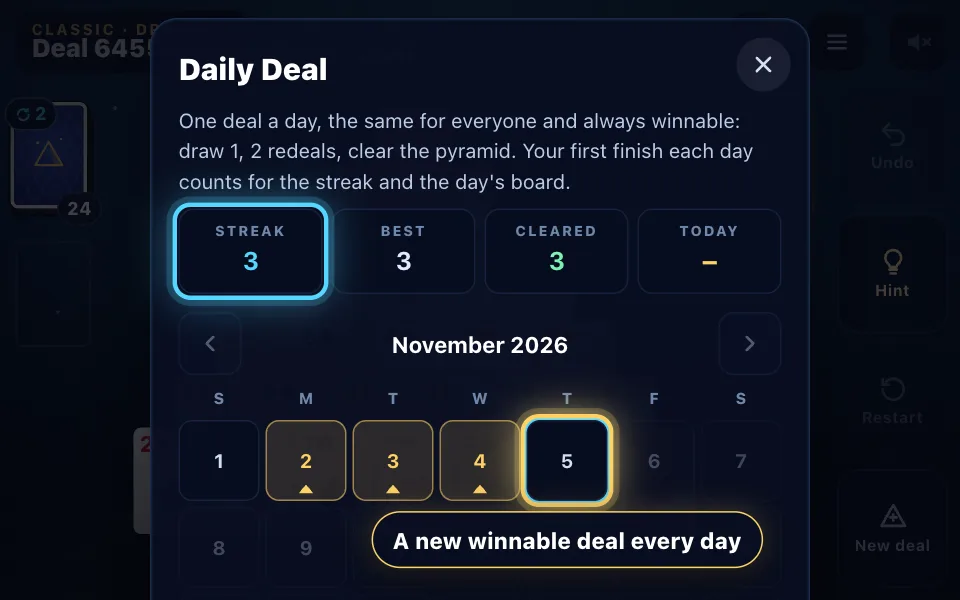
Every day brings one winnable deal, the same for everyone. Clear it to grow your streak and mark the day on your calendar.
The rules in full
- The goal is to clear all 28 cards of the pyramid. A card is free when no card from the row below overlaps it, so at the start only the bottom row of seven is free.
- Remove two free cards that add up to 13. Aces count 1, number cards their number, jacks 11, queens 12 and kings 13. The pairs are A and Q, 2 and J, 3 and 10, 4 and 9, 5 and 8, and 6 and 7.
- Kings count 13 on their own, so a free king goes with a single tap. With Remove kings by themselves switched on in Settings, as it is to start with, a king goes the moment it comes free.
- Tap one card and then its partner, or drag one card onto the other. A picked card's partners light up, and cards that can go right now glow.
- Tap the stock to turn a card onto the waste (three with draw 3). The top card of the waste is free, so it can pair with a free card in the pyramid.
- When the stock is empty, tap its place to turn the waste over and go through it again. The badge on the stock shows how many redeals you have left.
- Undo is unlimited. A hint shows the next move of a winning line, and if the pyramid can't be cleared from where you are, it tells you how many moves to undo.
- Clear the last card, the peak, to win. With the strict goal of every card, the stock and the waste have to be emptied as well.
- With a keyboard, the arrow keys move between free cards and the stock, Enter picks and pairs, D turns the stock, U undoes and H asks for a hint.
Pyramid Solitaire tips and strategy
- Look before you pair. If two free 6s could both go with one 7, take the 6 that uncovers the card you need most.
- When a free card could pair with either the waste or another pyramid card, think about which one opens up more of the pyramid. With redeals left, a waste card you skip comes round again, while a covered pyramid card blocks everything above it.
- With draw 3, using the top card of the waste uncovers the one beneath it, so a pair from the waste can reach cards you would otherwise only see on the next pass.
- If you switch off Remove kings by themselves in Settings, take every free king at once. A king never pairs with anything, so leaving it in place only blocks the cards above it.
- Don't rush through the stock. Before you turn the next card, check every free card against the top of the waste.
- Use the first pass to learn the stock. With redeals left, you'll meet those cards again in the same order, so plan which ones you'll need next time round.
- If you get stuck, ask for a hint: it tells you exactly how many moves to undo to get back on a winning line.
- For the best score, clear the pyramid before turning the waste over and keep the time under three minutes.
Pyramid solitaire rules and variants
The deal is always the same shape: seven rows of cards from a single card at the top to seven at the bottom, each row overlapping the one above, and 24 cards left over as the stock. Every free card in the pyramid and the top card of the waste can be used. Pairs that make 13 are removed, kings go alone, and nothing else moves.
Rule books differ on the details, so this version lets you choose. Draw 1 turns one card at a time; draw 3 turns three and only the top one is free. You can allow no redeals (a single pass through the stock), two redeals, or as many as you like. The usual goal is to clear the pyramid; the strict old rule asks you to clear all 52 cards, stock and waste included, which only about one random deal in fifteen allows even with draw 1 and two redeals.
Two combinations are switched off because almost no deal can be won with them: draw 3 with no redeals, which leaves most of the stock buried in the waste, and clearing every card in a single pass. Our solver wins only about one random deal in a thousand with either.
Where Pyramid patience comes from
Pyramid is a patience, the British name for solitaire, from the family of adding games where cards leave the table in pairs that make a set total. Baroness, also called Thirteens, is a close cousin that pairs cards to 13 from five piles instead of a pyramid. The triangle of the deal gives Pyramid its name.
The strict version, where every card has to go, is rarely won: our solver finds a way through only about one random deal in fifteen with draw 1 and two redeals, and fewer still with draw 3. Most computer versions count a cleared pyramid as the win, and that is how most people play it today. Both goals are here.
How to win at Pyramid solitaire: strategy
Most lost games are lost by a pair made too early. When you have a choice between two cards of the same rank, the right one is usually the card that uncovers something useful, not simply the first one you spot.
Think about the cards that can never help each other. A card can't pair with any card that covers it, however far down, or with any card it covers, so a 4 that covers a 9 needs a different 9. Every card covers the peak, so unless it's a king, its partner always comes from the stock.
With redeals, the stock comes round again in the same order. A card you can't use now may be exactly what you need on the next pass, so there's no need to force a weak pair.
Winnable deals, smart hints and the Daily Deal
About two random deals in three can be won with draw 1 and two redeals, and far fewer with harder rules: about one in five with draw 3, and about one in seventeen with a single pass through the stock. With winnable deals on, as it is unless you turn it off, every new deal is checked by a solver first, and you only get it once the solver has found a way to clear it with your rules.
The same solver gives the hints. It looks at the cards as they are now and shows the next move of a way to win. If there is no way through any more, it searches back through your moves and tells you how many to undo. Each hint costs 15 points, so they help without being free, and asking twice in the same position costs nothing more.
The Daily Deal is one winnable deal for everyone each day, played with draw 1 and two redeals. Your first finish counts for your streak and the day's board, the calendar marks the days you've cleared, and you can play past days to fill the gaps.
Scoring and Pyramid Run
Each pair is worth 10 points and each king 5. Clearing a row of the pyramid adds 25, and clearing the pyramid adds 500. On a win you get 100 more if you never turned the waste over, and a time bonus of 2 points for every second under three minutes. Each undo costs 5 points and each hint 15. You can turn scoring off for Classic games, which makes undo free.
Pyramid Run deals five pyramids back to back with one running score. Each pyramid has its own clock, so every quick clear earns its own time bonus, and clearing all five adds 1,000. If a pyramid beats you, skip it and carry on: the points you made in it still count.
Play Pyramid solitaire on your phone
The table fits any screen from a small phone upwards. Tap a card and then its partner, or drag one onto the other; the cards are sized to be easy to hit, and on a wide screen the stock moves to the side so the cards can be bigger.
Your game is saved on your device as you play, so you can close the page and pick up where you left off. Tap Full screen to give the cards the whole screen, and turn on calm motion in the settings if you prefer cards that simply snap into place.
Pyramid Solitaire FAQ
Is Pyramid Solitaire free?
Yes. Pyramid Solitaire is free to play in your browser, with no download, no account and no ads in the game. Your stats, streaks and saved games are kept on your device.
How do you play Pyramid solitaire?
Remove pairs of free cards that add up to 13 until the pyramid is gone. A card is free when nothing from the row below overlaps it. Turn cards from the stock onto the waste to find more partners; the top card of the waste is free too.
What are the cards worth in Pyramid?
An ace is 1, number cards are worth their number, a jack is 11, a queen 12 and a king 13. So the pairs are A and Q, 2 and J, 3 and 10, 4 and 9, 5 and 8, and 6 and 7, and a king goes on its own.
Can a card pair with the card that covers it?
No. Both cards have to be free at the same time, so a card can never pair with one that overlaps it or one it overlaps. That is why the peak card's partner always comes from the stock.
Is every game of Pyramid solitaire winnable?
No. With draw 1 and two redeals about two random deals in three can be won, and far fewer with harder rules. Here every new deal is checked by a solver unless you turn winnable deals off, and the Daily Deal is always winnable. A deal you pick by number is played as it comes.
How many times can I go through the stock?
You choose: no redeals (one pass), two redeals (three passes, the usual rule) or unlimited. The Daily Deal and Pyramid Run use two redeals. The badge on the stock shows how many you have left.
What is the difference between draw 1 and draw 3?
Draw 1 turns one card from the stock at a time. Draw 3 turns three, and only the top one of the three is free until it's used. Draw 3 is harder because cards can stay hidden under others in the waste.
How does the scoring work?
Each pair scores 10 and each king 5. Clearing a row adds 25 and clearing the pyramid 500. A win adds 100 if you never turned the waste over, plus 2 points for every second under three minutes. Each undo costs 5 points and each hint 15.
What is the Daily Deal?
One winnable deal a day, the same for everyone, with draw 1 and two redeals. Your first finish each day counts for your daily streak and the day's board. The calendar shows the days you've cleared, and you can play past days.
What is Pyramid Run?
Five pyramids in a row with one running score. Each pyramid has its own clock and time bonus, so speed pays, and clearing all five adds 1,000 points. You can skip a pyramid that has you stuck and keep its points.
How do hints work?
A hint asks the solver for the next move of a winning line from the cards as they are now. If the pyramid can't be cleared from there, it tells you how many moves to undo and offers to do it, then shows the next move once you're back. Each hint costs 15 points.
Is my game saved if I close the page?
Yes. Your current Classic deal, your Daily Deal and your Pyramid Run are each saved on your device as you play, so you can switch between them or come back later and carry on.
More games
Rocket Peaks
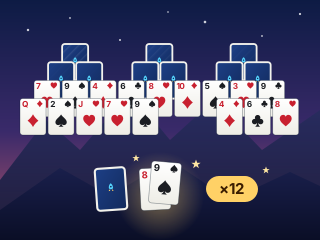
TriPeaks solitaire with 60 levels, star goals, streak combos, an endless mode and a daily deal. Free, no account.
PLAY →
Rocket Solitaire
Classic Klondike solitaire: draw one or draw three, standard scoring, undo and auto-finish. Free, no account.
PLAY →
Rocket Spider
Spider Solitaire with 1, 2 or 4 suits, winnable deals, a daily deal and leaderboard, hints and unlimited undo. Free, no download.
PLAY →