Canasta: Play the Classic Card Game Online Free
Meld, build canastas of seven and go out first. Classic partnership Canasta with a computer partner, or two-player Canasta head to head, against Easy, Normal or Hard computer players, with a daily deal.
What is Canasta?
Canasta is the classic rummy card game for partners, and here you can play it free in your browser on a phone, tablet or computer. Two packs and four jokers are shuffled together, and each side races to meld cards of the same rank, build canastas of seven cards and go out before the other side does.
Play the four-player partnership game with a computer partner against two computer opponents, or the two-player game head to head, with 15 cards each and two cards drawn every turn. The computer players come in three levels: Easy for learning, Normal for a steady game and Hard, which counts cards and thinks ahead.
Every rule of classic Canasta is here: wild twos and jokers, red threes, black threes that block the pile, the frozen discard pile, the first-meld minimum that rises with your score, "May I go out?" and the concealed bonus. A helper shows the melds you can make and explains any move that isn't allowed, so it is a friendly way to learn.
How to play Canasta
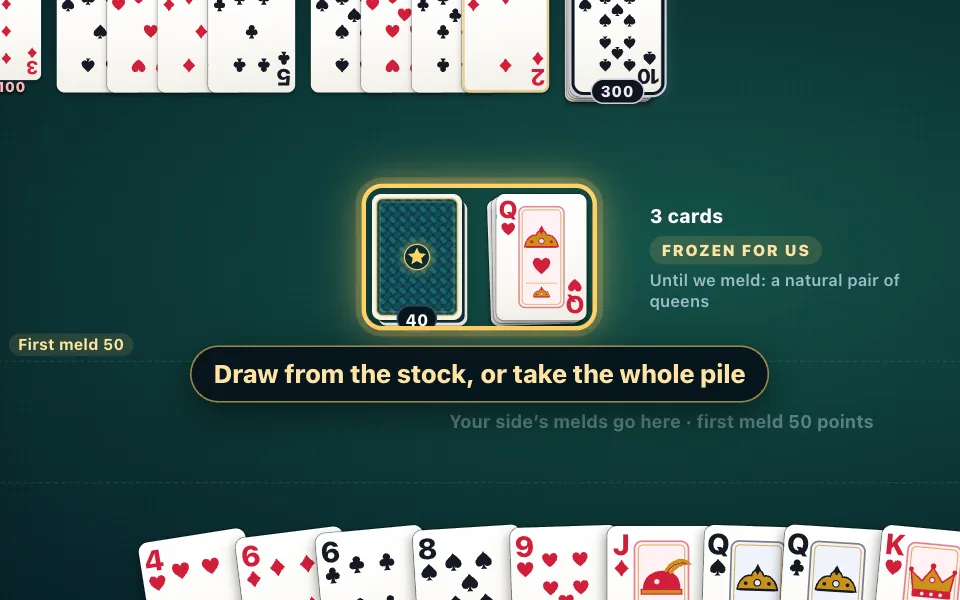
Draw or take the pile
Start each turn by drawing from the stock (two cards in the two-player game) or by taking the whole discard pile.
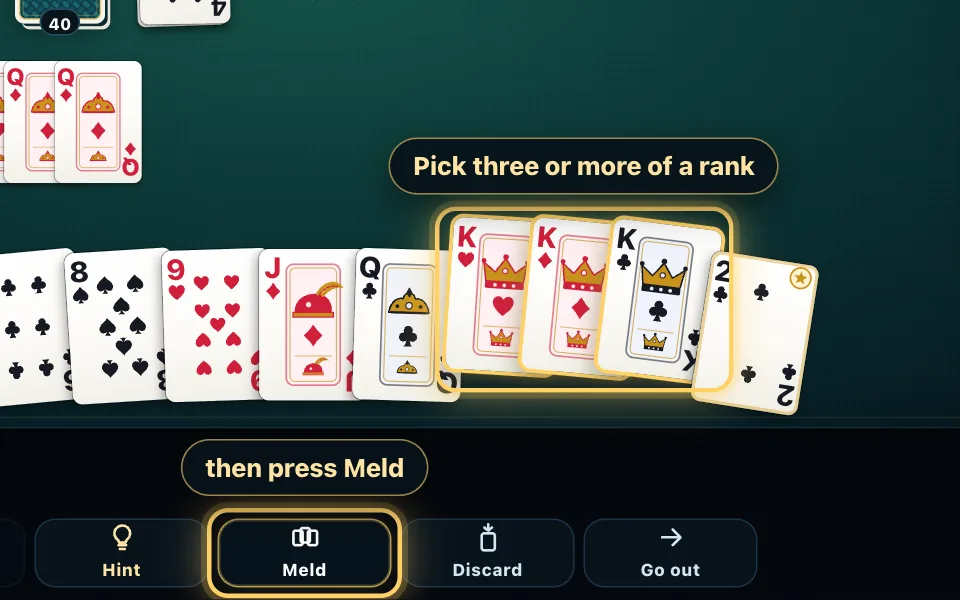
Meld cards of one rank
Pick three or more cards of the same rank and press Meld. Twos and jokers are wild, and you and your partner add to the same melds.
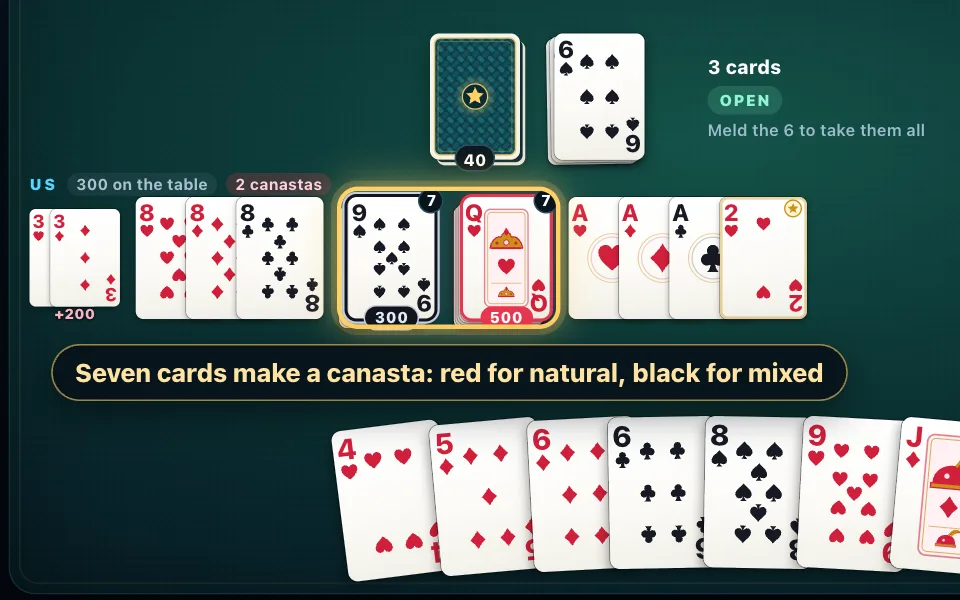
Build canastas of seven
Seven cards in a meld make a canasta: 500 points when every card is natural (edged in red), 300 with wild cards (edged in black).
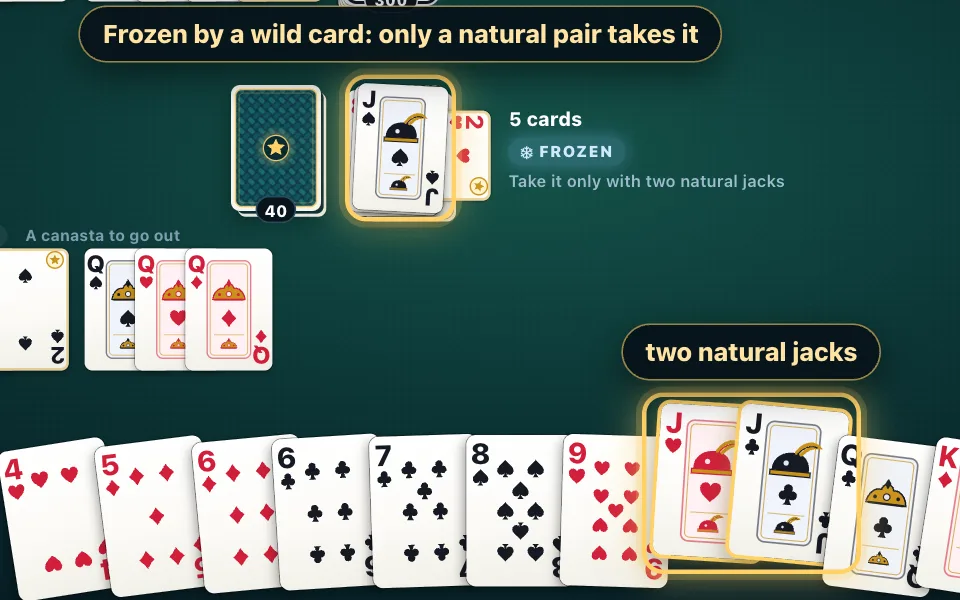
Take a frozen pile with a pair
A wild card in the pile freezes it, and then only a natural pair matching the top card takes it. Tap the pile and the helper picks the pair for you.
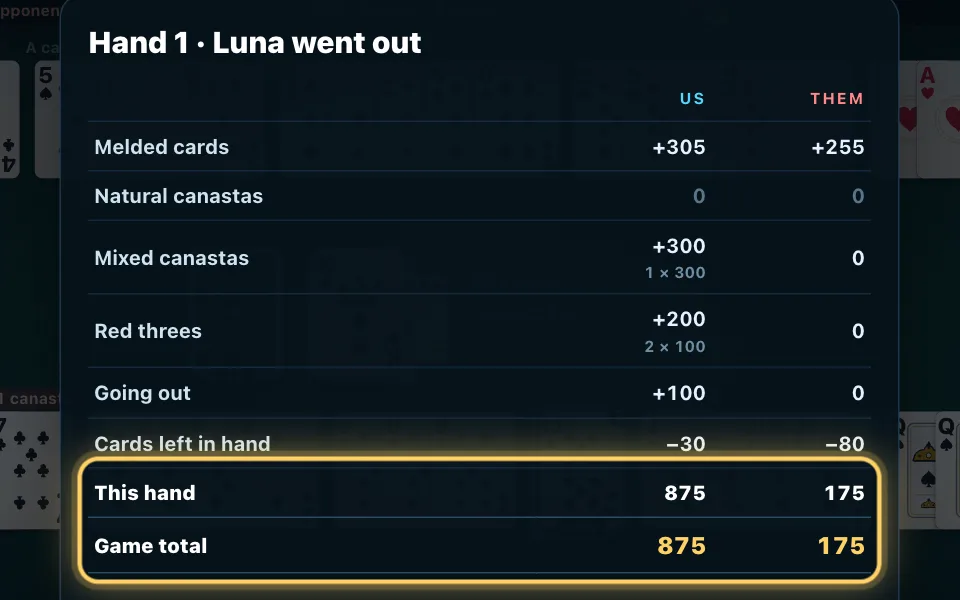
Go out and score the hand
With a canasta on your side, meld every card (you may discard one) to go out. Each hand is scored and the first side to 5000 wins.
The rules in full
- Each turn, draw from the stock (two cards in the two-player game) or take the whole discard pile, then meld if you can, and end your turn by discarding one card.
- A meld is three or more cards of the same rank. Twos and jokers are wild: a meld needs at least two natural cards and can hold at most three wild cards. Your side keeps one meld of each rank, which you and your partner both add to.
- Your side's first meld of each hand must be worth a minimum number of points: 50 at the start, then 90 once your score reaches 1500, 120 from 3000, and only 15 if your score is below zero. You can lay down several melds at once to reach it.
- To take the discard pile, meld its top card straight away: with a natural pair from your hand, a natural card and a wild card, or onto your side's meld of that rank. Then the rest of the pile goes into your hand.
- The pile is frozen for your side until you have made your first meld, and for everyone once a wild card or red three is in it. A frozen pile can only be taken with a natural pair of the top card. A black three or a wild card on top means nobody can take it that turn.
- Seven or more cards in one meld make a canasta: 500 points if every card is natural, 300 if it has wild cards. Red threes are laid out as soon as you get them and replaced from the stock, worth 100 each, or 800 for all four.
- Once your side has a canasta (two in the two-player game), you can go out by melding every card, discarding at most one. In the partnership game you may ask your partner "May I go out?" first, and the answer is binding.
- Going out scores 100, or 200 if you go out concealed, melding your whole hand in one turn. Melded cards count for you and cards left in hand count against you: jokers 50, aces and twos 20, kings down to eights 10, sevens down to fours and black threes 5. The first side to 5000 wins.
Canasta tips and strategy
- Make your first meld early. Until you do, the pile is frozen for your side and you can only take it with a natural pair.
- Keep natural pairs in your hand. They are the only way to take a frozen pile, and a big pile can win the hand.
- Save wild cards for completing canastas. A meld of five or six natural cards plus one or two wild cards becomes a canasta you can go out with.
- Natural canastas are worth 200 more than mixed ones, so don't add a wild card to a meld that could still become natural unless you need to go out.
- Watch the other side's melds. When the pile isn't frozen for them, discarding a rank they have melded hands them the whole pile.
- When the pile gets big and the next player could take it, freeze it by discarding a wild card, or block it for a turn with a black three.
- Count what is left. If most of a rank has been played or discarded, the next player is unlikely to hold a pair of it, which makes it a safer discard.
- Go out when you are ahead on the table. Ending the hand early catches the other side holding cards that count against them.
- In the partnership game, ask your partner before going out when they hold a lot of cards: a "no" gives them a turn to meld.
The history of Canasta
Canasta was devised in Montevideo, Uruguay, in 1939 by Segundo Santos and Alberto Serrato, and its name is the Spanish word for basket. It belongs to the rummy family, where players collect sets of matching cards, but it is played with two packs and jokers and rewards big melds of seven.
The game spread to Argentina and then to the United States, where it became one of the most popular card games in the country in the early 1950s. Variants such as Samba and Hand and Foot grew out of it later, but classic Canasta, with its red threes, black threes and frozen pile, is the game they all come from.
Canasta rules in this version
This is classic partnership Canasta: two packs and four jokers, eleven cards each for four players in two partnerships, red threes as bonus cards, black threes as stop cards and canastas of seven. The first-meld minimum follows your side's score (15, 50, 90 or 120), and the game runs to 5000 points.
A meld needs at least two natural cards and can hold no more than three wild cards, so a canasta always has natural cards in the majority. If you prefer the stricter house rule where every meld must have more natural cards than wild ones, switch it on in Settings. You can also play a shorter game to 2500 or a single hand.
Two-player Canasta and partnership Canasta
In the partnership game you sit opposite your computer partner, Luna, and share one set of melds. You can ask "May I go out?" before going out, and Luna will sometimes ask you, with a reminder of what your hand would cost if you said yes.
Two-player Canasta follows the standard changes: 15 cards each, you draw two cards from the stock and discard one, and you need two canastas to go out. Hands run longer and the piles grow bigger, so taking the pile at the right moment matters even more.
Play Canasta against the computer at three levels
Easy melds what it can and discards almost at random, which makes it a good partner and opponent while you learn. Normal plays sound Canasta: it makes its first meld early, takes useful piles and avoids discarding a card the next player could use to take the pile.
Hard counts every card it has seen, judges how likely the next player is to hold a pair before it discards, freezes a big pile when it has to, and plays each important choice out many times in its head before it decides. Hints come from the Hard player, with a short reason.
How to score in Canasta
At the end of each hand both sides add up their melded cards, their canasta bonuses (500 natural, 300 mixed), their red threes and 100 for going out (200 concealed), then subtract the cards left in their hands. Red threes count against a side that hasn't melded anything.
After every hand a score sheet shows each line for both sides, the cards that were left in every hand, and the running scoreboard. The first meld you need next hand is shown too, since it rises as your score passes 1500 and 3000.
Daily Canasta deal and playing on your phone
The daily deal is one partnership hand against Normal computer players, dealt the same for everyone that day. Score as many points as you can, keep your streak going and play past days from the calendar.
Your game is saved after every move, so you can close the page and pick it up later. Stats track your wins at each level, your best hand and game, canastas, going out and red threes.
The table is built for a phone held upright: your hand fans out and folds into rows when it gets big, and canastas square up into one card edged in red for natural or black for mixed. Tap cards to pick them, then press Meld, or tap the pile to discard. On a computer you can play with the mouse or entirely with the keyboard.
Canasta FAQ
Is this Canasta free to play?
Yes. Canasta is free in your browser with no download and no account. Your games, stats and daily streak are saved on your device.
How do you play Canasta?
Each turn you draw from the stock or take the discard pile, meld cards of the same rank, and discard one card. Melds of seven cards are canastas. When your side has a canasta you can go out by melding all your cards, and the first side to 5000 points wins.
What is a canasta?
A meld of seven or more cards of the same rank. A natural canasta has no wild cards and scores a 500-point bonus; a mixed canasta includes wild cards and scores 300. Here natural canastas are edged in red and mixed ones in black.
Can I play Canasta against the computer?
Yes. Every game is against computer players: a partner and two opponents in the four-player game, or one opponent in the two-player game, at Easy, Normal or Hard.
How many points do you need for the first meld in Canasta?
It depends on your side's score at the start of the hand: 15 if you are below zero, 50 from 0 to 1495, 90 from 1500 to 2995 and 120 from 3000. Red threes and canasta bonuses don't count toward it, but you can make several melds at once to reach it.
What does it mean when the discard pile is frozen?
A frozen pile can only be taken with a natural pair matching the top card. The pile is frozen for your side until you have melded, and for everyone once a wild card or a red three is in it. Discarding a wild card on purpose is a way to protect a big pile.
What do red threes and black threes do?
Red threes are bonus cards: lay them out at once and draw a replacement. They are worth 100 each, or 800 for all four, but count against your side if it hasn't melded. Black threes stop the next player taking the pile, and can only be melded, three or four together, when you go out.
How many wild cards can a meld have?
At most three, and every meld needs at least two natural cards. Twos and jokers are the wild cards. A house rule in Settings makes natural cards outnumber the wild cards in every meld.
What is going out concealed?
Going out in one turn by melding your whole hand, including a complete canasta, when you haven't melded anything earlier in the hand and don't add to your partner's melds. It scores 200 instead of 100, and you don't need to reach the first-meld minimum unless you took the pile.
How is two-player Canasta different?
Each player gets 15 cards, you draw two cards from the stock each turn and discard one, and you need two canastas instead of one to go out. Everything else, including the scoring and the first-meld minimums, is the same.
Can I ask my partner if I can go out?
Yes. In the partnership game you can ask "May I go out?" after you draw and before you meld. If your partner says yes you must go out that turn, and if they say no you can't. Asking is optional.
Is my game saved if I leave?
Yes. The game in progress is saved after every move, so you can close the page and carry on later from the same hand.
More games
Bidstar Spades
Bid your tricks, team up with your partner and make your contract. Classic partnership Spades with nil bids and bags, to 500, against the computer or friends.
PLAY →
Moonshot Hearts
Pass three cards, duck the queen of spades and maybe shoot the moon. Classic four-player Hearts against the computer, friends online or on one screen.
PLAY →
Dragonrun Tiến Lên
Shed your cards first in the Vietnamese climbing game. Beat each play with a higher one, chop the twos with bombs and race to go out, against the computer or friends.
PLAY →