Bridge Card Game Online: Play Free
Contract bridge with a computer partner you can trust: every bid explained in plain words, 25 short lessons, a Daily Deal, Chicago and rubber.
What is Bridge?
This is contract bridge, the modern form of the game, free in your browser. You sit South. A computer partner sits across from you as North, and two computer opponents sit East and West. Nothing to download and no account to make.
Every deal has two halves. First comes the auction, where the four players bid for the right to name trumps and promise a number of tricks. Then come thirteen tricks of card play, where the side that won the auction tries to keep its promise.
Bridge has a name for being hard to start. So this table explains itself. Tap any bid, yours or anyone else's, and read in plain words what it shows. Your partner bids by exactly those meanings, every time.
New to the game? Twenty-five short lessons take you from your first trick to your first slam. Know it already? Play single deals, the Daily Deal, a four-deal Chicago or a full rubber.
How to play Bridge
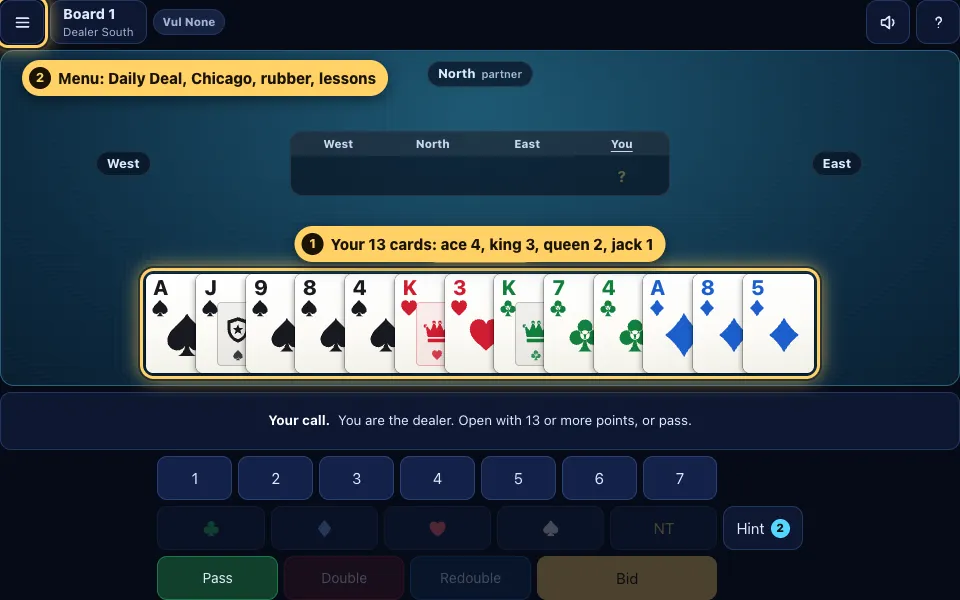
Start with the deal on the table
A deal is ready the moment the page opens; the menu holds the Daily Deal, Chicago, rubber and lessons. Count your thirteen cards: ace 4, king 3, queen 2, jack 1. With 13 or more you can open the bidding.
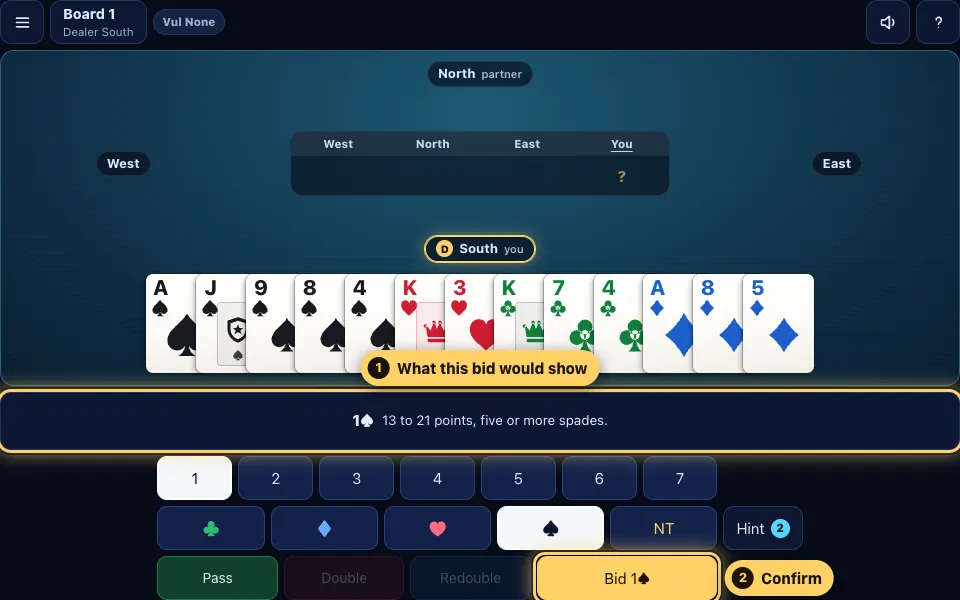
Pick a bid and read it
Choose a level, then a suit. Before you confirm, the table tells you in plain words what the bid shows.
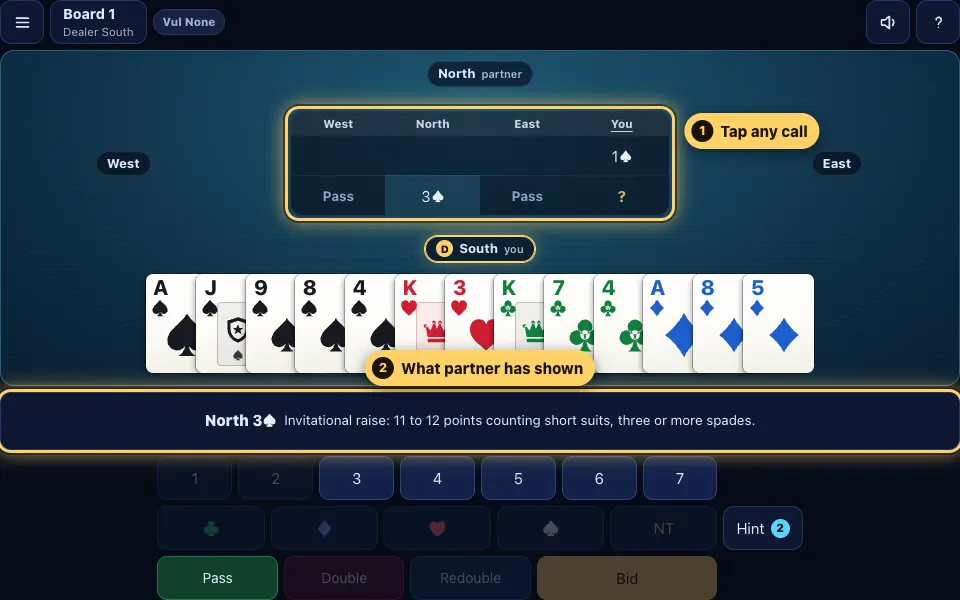
Follow the auction
Calls appear in four columns, one for each seat. Tap any of them to see what that player has promised.
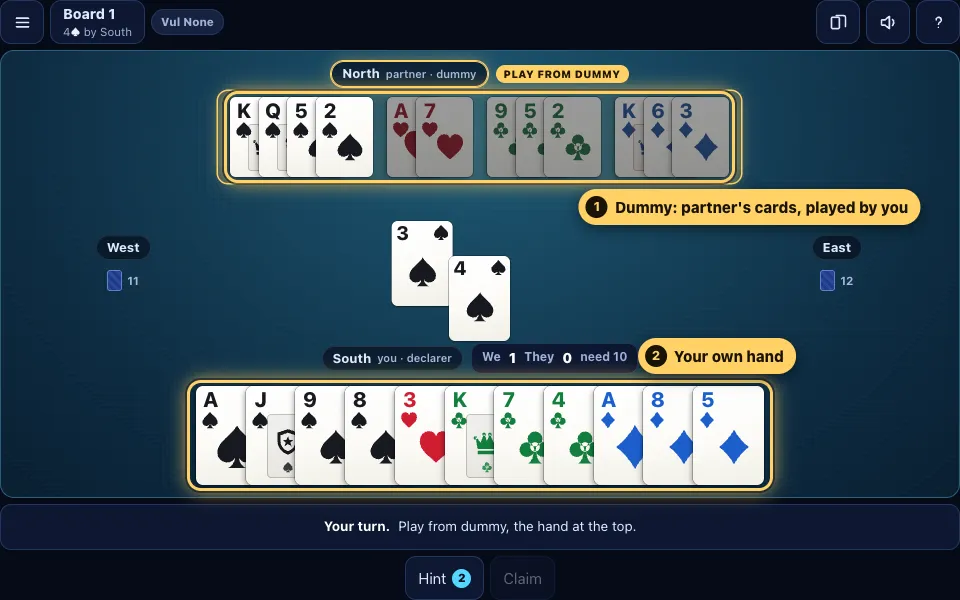
Play both hands
When your side wins the contract, North's cards are laid face up at the top of the table, sorted by suit, and you play them as well as your own.
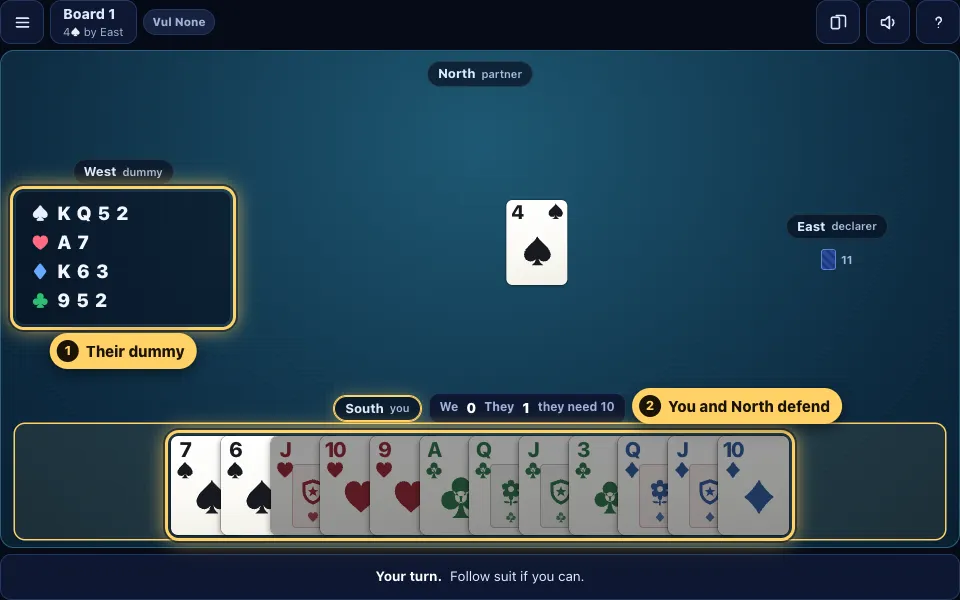
Defend together
When East or West declare, you see their dummy. Work with North to take enough tricks to beat the contract.
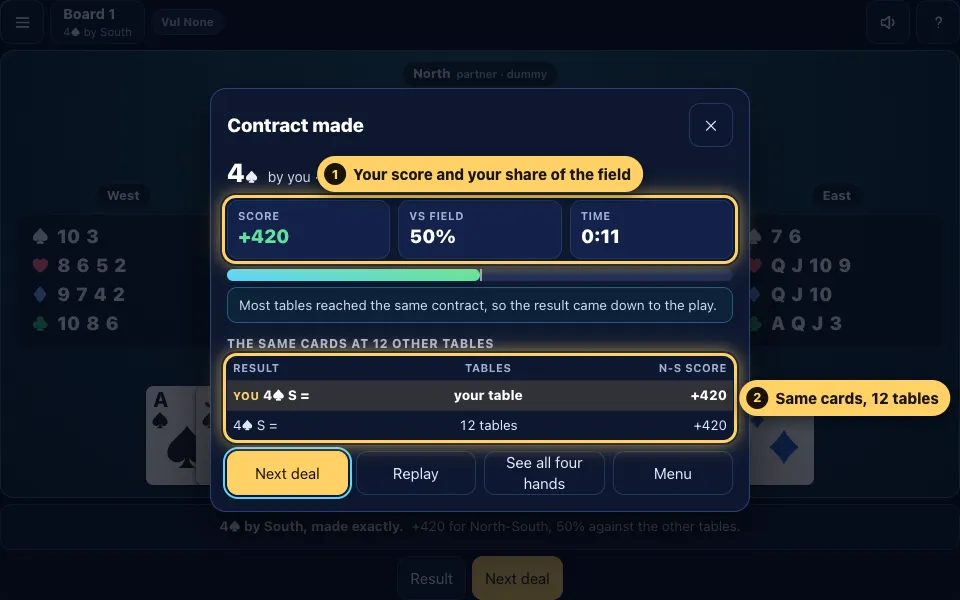
Read the result card
See the contract, your tricks and score, and how twelve other tables did with the very same cards.
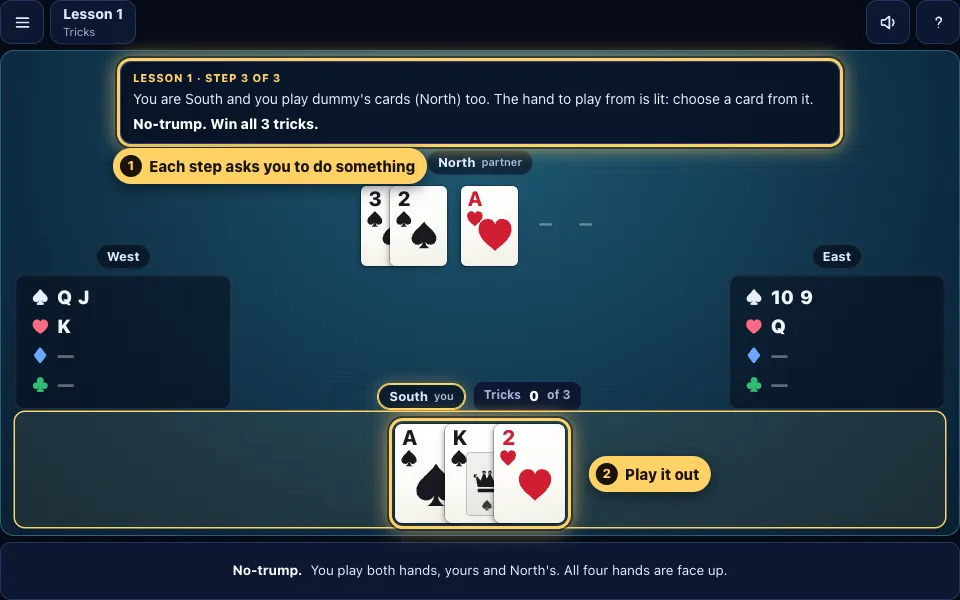
Take a short lesson
Twenty-five lessons teach the game step by step. Each asks you to answer, bid or play a few cards.
The rules in full
- Each player is dealt 13 cards. Yours are sorted by suit along the bottom of the table. Count your high cards: ace 4, king 3, queen 2, jack 1.
- The dealer calls first and the auction runs clockwise. On your turn pick a level from 1 to 7, then a suit or no-trump, read what the bid means, and confirm. Or pass, double or redouble.
- A bid promises six tricks plus its number. 3♠ says your side will win nine tricks with spades as trumps. Each bid must outrank the last: clubs, diamonds, hearts, spades, then no-trump.
- Three passes in a row end the auction. The last bid is the contract. The player on the winning side who first named that suit is the declarer.
- The player on declarer's left leads the first card. Then declarer's partner lays the whole hand face up on the table. That hand is the dummy.
- If you or North declare, you play both hands. The hand to play from is lit in gold, so you always know where the next card comes from.
- Follow the suit that was led if you can. If you cannot, play any card. The highest card of the suit led wins the trick, unless someone played a trump; then the highest trump wins.
- The winner of a trick leads to the next one. Tap the two-cards button at the top, or press L, to look again at the four cards just played.
- When every trick left is certainly yours, press Claim and the deal ends at once. If the claim is not safe the table tells you so and play goes on.
- After the thirteenth trick a result card shows the contract, the tricks, your score, and how twelve other tables scored with the same cards.
Bridge tips and strategy
- Open the bidding with about 13 points or more. With less, pass and listen. You can still come in later once you know what partner has.
- Look for eight trumps between the two hands. With an eight-card fit in hearts or spades and 25 points together, bid game at the four level.
- No fit in a major but 25 points and every suit guarded? Three no-trump needs only nine tricks, the cheapest game there is.
- As declarer, stop before you play to the first trick. Count your sure winners, see how many more you need, and decide where they will come from.
- Draw the opponents' trumps early unless you need dummy's small trumps to ruff your losers first.
- Lead towards your high cards, not away from them. A king wins far more often when the ace has to play before it.
- On defence, lead the top of a run of honours such as king from K Q J, or the fourth highest card of your longest suit against no-trump.
Which bridge is this?
Contract bridge, as it has been played since the late 1920s: four players, two partnerships, an auction and thirteen tricks. The rules of the auction and the play follow the standard laws of the game.
Three ways of keeping score are built in. Single deals and the Daily Deal use duplicate scoring, where each deal stands alone. Chicago is four deals with a set pattern of vulnerability. Rubber is the classic home game, first side to two games.
One house rule is offered as an option. In Chicago, some tables make the dealer's side vulnerable on deals two and three, and others the non-dealer's side. Pick whichever your own table plays.
A partner you can read
Bidding is a language, and partners need to speak the same one. North speaks one system and never drifts from it: five-card majors, a 1NT opening of 15 to 17 points, Stayman, Blackwood, a strong artificial 2♣, weak two bids, preempts, and takeout and negative doubles.
You do not have to remember any of that. Tap a bid in the box before you make it and the table says what it would show. Tap a bid already made, by partner or by an opponent, and it says what that player holds.
Those notes are not flavour text. They are the same rules the computer bids by, so what you read is what North has. Transfer bids are left out to keep the system small enough to learn.
Built for a 13-card hand on a phone
Thirteen cards is a lot for a small screen. Your hand fans evenly across the bottom, sorted by suit with the colours alternating, and closes up neatly as cards are played. Every card stays big enough to tap.
Dummy is laid face up at the top of the table, sorted by suit, so you can count a suit at a glance; on a small phone it lies in one row with every card's corner showing. The bidding box takes two taps and a confirm: a level, then a suit. It sits under the table, or beside it on a phone held sideways, and is on screen the moment the page opens.
On a computer the keyboard does it all. Press 1 to 7 and C, D, H, S or N for a bid, P to pass, X to double, and Enter to confirm. Arrow keys walk along your cards.
Three levels of computer play
Beginner is the place to start. The opponents follow simple, sound rules, and a coach is on call. Twice a deal you can ask it for a hint. It points at a bid or a card and tells you why, but the choice and the tap stay yours.
Club takes the coach away and sharpens the card play. Before each card the computer imagines many ways the hidden cards could lie, works out the best line on each, and plays the card that wins most often.
Expert looks deeper again. At every level the computer sees only what a player in that seat could see. It never peeks at your hand.
Scoring: part-score, game and slam
Tricks bid and made score 20 each in clubs or diamonds and 30 each in hearts or spades. In no-trump the first is worth 40 and the rest 30. Bid and make 100 points of tricks in one deal and you have a game.
A game earns a bonus of 300, or 500 when your side is vulnerable. Anything less is a part-score, worth a bonus of 50. A small slam, twelve tricks bid and made, adds 500 or 750. A grand slam, all thirteen, adds 1000 or 1500.
Fall short and the other side scores instead: 50 for each trick you are down, 100 when vulnerable, and a good deal more when the contract was doubled.
Chicago and rubber
Chicago is bridge in a coffee break. Four deals, the deal passing round the table once. Nobody is vulnerable on the first, one side on the second and third, and everybody on the last. A deal that is passed out is dealt again. Highest total wins.
Rubber is the long game. Trick points for contracts bid and made go below the line, and 100 below the line wins a game. Win one game and your side is vulnerable. Win two and the rubber is over.
Overtricks, penalties, slam bonuses and honours go above the line. Winning the rubber two games to none adds 700, two games to one adds 500. Then both columns are added up, and the bigger total takes it.
The Daily Deal and the field
Bridge is a fairer test than most card games because luck can be taken out. Every deal here is also played at twelve other tables by computer pairs holding the same cards. Your score is the share of those tables you beat, shown as a percentage.
So a poor hand is no excuse and no handicap. Go down one when every other table went down two, and you have a fine result.
The Daily Deal is the same deal for everyone, once a day. It is played at the Club level with no hints, and it counts once. Your first call starts it. Leave part-way and it waits for you: come back the same day and it carries on from the same position. Once it is finished, any replay is practice and is not sent to the leaderboard. Finish above half the field to win the day, and come back tomorrow to build a streak.
Learn bridge in 25 short lessons
The Learn path starts from nothing. Lesson one is a single trick. From there it climbs through trumps, counting points, the contract, opening bids, replies to partner, Stayman and Blackwood, then on to the finesse, drawing trumps, opening leads and defence.
Each lesson takes a minute or two and asks you to do something: answer a question, choose a bid for a hand, or play a few cards to win a set number of tricks. A wrong answer earns a nudge and another go.
Your progress is saved on your device, so you can do one lesson a day and pick up where you stopped.
Bridge FAQ
Is this bridge game free?
Yes. It is free to play in your browser on a phone, tablet or computer, on your own with a computer partner. There is nothing to download and you do not need an account.
I have never played. Where do I start?
Open the menu and choose Learn bridge. The first lessons cover tricks, trumps and counting points, each in a minute or two. Then play single deals on the Beginner level, where the coach explains the bids and gives two hints a deal.
What bidding system does my partner use?
A standard five-card major system: 1NT shows 15 to 17 points, 2♣ is strong and artificial, two-level openings in the other suits are weak, and Stayman and Blackwood are in use. Tap any bid to read what it shows.
How do hints work?
On the Beginner level you get two hints on each deal, in the bidding or the play. A hint marks a bid or a card and gives the reason. It never makes the move for you. Ask again on the same turn and the same advice comes back at no cost. The Club and Expert levels and the Daily Deal have no hints.
What is the Daily Deal?
One deal a day that is the same for every player. It is played at the Club level, without hints. Your score is the percentage of twelve computer tables you beat, and the day's ranking goes by score, then by time. You get one go a day: if you leave part-way it carries on where you left it, and after it is finished further goes are practice.
What does vulnerable mean?
A vulnerable side has more to win and more to lose. Its game and slam bonuses are bigger, and each trick it goes down costs 100 instead of 50. The plate at the top of the table shows who is vulnerable on this deal.
How is my result worked out?
Twelve computer pairs bid and play the same cards. You get one point for each table you beat and half for each you tie, turned into a percentage. Above 50% is a win for the deal, below it is a loss.
Is my game saved if I close the page?
Yes. A deal in progress, a Chicago or a rubber is saved on your device and picks up at the same card when you come back. Lesson progress and your statistics are kept the same way.
Can I play with friends online?
Not yet. This table is for one player with computer partners and opponents. For a card game with friends, try one of the online tables in the related games below.
More games
Bidstar Spades
Bid your tricks, team up with your partner and make your contract. Classic partnership Spades with nil bids and bags, to 500, against the computer or friends.
PLAY →
Moonshot Hearts
Pass three cards, duck the queen of spades and maybe shoot the moon. Classic four-player Hearts against the computer, friends online or on one screen.
PLAY →
Euchre
Order up, call trump and go alone: the classic four-player trick-taking game with you and a computer partner against two computer players. Three levels, a Daily Deal, house rules you can switch on and full stats.
PLAY →
Pinochle
Four-handed partnership pinochle with a 48-card deck. Bid for trump, lay down your meld and win the counters with a computer partner, or take a seat at an online table.
PLAY →
Canasta
Meld, build canastas of seven and go out first. Classic partnership Canasta with a computer partner, or two-player Canasta head to head, against Easy, Normal or Hard computer players, with a daily deal.
PLAY →