Blackjack. Get closer to 21 than the dealer without going over. Blackjack pays 3 to 2 and the dealer stands on all 17s. Use the buttons under the table or the keys H, S, D, P and R.
Blackjack Online: Free 21 Card Game
Beat the dealer to 21 at a six-deck table where blackjack pays 3 to 2, with a free trainer that checks every move you make.
What is Blackjack?
Blackjack is the card game of 21. You and the dealer each start with two cards, and you win by finishing closer to 21 than the dealer without going over. This table deals six decks, pays 3 to 2 for a blackjack and has the dealer stand on every 17.
There are two ways to play. The strategy trainer is free and needs no account: you get 1,000 practice chips, and every move is checked against basic strategy the moment you make it. A chart beside the table lights up your hand, and you can hide it to test yourself.
The coin tables are played with the site's coins. Buy in for 5, 10, 25 or 50 coins, play up to three circles a round and cash out when you like: every 10 chips is a coin back. Coins are free. You earn them by playing games on the site, and they cannot be bought.
Every card at a coin table is dealt by the server, so nothing in your browser can change the shoe. Play with taps, clicks or keys, on a phone or a desktop, with no download.
How to play Blackjack
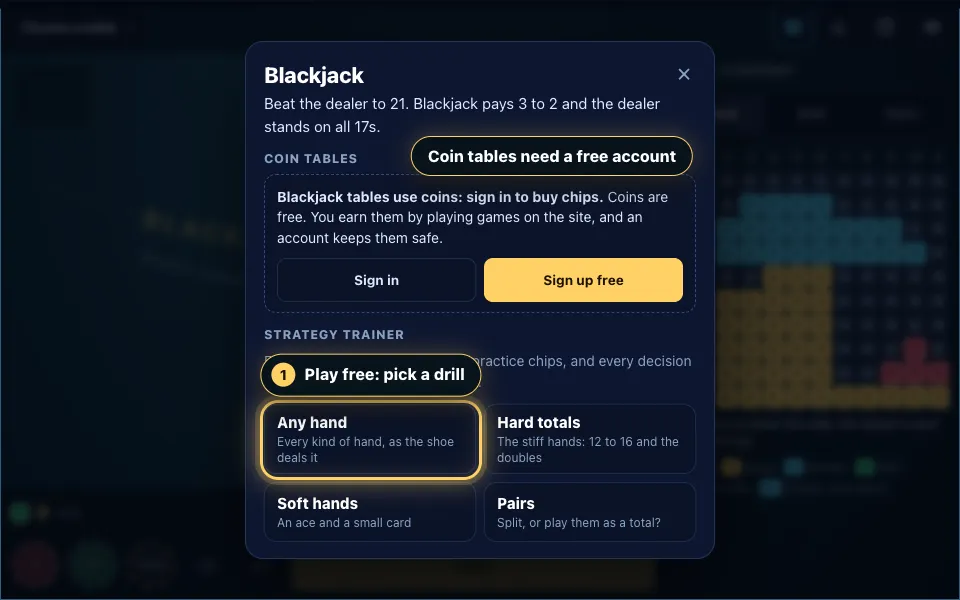
Pick a table
Blackjack opens on the table list. Choose a strategy trainer drill to play free straight away, or sign in and buy chips at a coin table.
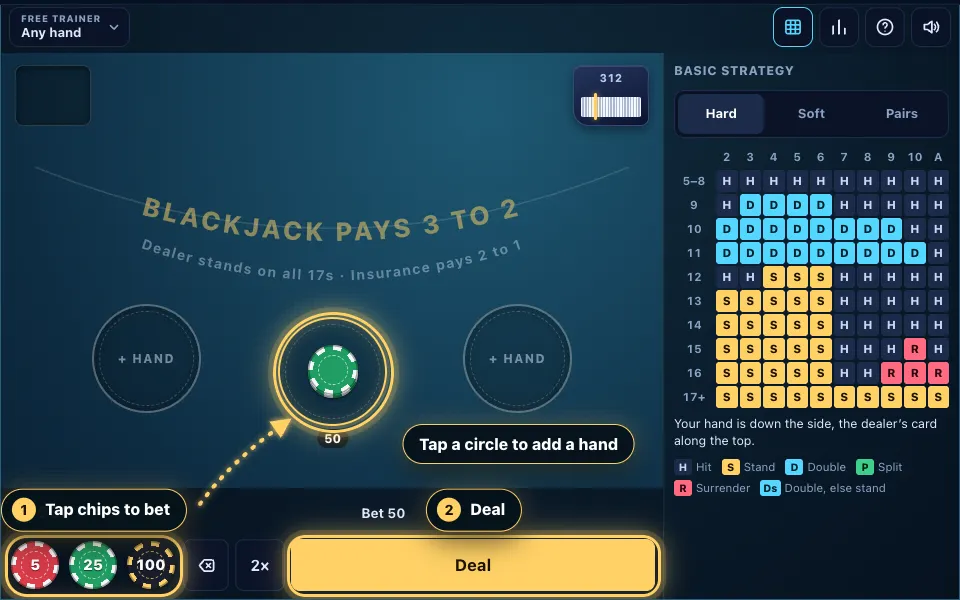
Place a bet and deal
Tap a chip to add it to the lit circle, tap another circle to play up to three hands, then press Deal. A trainer drill deals its first hand at once for 25 chips, and Change bet brings the chips back after any round.
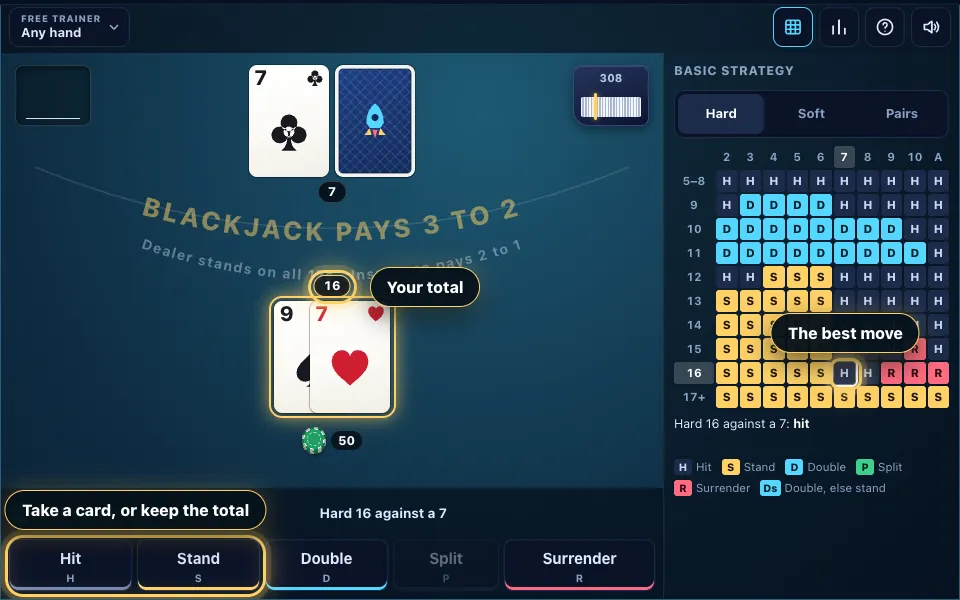
Hit or stand
Your total shows in a badge by your cards. Hit takes a card and Stand keeps the total. The chart lights the best move for your hand against the dealer's card.
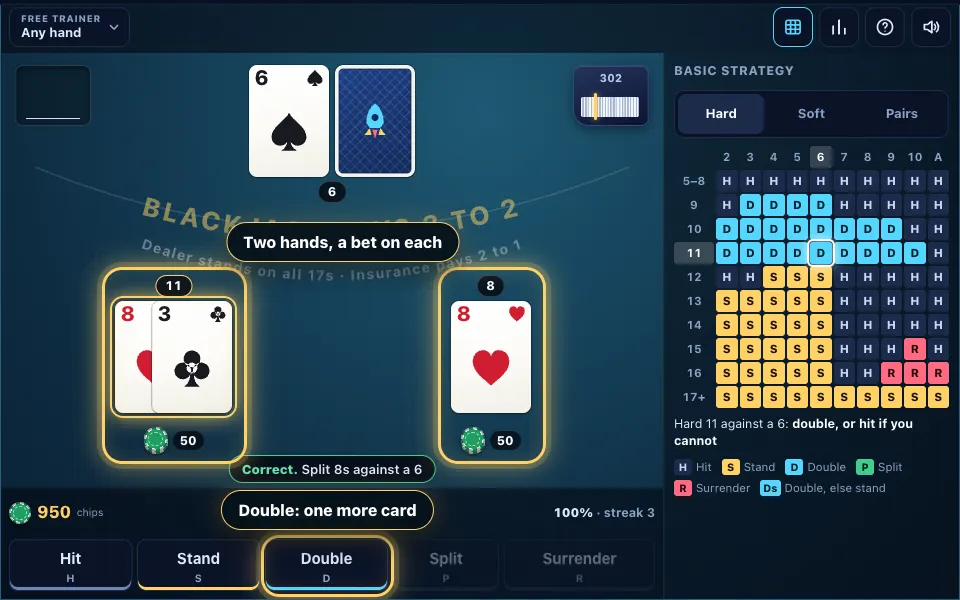
Double and split
Double puts up a second bet for exactly one more card. Split turns a pair into two hands side by side, each with its own bet.
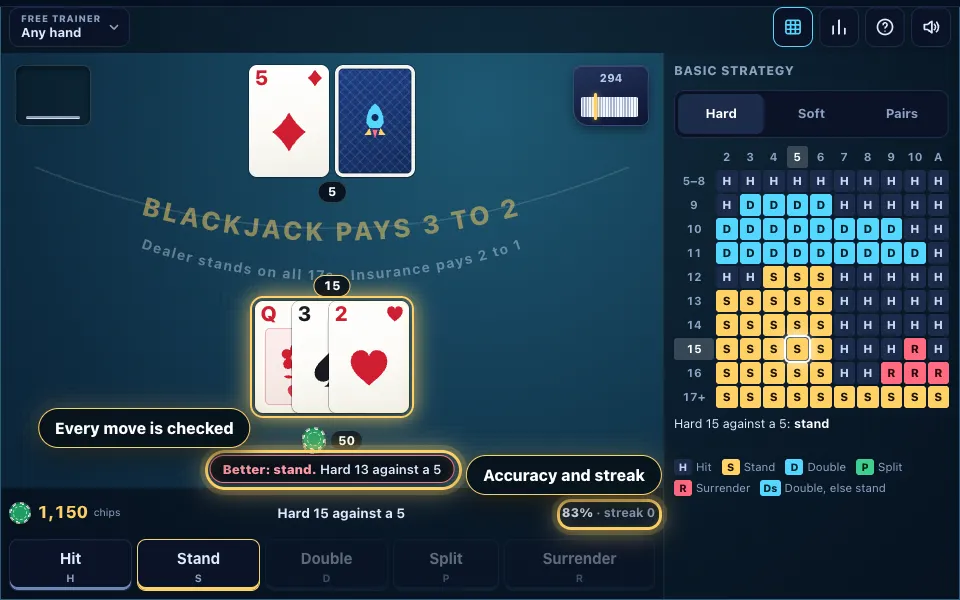
Learn from the feedback
In the trainer every move is checked. A badge says Correct or names the better move, and your accuracy and streak show under the table.
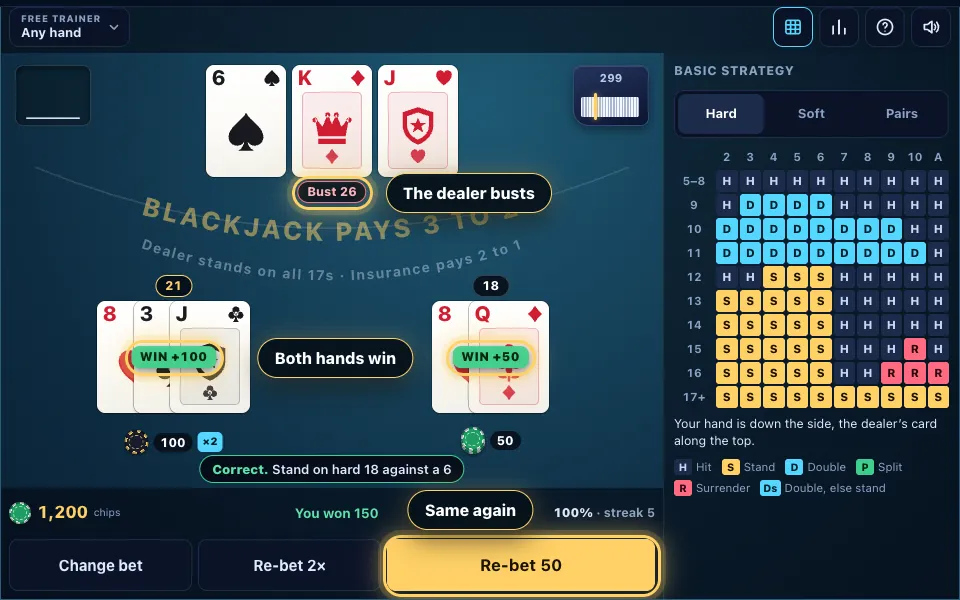
See how the round ends
The dealer turns the hole card, draws to 16 and stands on 17. A ribbon on each hand shows the result, and Re-bet deals the same bets again.
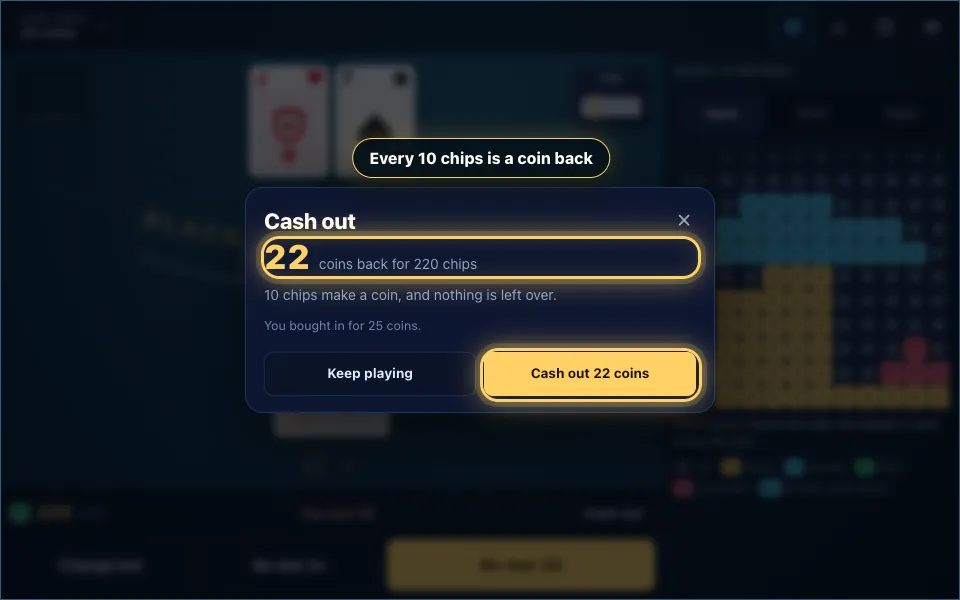
Cash out your chips
At a coin table 1 coin buys 10 chips. Press Cash out between hands, and every 10 chips goes back to your balance as a coin.
The rules in full
- Put chips on a circle and press Deal. Bets go in steps of 5 chips, and you can play one, two or three circles in the same round.
- You get two cards face up. The dealer gets one face up and one face down. Cards 2 to 10 count their number, jacks, queens and kings count 10, and an ace counts 11 or 1, whichever is better for the hand.
- An ace and a ten-value card on the deal is a blackjack. It pays 3 to 2, so a 10-chip bet wins 15, unless the dealer has a blackjack too, which is a push.
- Hit to take another card, as often as you like. If your total goes over 21 you bust and lose the bet at once. Stand to keep your total and end the hand.
- Double doubles your bet for exactly one more card, and then the hand stands. You can double on any first two cards, and after a split except on split aces.
- Split two cards of the same value into two hands, each with a bet equal to your first, up to three hands on a circle. Split aces get one card each and cannot be split again, and 21 on a split hand is not a blackjack.
- Surrender gives up the hand for half your bet back. It is offered on your first two cards only, once the dealer has checked for blackjack, and never after a split.
- When the dealer shows an ace you are offered insurance: a side bet of half your stake that pays 2 to 1 if the hole card is a ten. The dealer peeks under an ace or a ten, and a dealer blackjack ends the round before you play.
- When every hand has played, the dealer turns the hole card, draws to 16 and stands on every 17, soft 17 included. A higher total than the dealer's, or a dealer bust, pays even money. Equal totals push and the bet comes back.
- The shoe holds six decks, 312 cards. When the yellow cut card comes out, 78 cards from the end, the round is finished and the shoe is shuffled.
- There is no last round. A session ends when you finish it in the trainer or cash out at a coin table, and your score is the chips you won or lost.
Blackjack tips and strategy
- Always split aces and eights. Two aces are two chances at 21, and a pair of eights is 16, the worst total in the game.
- Never split tens or fives. Twenty is already a winning hand, and two fives play far better as a 10 that you double against a 2 to 9.
- Stand on hard 13 to 16 when the dealer shows 2 to 6, and on 12 against a 4, 5 or 6: the dealer has to draw and busts often. Hit those hands when the dealer shows 7 or more, even though it feels wrong.
- Double 11 against anything but an ace, 10 against 2 to 9 and 9 against 3 to 6. These are the hands where a second bet earns the most.
- Never stand on soft 17 or less: one card cannot bust it. Stand on soft 18 against a 2, 7 or 8, double it against 3 to 6, and hit it against a 9, 10 or ace.
- Skip insurance. Fewer than a third of the cards are tens, so a bet that pays 2 to 1 on a ten loses over time, even when you hold a blackjack.
- Surrender hard 16 against a 9, 10 or ace, and hard 15 against a 10. Half a bet back beats playing those hands out.
- Keep your bets small beside your stack. With 50 chips, a 5-chip bet leaves room to double and split when the chart says so. A 25-chip bet often does not.
How to play blackjack online
Open the game and pick a table. A trainer drill deals its first hand at once from 1,000 practice chips, and a coin table asks you to sign in and buy chips. To set a bet, tap a chip to add it to the lit circle, tap another circle to bet there too, and press Deal.
Each hand shows its total in a badge, so you never have to add up. The buttons under the table offer only the moves the rules allow: Hit, Stand, Double, Split and Surrender. When the round is over, Re-bet deals the same bets again and Change bet lets you move chips first.
On a keyboard, H hits, S stands, D doubles, P splits and R surrenders. Space deals, Y and N answer the insurance offer, and C opens the chart.
Blackjack rules at this table
House rules decide how fair a blackjack game is, and these are the friendly ones: six decks, blackjack pays 3 to 2, the dealer stands on soft 17, you can double on any two cards and after a split, and late surrender is allowed.
The payout for a blackjack matters most. Some tables pay only 6 to 5, which adds about 1.4 points to the house edge on its own. This table pays the full 3 to 2 at every buy-in. Bets are counted in half chips, so a 5-chip blackjack pays exactly 7.5.
We measured the edge instead of quoting it. A simulation of 400 million rounds played with perfect basic strategy came out at 0.37% of the first bet: a little over a third of a chip for every 100 chips bet.
Blackjack basic strategy chart
Basic strategy is the best move for every hand you can hold against every card the dealer can show. It does not make you the favourite, but at this table it cuts the house edge to under half a percent.
The chart is built for these exact rules. It has three parts: hard totals, soft hands that count an ace as 11, and pairs. Find your hand down the side and the dealer's card along the top, and the cell says hit, stand, double, split or surrender.
While you play, the cell for your hand lights up. On a desktop the chart sits beside the table, and on a phone it opens as a sheet. Press C or the grid button to hide it when you want to play from memory.
The free blackjack strategy trainer
The trainer grades every decision. Make the right move and a badge says Correct. Make another and it names the better move, and the hand carries on either way. Nothing is at stake but practice chips.
Four drills choose what you are dealt. Any hand plays the shoe as it comes. Hard totals deals the stiff hands from 12 to 16 and the doubles, Soft hands deals an ace with a small card, and Pairs asks the split question again and again.
The stats sheet shows your accuracy, your best streak, your score for each kind of hand and the hands you miss most, with the right answer beside each one. Drill those few hands until the answer is automatic.
Coin tables: buy in, play and cash out
Coin tables use the site's coins, the free play money you earn by playing games here. One coin buys 10 chips. There are four tables: 5 coins for 50 chips with bets from 5 to 25, 10 coins for 100 chips with bets up to 50, and 25 or 50 coins for 250 or 500 chips with bets up to 100.
Cash out between hands whenever you like. Every 10 chips becomes a coin, and chips short of a full ten are not paid, so the cash out sheet tells you what would be left over and lets you keep playing to round up.
The server deals every card and keeps every chip count, so a refresh or a dropped connection cannot lose a hand. A table left idle for 30 minutes is cashed out for you. The leaderboard ranks the biggest profit from one sitting.
Blackjack mistakes that cost the most
Most chips are lost to a few habits. Never hitting a hand that could bust feels safe and costs about 3.9% of every bet. Copying the dealer, by hitting to 16 and standing on 17 with no doubles or splits, costs about 5.5%, because you play first and lose when you bust even if the dealer busts too.
Insurance is the other leak: with six decks it loses about 7% of what you put on it.
The cure is dull and it works: follow the chart on every hand, including the ones that feel wrong, such as hitting 16 against a 10 or 12 against a 3.
The history of blackjack and 21
The game is at least four centuries old. The earliest known description is in a Spanish story by Cervantes, written around 1601, in which two card sharps in Seville cheat at veintiuno, or twenty-one: the aim is 21 and an ace counts 1 or 11.
As vingt-un it had printed English rules by 1800 and reached the United States early in that century. The name blackjack appears around 1899. The popular tale of a bonus for the ace of spades with a black jack has no evidence behind it.
The modern game dates from 1956, when four US Army mathematicians published the first sound basic strategy, worked out on desk calculators.
Blackjack FAQ
Is this blackjack free?
Yes. The strategy trainer is free with no account and no download. The coin tables use the site's coins, which are free too: you earn them by playing games here, and they cannot be bought.
Can I win real money?
No. Chips and coins are free play money for fun and for the leaderboard. They cannot be bought, and there is no real-money play here.
What does a blackjack pay?
3 to 2 at every table, so a 10-chip bet wins 15. Other wins pay even money, insurance pays 2 to 1 and a surrender returns half the bet.
Does the dealer hit on soft 17?
No. The dealer draws to 16 and stands on every 17, an ace with a six included. That is the better rule for the player.
Should I take insurance?
No. Insurance loses about 7% of the amount bet on it over time, whatever you hold. The trainer marks taking it as a mistake.
What is the house edge at this table?
About 0.4% with perfect basic strategy: our simulation of 400 million rounds measured 0.37%.
How do the coin tables work?
Sign in, pick a table and buy in for 5, 10, 25 or 50 coins at 10 chips a coin. Cash out between hands, and every 10 chips is one coin back.
What happens if I close the page in the middle of a hand?
Nothing is lost. The server holds the table, so the hand is waiting when you come back. After 30 idle minutes the hand is finished with every hand standing, and the table is cashed out to your balance.
Is the deal fair?
Yes. Coin tables are dealt by the server from a shuffled six-deck shoe, and your browser is sent only the cards a player at the table could see. The dealer's hole card stays on the server until it is turned.
Can I play blackjack on my phone?
Yes. The table fits a phone held upright or sideways, with large buttons under the cards and the chart one tap away.
More games
Gin Rummy
The classic two-player card game of melds and deadwood. Draw, discard, knock or go gin against an Easy, Medium or Hard computer, with Oklahoma rules, a daily deal and full match scoring.
PLAY →
War Card Game
The classic card game of War. Flip a card, the higher one takes both, and a tie means war. Play the computer, a friend on the same screen, or a table of four, with auto-play and four speeds.
PLAY →
Rummy
The classic draw-and-discard card game for 2 to 4 players. Meld sets and runs on the table, lay off on anyone's melds and be first to go out, against computer players, on one device or at an online table.
PLAY →
Rocket Solitaire
Classic Klondike solitaire: draw one or draw three, standard scoring, undo and auto-finish. Free, no account.
PLAY →
Cribbage
The classic six-card game to 121 on an animated pegboard: play the computer, a friend on one screen or an online table.
PLAY →