Bingo Online: Free 75-Ball and 90-Ball Games
Eyes down for 75-ball, 90-ball and speed bingo in a lively hall, with a 64-hall Tour, 41 patterns, power-ups, a Stamp Book and a Daily Card that is the same for everyone.
What is Bingo?
Bingo is the game of numbered balls, cards and one loud shout, free to play online here on your phone, tablet or computer. A caller draws a ball every few seconds. If its number is on your card you daub it, and the first player to cover the winning pattern shouts Bingo and takes the prize.
This hall plays three kinds of game. 75-ball bingo uses a five-by-five card with a free centre and 41 patterns to cover, from any line to a full blackout. 90-ball bingo is the three-row ticket game with three prizes: one line, two lines and the full house. Speed bingo squeezes a whole game into nine numbers and thirty balls.
You play against a room of computer players whose progress you can see, with one to four cards, four calling speeds and a caller who reads out the traditional rhyming calls. Quick daubs score more and fill a meter that hands out power-ups: a free daub, double points or a peek at the next two balls.
Around the games there is a Tour of 64 halls in eight venues, a Stamp Book of 45 stamps, a Daily Card that is the same for everyone that day, and a Caller mode that calls the numbers for your own paper cards. No download, no account and no real money: just eyes down.
How to play Bingo
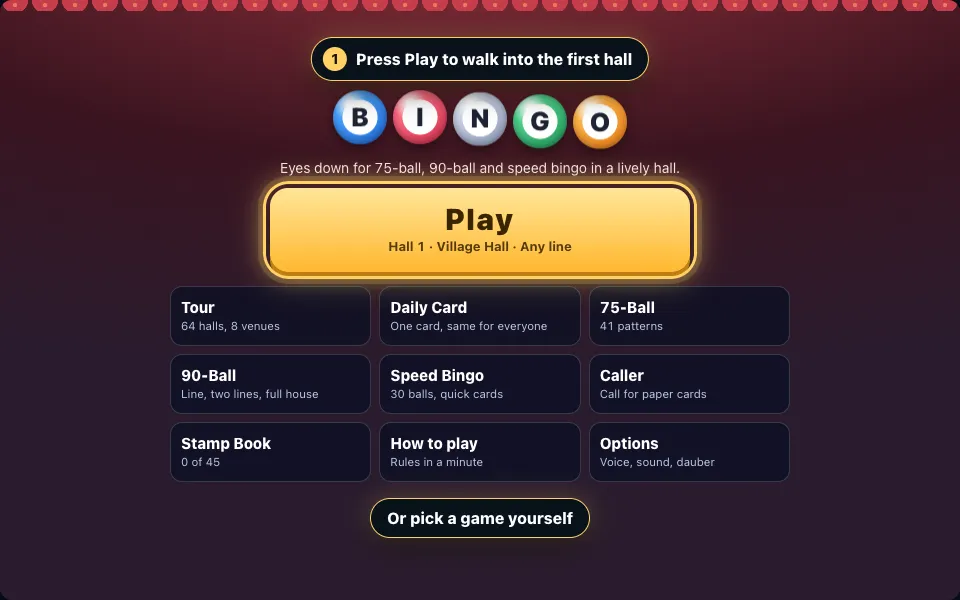
Press Play
The big Play button takes you straight into the next hall of the Tour. The tiles underneath open the Daily Card, 75-ball, 90-ball and Speed Bingo with your own choice of cards, speed and room.
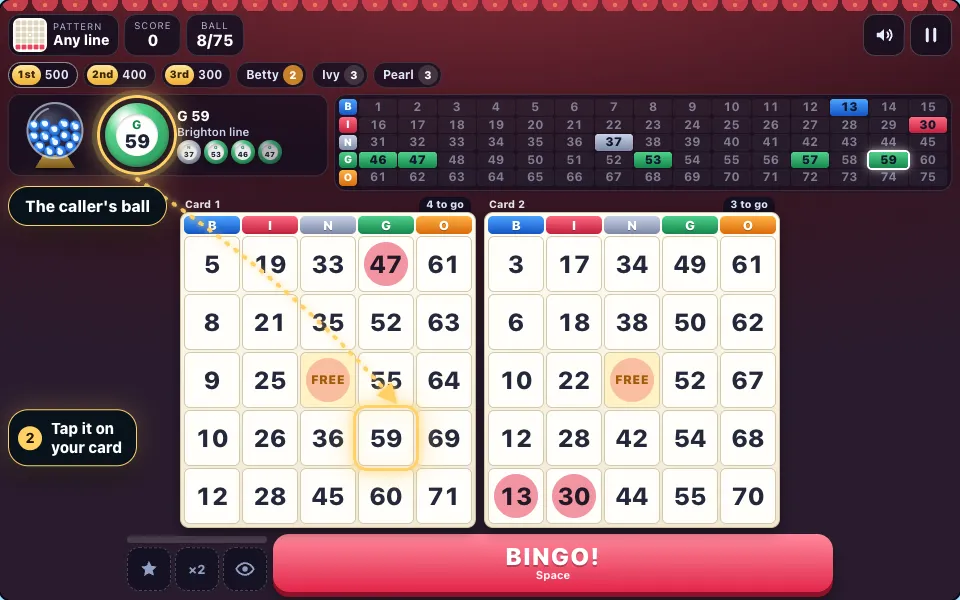
Daub the number that is called
Each new ball rolls out of the machine and is read aloud. Find its number on your cards and tap it. Daub within a couple of seconds for the most points.
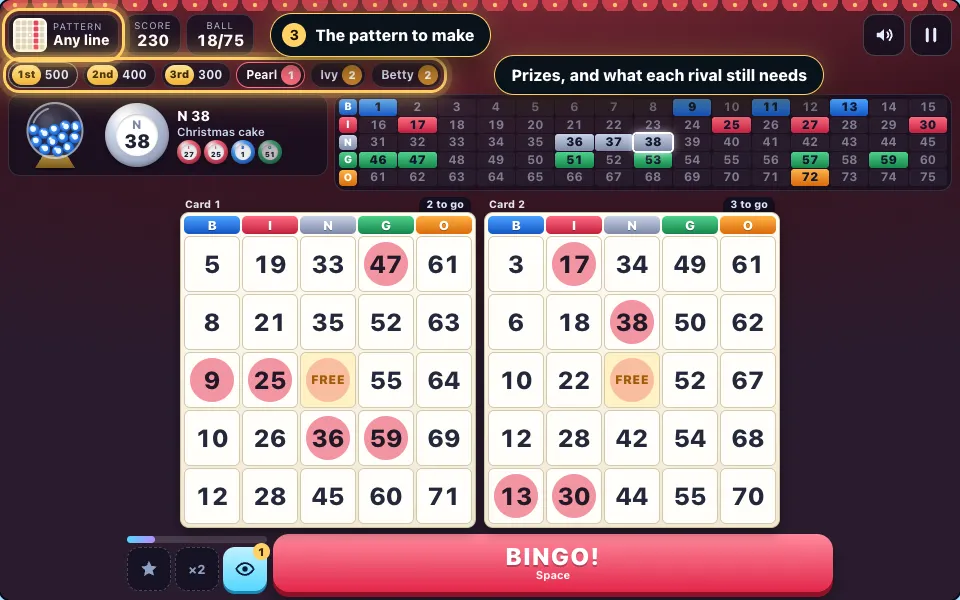
Know the pattern, watch the room
The chip at the top left shows the pattern you are playing for; tap it for every way to win. The strip below shows the prizes and how many numbers each rival still needs.
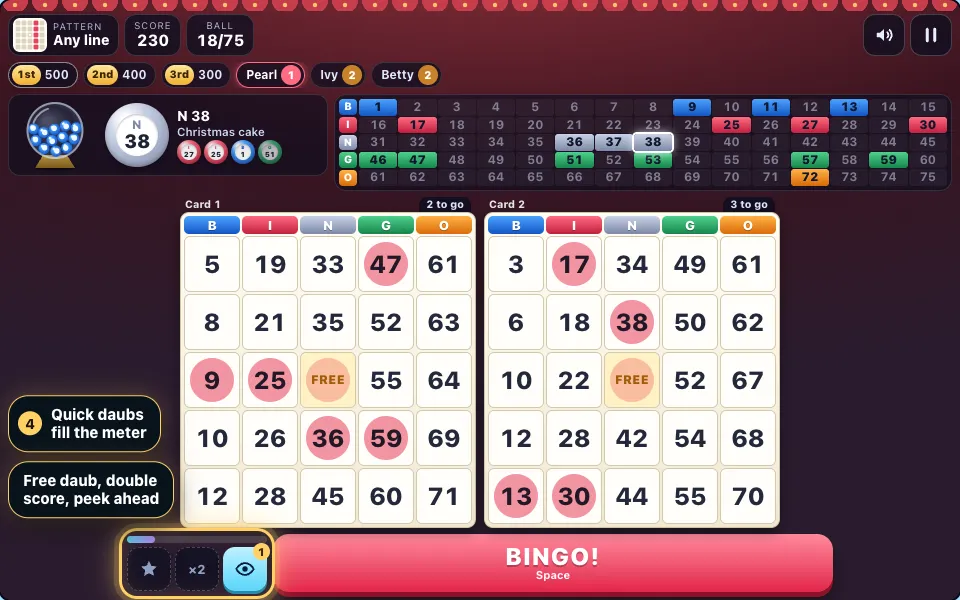
Spend your power-ups
Quick daubs fill the meter above the three power-up buttons. The star daubs a number you need, ×2 doubles your points for five balls, and the eye shows the next two balls.
Shout Bingo
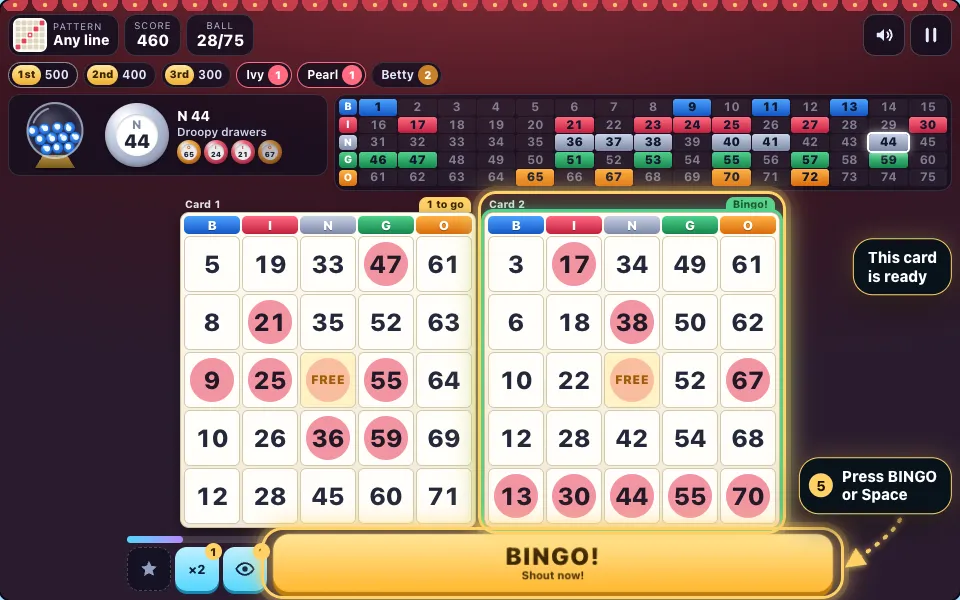
When a card needs nothing more, its label turns to Bingo and the big button glows. Press it, or hit the space bar, before a rival does. The faster the shout, the bigger the bonus.
Play 90-ball for three prizes
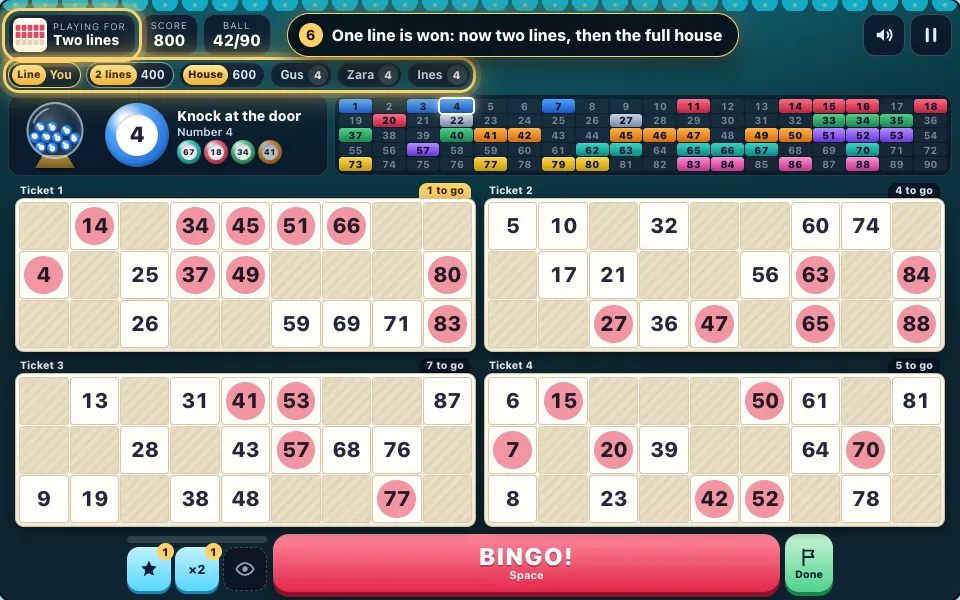
A 90-ball game does not stop at the first shout. Win the line, then go for two lines, then the full house. The prize you are playing for is always shown at the top.
Climb the Tour
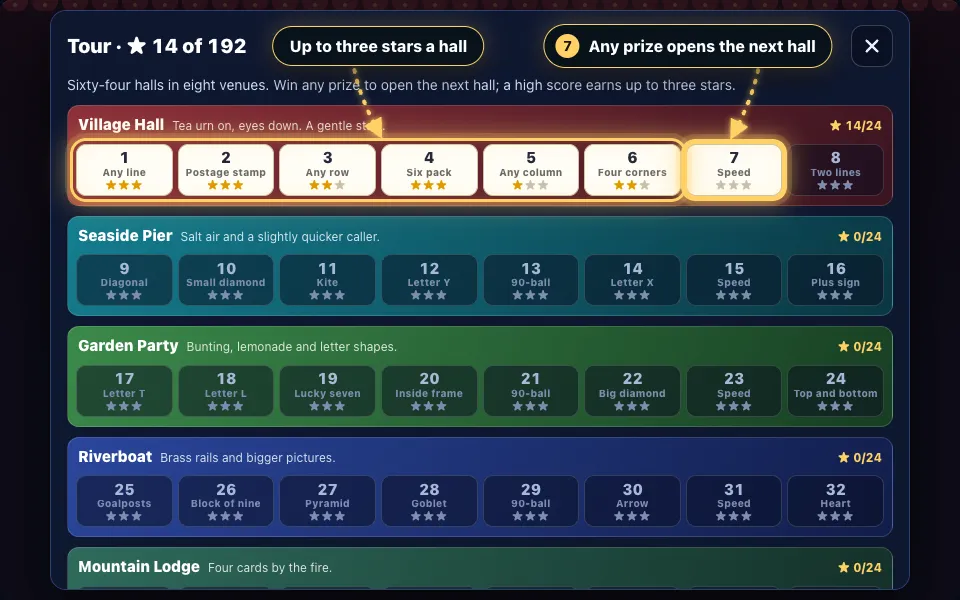
Any prize opens the next hall, and a high score earns up to three stars. Eight venues with eight halls each take you from the Village Hall to the Grand Palace.
The rules in full
- Press Play to walk into the next hall of the Tour, or pick 75-Ball, 90-Ball or Speed Bingo and choose your cards (one to four), the calling speed and the size of the room.
- The caller draws one ball at a time. Its number shows on the big ball beside the machine, is read aloud, and lights up on the board of called numbers.
- If the number is on one of your cards, tap or click it to daub it. Only called numbers can be daubed, and a number you miss stays good for the rest of the game.
- In 75-ball bingo the numbers 1 to 75 sit under the letters B, I, N, G and O, and the centre square is free. Cover the pattern shown at the top left: a line, four corners, a letter, a shape or the whole card.
- In 90-ball bingo each ticket has three rows of five numbers from 1 to 90. One game pays three prizes in order: the first full row, then two full rows on one ticket, then the full house of all fifteen numbers.
- In Speed Bingo each card has nine numbers from 1 to 30 and only thirty balls are in the machine. Cover all nine to win.
- When a card completes the pattern, press BINGO! (or the space bar) before the room does. 75-ball and Speed Bingo pay 500, 400 and 300 points for first, second and third; 90-ball pays 300 for the line, 400 for two lines and 600 for the house.
- The shout is checked against the balls called, so a number you forgot to daub still counts. A shout with no winning card costs nothing but locks the button for a few seconds.
- Each daub scores 10 to 30 points, more the sooner it follows the call. Every fifth quick daub in a row adds a 50-point streak bonus, and a fast shout adds up to 100 to the prize.
- Every daub fills the power meter, and quick daubs fill it twice as fast. A full meter gives you a free daub, a double-score spell of five balls or a peek at the next two balls.
- The game ends when the last prize has gone or the balls run out. Once you hold a prize you can press Done to finish there, or play on for another with your other cards.
Bingo tips and strategy
- Daub fast. A number marked at once scores the full 30 and one marked three seconds late scores 10. Anything inside two seconds counts as quick and keeps your streak alive.
- Start with two cards. More cards mean more chances, but every extra card is more to scan, and a missed number breaks a streak. Add the third and fourth once two feel easy.
- Read the ball's letter first in 75-ball. B is always the left-hand column and O the right-hand one, so you only ever need to scan five squares on each card.
- Save a free daub for a card that is one away. It marks a number you still need, so used at the right moment it wins the game outright.
- Turn on Double just before you expect to shout. It doubles the prize as well as the daubs for the next five balls.
- Keep an eye on the rival chips. When one shows a single number to go, a slow shout from you will be too late, so have your thumb over the button.
- Never shout on a hunch. A false call locks the Bingo button for five seconds, and longer each time, which is exactly when someone else gets there first.
- On a phone with three or four 75-ball cards, watch the tabs under the card: a badge shows how many called numbers are waiting on each card you cannot see.
How to play bingo: the rules in brief
Every player has one or more cards printed with numbers. A caller draws numbered balls at random, one at a time, and players daub any called number that appears on their cards.
Each game is played for a pattern: a line, a shape or the whole card. The first player to complete it shouts Bingo and takes the prize; here, the next to finish take second and third. Nothing you do changes the balls: the skill is in keeping up across several cards and shouting first.
75-ball bingo and its 41 patterns
A 75-ball card is a five-by-five grid under the letters B, I, N, G and O. The B column holds five numbers from 1 to 15, I from 16 to 30, N from 31 to 45, G from 46 to 60 and O from 61 to 75. The centre square is free and counts for every pattern.
This version has 41 patterns. The quick ones are any line, four corners, the postage stamp and the six pack. Then come the letters X, T, L, Y, C, U, H, N, Z, M and E, and shapes such as the heart, kite, arrow, pyramid, tree, goblet, bow tie and windmill.
At the long end are the picture frame, the checkerboard and the blackout, where every number on the card must go. In the 75-Ball set-up you can pick any pattern or choose Surprise me for a different one each game.
90-ball bingo: one line, two lines, full house
A 90-ball ticket has three rows and nine columns. Each row holds five numbers and four blanks, so a ticket has fifteen numbers. The first column takes 1 to 9, the second 10 to 19 and so on up to 80 to 90 in the last.
One game has three prizes: one complete row, then two complete rows on the same ticket, then the full house. A new prize starts the moment the last one is claimed, so a ticket that missed the line can still take the house.
On a phone, tickets close up their blank squares so that the numbers stay big enough to tap, and you can play up to four tickets at once.
Speed bingo, cards, calling speeds and rooms
Speed Bingo is the short game: a three-by-three card of nine numbers, thirty balls in the machine and a caller in a hurry. A round is over in a minute or two.
Every quick game lets you set the pace. Relaxed calls a 75-ball number every six seconds, Steady every four and a half, Brisk a little over three and Frantic just over two. A Cosy room has three other players, a Busy room five and a Packed room seven, and bigger rooms hold more rival cards.
By default a 75-ball or 90-ball game opens with a warm-up: the first few balls tumble out together and are daubed for everyone, so play starts with the cards already alive. Switch it off to make every ball live, or turn on auto-daub and simply watch for the win.
Bingo scoring, streaks and power-ups
Points come from two places. Each daub scores 10 to 30 depending on how quickly you make it, with a 50-point bonus for every fifth quick daub in a row. Each prize adds its own points, plus up to 100 more for an instant shout.
The power meter fills as you daub. A full meter hands you one of three power-ups, and you can hold two of each. Free daub marks one number you still need on your closest card. Double doubles everything you score for five balls. Peek shows the next two balls before they are called.
Auto-daubed numbers score a flat 10 each, so playing by hand is always worth more. The Daily Card has no power-ups at all, which keeps it the same test for everyone.
The Tour, stars and the Stamp Book
The Tour is a run of 64 halls through eight venues: the Village Hall, Seaside Pier, Garden Party, Riverboat, Mountain Lodge, Neon Arcade, Starlight Lounge and Grand Palace. The first hall is a gentle any-line game with two cards and three other players. Later halls call faster, fill the room and ask for harder patterns.
Any prize in a hall opens the next one and earns a star. Higher scores earn a second and a third, for 192 stars in all. Most halls are 75-ball games. Every venue has a Speed Bingo hall, and from the Seaside Pier onwards a 90-ball hall too.
Winning with a pattern for the first time puts its stamp in your Stamp Book. There are 45 stamps: one for each of the 41 patterns, three for the 90-ball prizes and one for a Speed Bingo win. Filling the book unlocks new dauber inks and shapes.
The Daily Card: the same bingo card for everyone
Once a day there is a single 75-ball card and a single ball order, the same for every player on that date. There are no rivals and no power-ups. Cover all 24 numbers as the caller speeds up, and score as many points as you can from quick daubs and streaks.
Your first finish of the day is the one that counts, and the menu shows your score for the rest of the day. After that you can play the same card again for practice. A new card arrives at midnight, your time.
Caller mode: a bingo number caller for paper cards
Caller mode turns the hall into a bingo caller for a real game at home, in a classroom or at a party. Choose 75 or 90 balls and press Start calling. Each press of Next ball draws a number, shows it large and reads it out, rhyming call and all.
From the pause menu you can let the hall call by itself every ten, six or four seconds. The board of called numbers is always one tap away, so checking a winner's card takes a moment.
Play bingo on your phone, tablet or keyboard
On a touch screen you tap a number to daub it and tap the big button to shout. With several 75-ball cards on a phone, each card gets a page of its own with large squares: swipe or use the tabs to move between them.
On a computer you can click, or play from the keyboard: the number keys 1 to 4 jump to a card, the arrow keys move, Enter daubs and the space bar shouts Bingo. Z, X and C use the power-ups, B opens the board, P pauses and M mutes.
The caller's voice is your browser's own, and it can be switched off on its own or along with the sound effects. The game saves itself as you play, so closing the page or losing your signal never loses a round, and it pauses whenever the tab is hidden.
Bingo FAQ
Is this bingo game free?
Yes. Bingo is free to play in your browser with no download and no account. It is played for points, stars and stamps only: there is no real money, no betting and nothing to buy.
How do you play bingo online?
Press Play, then tap each number on your cards as the caller draws it. When one of your cards completes the pattern shown at the top, press the BINGO! button before the other players do.
What is the difference between 75-ball and 90-ball bingo?
75-ball bingo uses a five-by-five card with a free centre and is played for a pattern, such as a line, a letter or a blackout. 90-ball bingo uses a three-row ticket with five numbers in each row and pays three prizes in one game: one line, two lines and the full house.
How do you win at bingo?
The balls are random, so no system changes which numbers come out. You win more often by playing as many cards as you can comfortably follow, daubing every number quickly and shouting the moment a card is ready.
How many cards can I play at once?
One to four in every game. Two is a good start; three or four give you more chances but leave less time to find each number.
What happens if I miss a number?
Nothing is lost. A called number can be daubed at any time later in the game, for fewer points, and a complete card wins even if you forgot a daub.
Can I play bingo on my phone?
Yes. The hall fits a phone held upright, the squares are big enough to tap, and with several 75-ball cards you swipe between them. Turn the phone sideways or press Full screen for more room.
Can I use this as a bingo caller for my own cards?
Yes. Caller mode draws and reads out 75 or 90 numbers, one press at a time or automatically every ten, six or four seconds, and keeps a board of every number called for checking wins.
What are bingo calls such as two little ducks?
They are the traditional rhyming nicknames a caller gives the numbers: two little ducks for 22, legs eleven for 11, key of the door for 21. The caller here uses them, in text and aloud.
Does the game save my progress?
Yes. Tour stars, stamps, best scores and options are saved in your browser, and a game in progress is saved too, so you can carry on from the same ball.
More games
Bunco
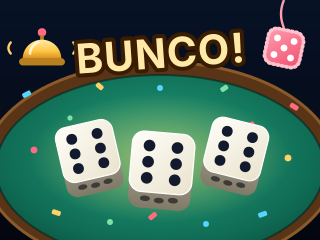
The dice party game: ring the bell, roll for the round’s number and shout Bunco.
PLAY →
Pipline Dominoes
Match the ends, block your rivals and go out first. Draw, Block and All Fives for 2 to 4 players, against the computer, friends online or on one screen.
PLAY →
Mahjong Solitaire
Match free tiles to clear all 144 from six classic layouts. Every deal can be won, with hints, undo, solvable shuffles and a saved game.
PLAY →
Ludo
Roll a six, race round the cross and send your rivals back to the yard. Two to four players: the computer at four levels, friends online or on one screen.
PLAY →
Go Fish
The family card game of asking, fishing and collecting books of four. Play Go Fish against one to three computer players, pass and play on one screen, or open an online table for two to four.
PLAY →