Play Ludo Online
Roll a six, race round the cross and send your rivals back to the yard. Two to four players: the computer at four levels, friends online or on one screen.
What is Ludo?
Ludo is the race game almost everyone learned as a child: four colours, four tokens each, one die. Roll a six to bring a token out of your yard, run it once round the board and up your own coloured column, and get all four home before anyone else does.
The catch is everyone else. Land on a rival's token and it goes straight back to its yard to wait for another six, so a lead is never safe until a token is resting on a star or tucked into its home column.
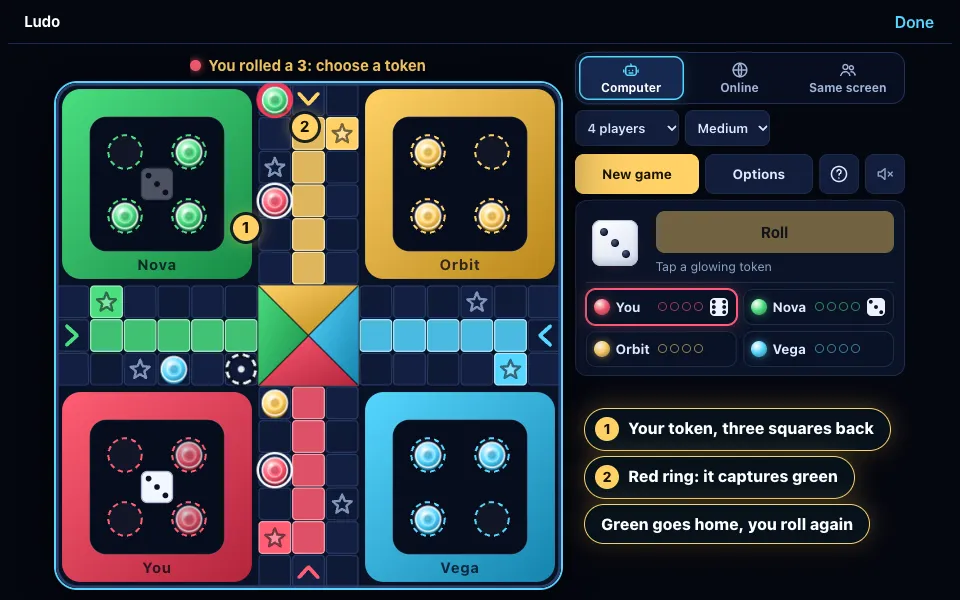
This version plays the standard rules exactly, with the common house rules as switches. Tokens hop square by square, the die tumbles, and the tokens you can move glow with a ring on the square each one would reach. A red ring means a capture.
Start at once against one, two or three computer players, pass one phone or laptop around the table, or open an online table for up to four where computer players fill any empty seats. It is free, with nothing to download.
How to play Ludo
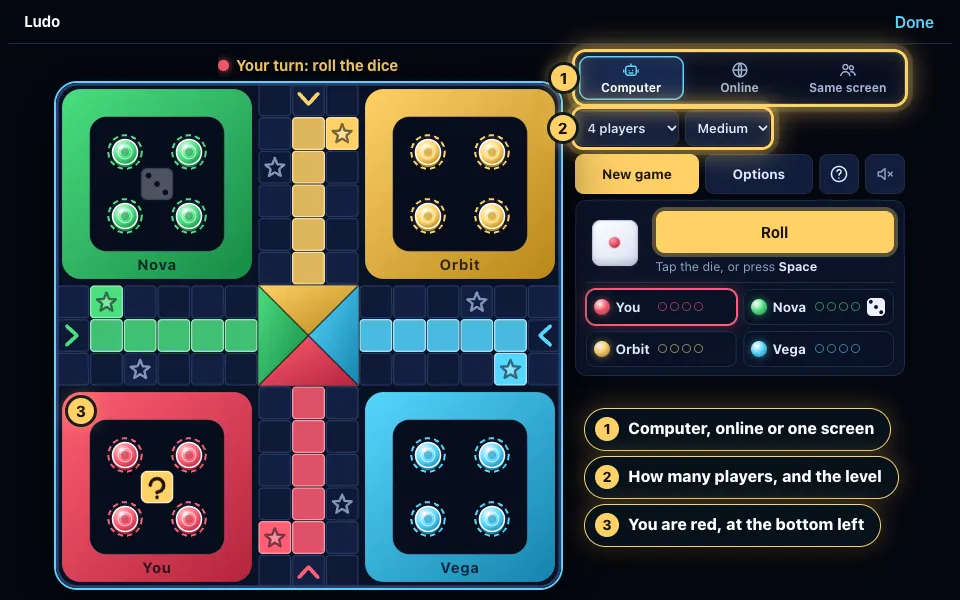
Start a game
Pick who you are playing: the computer, friends online, or everyone on one screen. Then choose how many players and how strong the computer is. A game starts at once, and your colour sits at the bottom left.
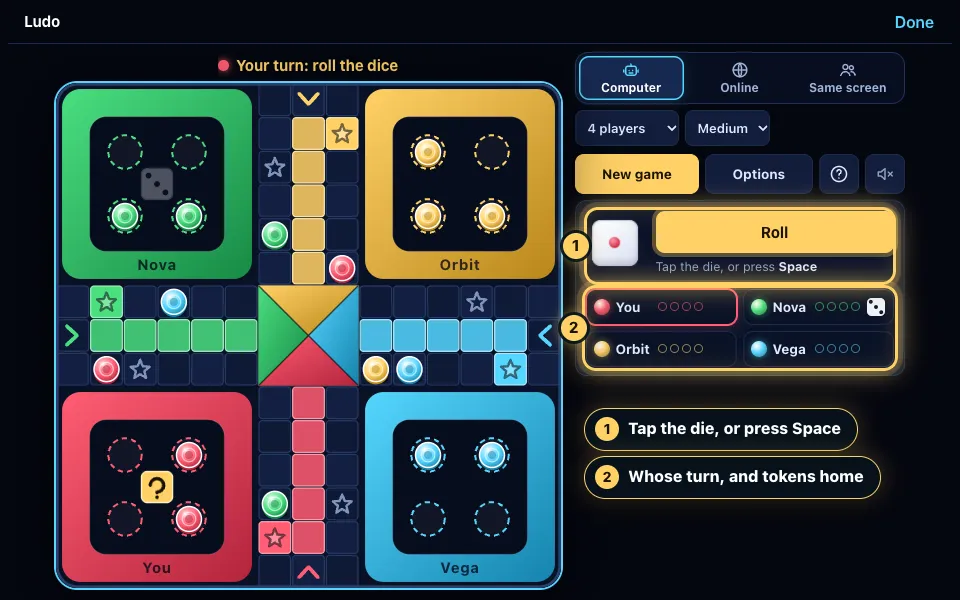
Roll the die
On your turn the die lights up. Tap it, tap the board or press Space to roll. The list beside the board shows whose turn it is and how many tokens each player has brought home.
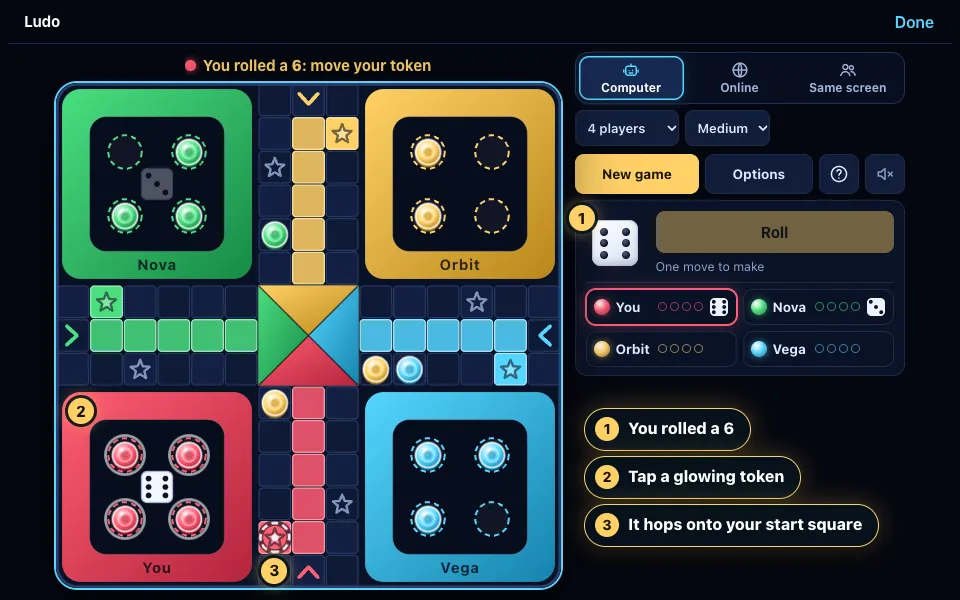
A six brings a token out
Roll a 6 and the tokens in your yard start to glow. Tap one and it hops onto your start square. A 6 also gives you another roll.
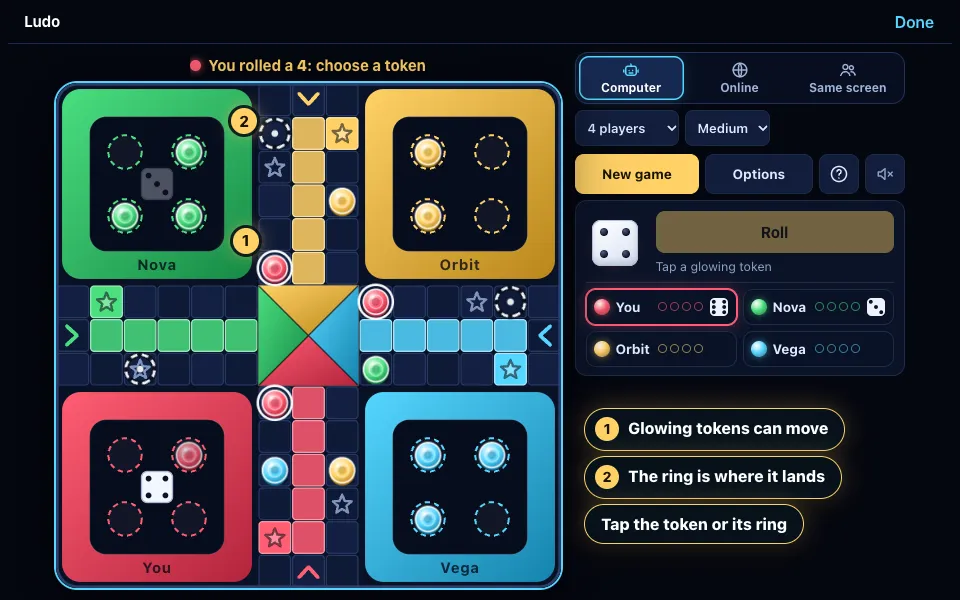
Choose which token to move
Every token that can move glows, and a ring marks the square it would reach. Tap the token or its ring. When only one move is possible it is played for you.
Capture a rival
A red ring means your token would land on a rival. Take it and that token goes back to its yard, and you roll again.
Rest on the safe squares
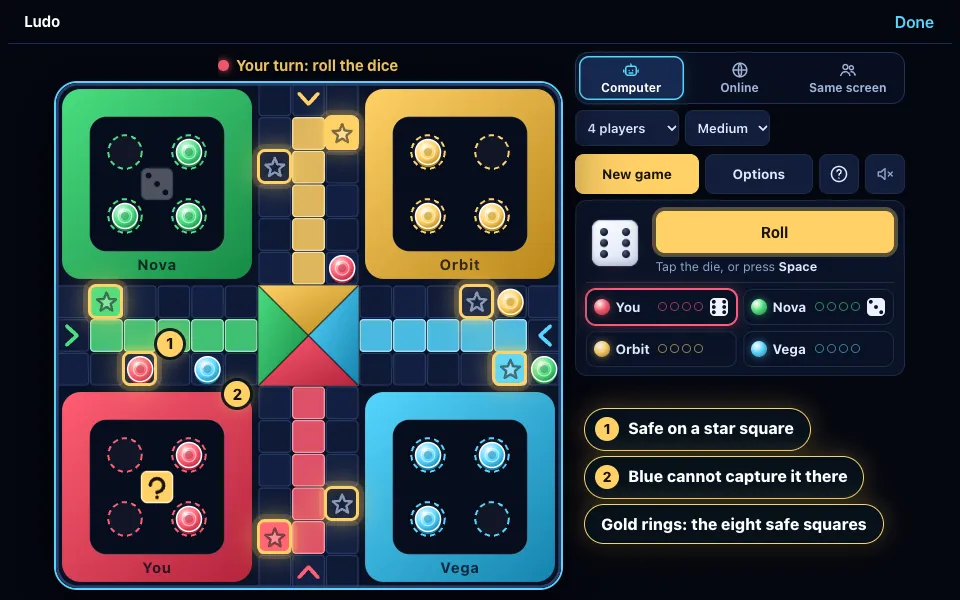
The star squares and the four coloured start squares are safe. A token there cannot be captured, even with a rival right behind it, so they are the places to stop when someone is chasing you.
Bring them home
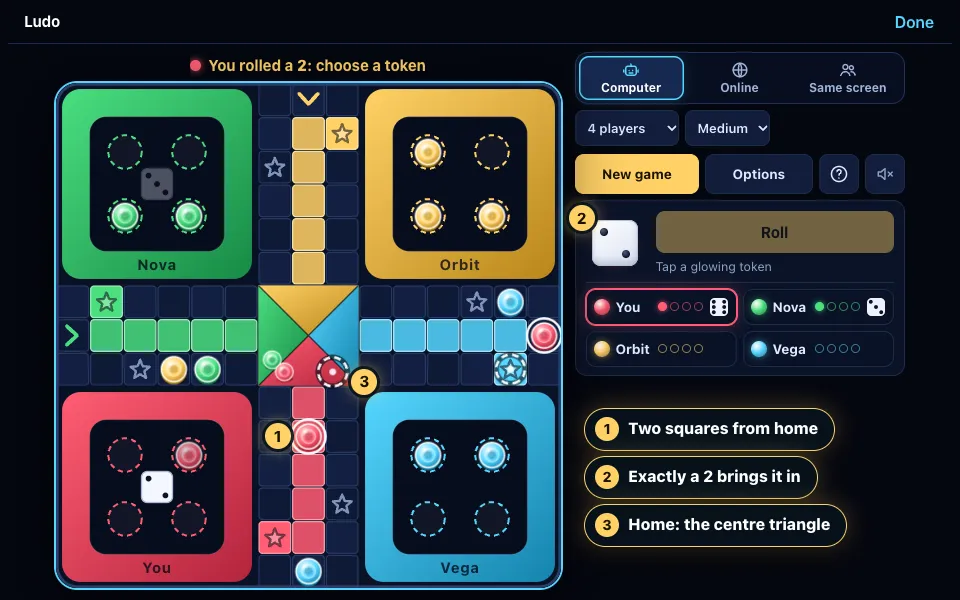
After a lap your token turns up your own coloured column, where nothing can touch it. The centre needs the exact number. The first player with every token home wins.
The rules in full
- Each player has four tokens in a yard of their own colour (two in a quick game). Turns go clockwise, and on your turn you roll one die.
- You need a 6 to bring a token out of the yard onto your start square, the coloured square just outside it. With every token in the yard and no 6, your turn passes.
- Otherwise move one token forward by exactly the number rolled, clockwise round the 52 squares of the track. You pick which one. If none can move, the turn passes.
- A 6 gives you another roll after your move. Three sixes in a row are too many: the third is not played and the turn passes.
- Land on a square that holds a rival's token and you capture it. It goes back to its yard and needs a 6 to come out again. A capture also earns another roll.
- Eight squares are safe: the four coloured start squares and the four marked with a star. A token on one cannot be captured, and different colours may share it.
- After a full lap a token turns up its own coloured home column, where no rival can follow. The centre needs an exact roll: three squares away, only a 3 will do. Bringing a token home earns another roll.
- The first player to bring all four tokens home wins. With three or four players the rest play on for places, unless you choose to stop at the first winner.
- In a team game the players sitting opposite each other are partners. Partners never capture each other, and once your own tokens are home your rolls move your partner's.
Ludo tips and strategy
- Use your sixes to bring tokens out early. With two or three on the board you almost always have a useful move, and fewer rolls are wasted.
- Count the squares behind you. A rival one to six squares back can hit you with a single roll; seven or more needs two rolls. Stop just out of reach or on a safe square.
- Capture whenever you sensibly can. It costs the rival a whole lap and gives you another roll, and the token that has travelled furthest is the one worth chasing.
- The squares just past a rival's start are the most dangerous on the board, because fresh tokens keep arriving behind you. Do not linger there.
- Once a token is in its home column it is safe for good, so there is no hurry to finish it. Spend your rolls on the tokens still out on the track.
- Without the Blocks rule, two of your tokens on one ordinary square are a double target: one hit sends both back. Stack them only on safe squares.
- After two sixes in a row, the third roll may cost you the turn. Make the move you most need with the second six.
Ludo rules: the standard game
The board is a cross. Each arm is three squares wide, and the outer squares join into one track of 52 squares that every token travels clockwise. Each colour has a yard in a corner, a start square beside it, and a home column of five squares leading to the centre.
A token's whole trip is 56 steps: 50 round the track from its start square, five up the home column and one into the centre. Tokens leave the yard on a 6, move by the number rolled and need the exact number to finish.
A 6 rolls again, three sixes in a row lose the turn, and landing on a rival sends it back to its yard. Those few rules are the whole game, which is why a five-year-old and a grandparent can sit down to it together.
House rules you can switch on
Every family plays Ludo a little differently, so the common variants are switches under Options. A new game starts with the rules you pick.
Extra roll: by default a capture or a token reaching home earns another roll, as a six does. You can keep either one, or play sixes only. Leave the yard: on a 6, or on a 6 or a 1 for a faster start.
Blocks: two tokens of one colour on a square form a block that rivals can neither capture nor pass. Safe squares: stars and start squares, or none at all.
Quick game gives everyone two tokens instead of four. With three or four players you can also end the game as soon as the first player is home.
Play Ludo against the computer: four levels
Choose one, two or three computer players and a level, and the game begins straight away. Easy moves any token it can. Medium knows the habits every player learns first: capture, come out on a six, get home, step onto a safe square.
Hard weighs each move, counting how many rolls would let a rival hit the token it leaves behind. Insane also looks ahead to the rolls that could follow. Neither can see the next roll, and the die is the same for everyone.
Ludo is a dice game, so even Insane loses often. Your record against each level is kept, along with your best run of wins.
Ludo with friends: one screen or an online table
Same screen is the board-game way: two to four people around one phone, tablet or laptop, taking turns to roll. Nothing is hidden in Ludo, so one screen works as well as a real board.
For friends elsewhere, choose Online and then Invite friends to get a link or a code, or Quick match to join an open table. The host picks the number of players, the house rules and how strong the computer players are.
Computer players fill any seat nobody takes, so two friends can still play a full four-colour game. In a team game, partners sit opposite each other.
Are the dice fair?
Yes. Every roll comes from one stream of random numbers that is fixed when the game starts and knows nothing about the board. The computer players roll the same die you do.
You can check it yourself. The end of every game shows how many times each player rolled, how many sixes they threw and their average roll, with captures made and tokens lost.
At an online table the dice are rolled by the table on our server, never by anyone's phone or computer, and every move is checked there too.
Controls on phone, tablet and computer
Touch or mouse: tap the die or anywhere on the board to roll, then tap a glowing token or the ring where it would land. Where two of your tokens share a square they count as one choice.
Keyboard: Space rolls and plays the chosen token, the arrow keys step between tokens, and 1 to 4 move a token directly. N starts a new game, O opens Options, M turns the sound off and H shows the rules.
Options also holds three speeds, from relaxed hops to a fast game, and auto-move, which plays your move for you when only one is possible. Full screen fills the display with the board.
Ludo strategy: when to run and when to wait
Each roll asks the same question: advance the leader, bring out a new token, capture, or step to safety? Good players answer it by counting the squares between tokens.
Keep two or three tokens in play so one bad roll never leaves you stuck. Sending back a rival that is close to home is worth more than a few squares of progress.
A short history of Ludo
Ludo comes from Pachisi, a cross-shaped race game played in India for many centuries with cowrie shells in place of dice.
A simpler form with one cube die and a square board was patented in England in 1896 as Ludo, Latin for "I play", and it spread quickly round the world.
Ludo FAQ
Is this Ludo game free?
Yes. It is free to play in your browser, with no download and no account needed.
How many players can play Ludo?
Two, three or four. Fill any seat with a computer player, share one screen, or sit at an online table. Four players can also play as two teams.
Do you need a six to start in Ludo?
By the standard rules, yes: only a 6 brings a token out of the yard. If you prefer the faster house rule, Options lets tokens come out on a 6 or a 1.
What happens if you roll three sixes in a row?
The first two sixes are played as usual, each followed by another roll. The third six is not played and your turn ends.
Which squares are safe in Ludo?
The four coloured start squares and the four star squares. A token on one cannot be captured, and different colours can stand there together. Home columns are safe too.
Can two tokens be on the same square?
Yes. Your own tokens can always share a square, and rivals can share a safe square. On an ordinary square, a rival that lands on your pair captures both unless the Blocks rule is on.
Do you need an exact roll to get home?
Yes. A token enters the centre only on the exact number. If the roll is too high that token cannot move, and you must move another token or pass.
Can I play Ludo online with friends?
Yes. Choose Online, tap Invite friends and send the link or the code. Computer players fill any empty seats, and the table rolls the dice for everyone.
Can I play Ludo on my phone?
Yes. The board fits a phone screen upright or sideways, the tokens are easy to tap, and full screen gives the board the whole display.
How long does a game of Ludo take?
A four-player game with four tokens each usually takes 15 to 25 minutes, less at the fast speed. A quick game with two tokens each takes about half that. Games against the computer and on one screen are saved, so you can come back later.
More games
Bunco
The dice party game: ring the bell, roll for the round’s number and shout Bunco.
PLAY →
Starhop Chinese Checkers
Hop your ten marbles across the star in long chains of jumps. Two to six players: the computer at four levels, friends online or on one screen.
PLAY →
Rocket Backgammon
Race your 15 checkers home and bear them off first. Play backgammon against the computer at four levels or friends online, with the doubling cube and match play.
PLAY →
Pipline Dominoes
Match the ends, block your rivals and go out first. Draw, Block and All Fives for 2 to 4 players, against the computer, friends online or on one screen.
PLAY →
Rocket Checkers
Play checkers online against a friend or another player, the computer at four levels, or a friend on the same screen. Real rules, forced captures and multi-jumps.
PLAY →
Seedfall Mancala
Sow glowing seeds, land in your store for an extra turn and capture your opponent's pits. Kalah or Oware against the computer, a friend online or on one screen.
PLAY →