New game
This leaves your current game unfinished.
Play the computer
Daily Board
Pass and play
Which letter is the blank?
A blank stands for any letter and scores 0. You can change it until you play.
Swap tiles
Tap the tiles to send back to the bag. Swapping takes your turn.
Pass your turn?
Tiles left
The small number on a tile is its points. The count beside it is how many you have not seen yet.
Moves so far
How to play Word Tiles
- Lay tiles from your rack in one row or column to spell a word. The first word covers the star; every later word joins the tiles already down.
- Every run of two or more letters you make must be a word. You score each word: letter points, with the coloured squares counted for tiles you lay this turn.
- Use all seven tiles in one turn for 50 extra points.
- A blank tile stands for any letter and scores 0.
- Stuck? Swap tiles with the bag or Pass. Either one takes your turn.
- The game ends when the bag is empty and someone plays their last tile, or after six turns in a row with no score (eight with four players). Tiles left on your rack count against you.
Laying tiles
- Drag a tile to a square, or tap a tile, then a square.
- Or tap a square first to put the arrow there (tap again to turn it), then tap tiles to lay them along it.
- Tap a tile you have just laid to take it back. Recall takes them all back.
- On a small screen the board zooms in as you play. Pinch or use the magnifier to zoom, and drag the board to move it.
- The bag button shows the tiles not seen yet and, on a small screen, every move so far.
- Keyboard: arrows move the square marker, Space turns it, letters lay tiles (Shift + letter uses a blank), Backspace takes one back, Enter plays, Esc recalls. 1 Shuffle, 2 Swap, 3 Pass, 4 Hint, 0 Sound.
Game over
Pass the device
Next player
Word Tiles: Crossword Board Game Online
Lay letter tiles on a 15 by 15 board, build words that cross and land on the bonus squares. Play the computer at four levels, pass and play with friends, or take on the Daily Board.
What is Word Tiles?
Word Tiles is a crossword board game, free to play online on your phone, tablet or computer. You hold seven letter tiles and take turns laying words on a 15 by 15 board. Each new word joins the ones already there, until the board looks like a crossword you wrote together.
Every tile has a points value, and the coloured squares multiply it: Glow doubles a letter, Flare triples it, Comet doubles the whole word and Nova triples it. Use all seven tiles in one turn for 50 points on top. The board, the letter values and the 104-tile bag are our own, so even old hands have something new to work out.
Play the computer at four levels, from friendly Cadet to Commander, which plays the strongest move it can find. Pass one phone or laptop around for two to four players. Or take the Daily Board: ten set racks, the same for everyone that day, and one score to beat.
The game adds up a word before you play it, names any word it does not accept, and after the last turn walks you back through the game to show the best play you missed.
How to play Word Tiles
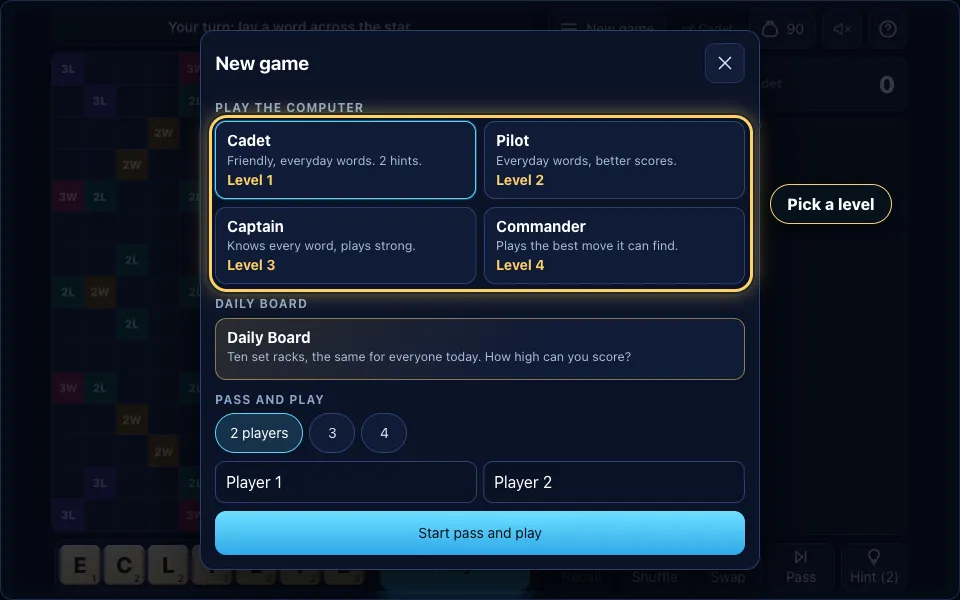
Pick a game
Word Tiles opens with a game against Cadet ready to play. Press New game to choose another level, the Daily Board, or pass and play for two to four players.
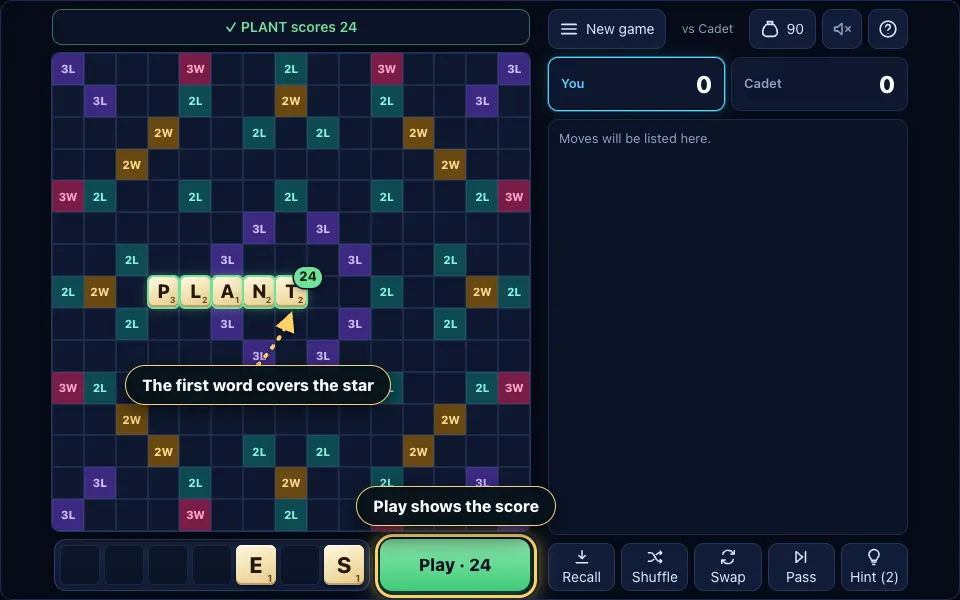
Lay your first word across the star
Drag tiles from your rack to the board, or tap a tile and then a square. The first word must cover the star, which doubles it. The Play button shows what the word scores.
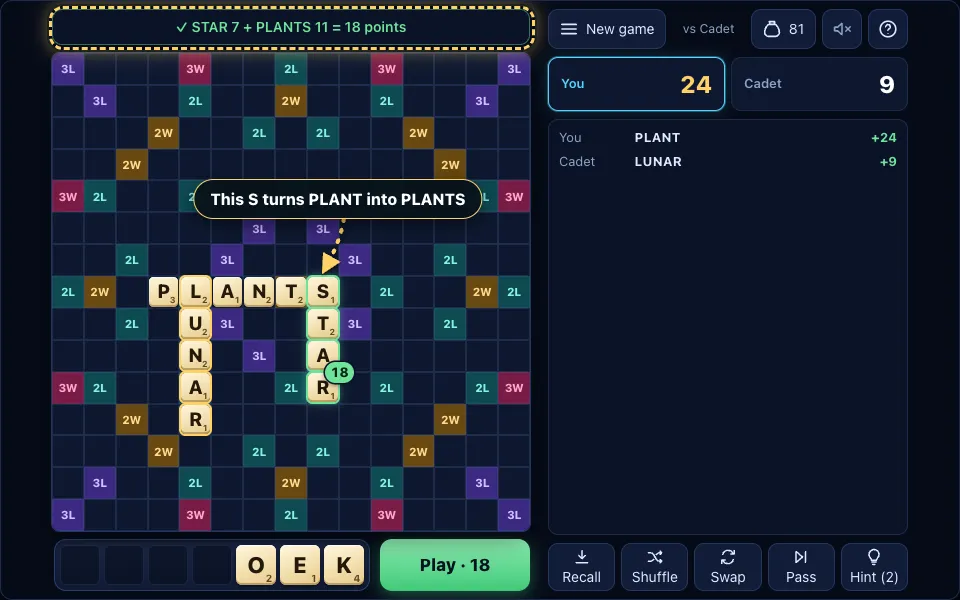
Join the words already there
Every later word has to touch the tiles on the board. Here STAR runs down from a new S that also turns PLANT into PLANTS, and both words score.
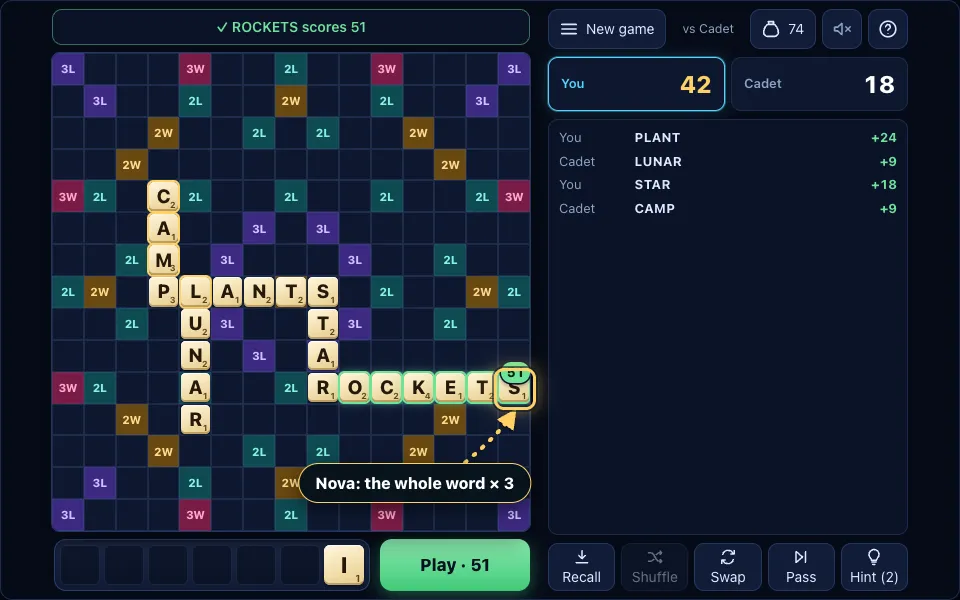
Aim for the coloured squares
Glow and Flare squares multiply the letter on them. Comet and Nova squares multiply the whole word. ROCKETS ends on a Nova, so its 17 points become 51.
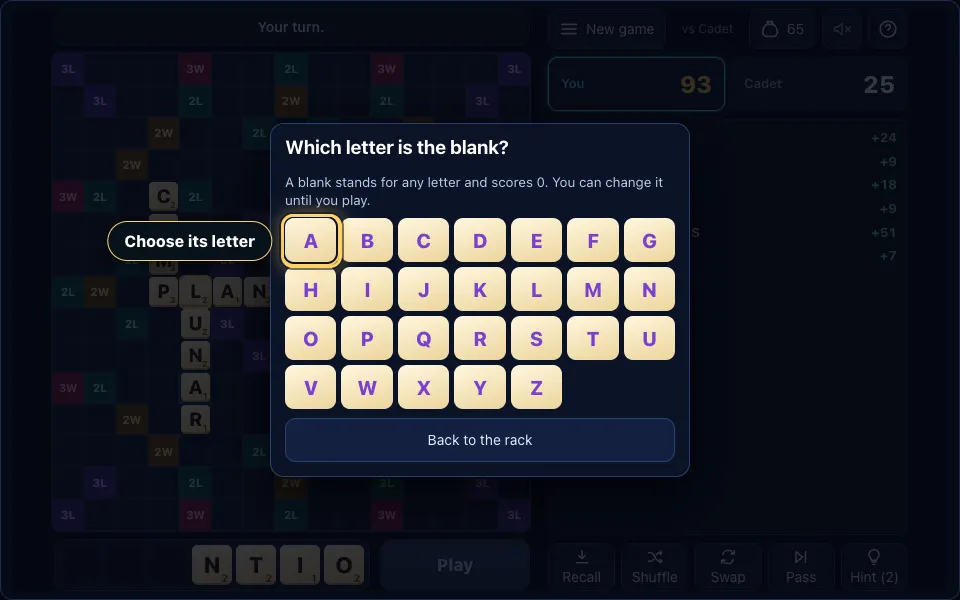
Give a blank its letter
A blank tile stands for any letter and scores 0. Pick its letter when you lay it. Tap the tile again to change the letter, any time before you press Play.
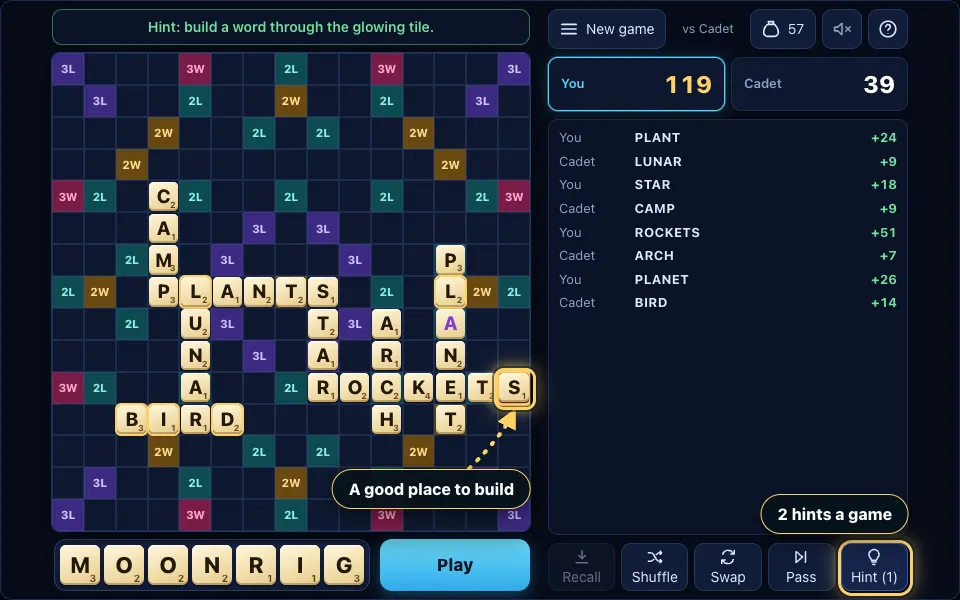
Take a hint against Cadet
Against Cadet you have two hints a game. A hint makes one square glow as a good place to build. Finding the word is still up to you.
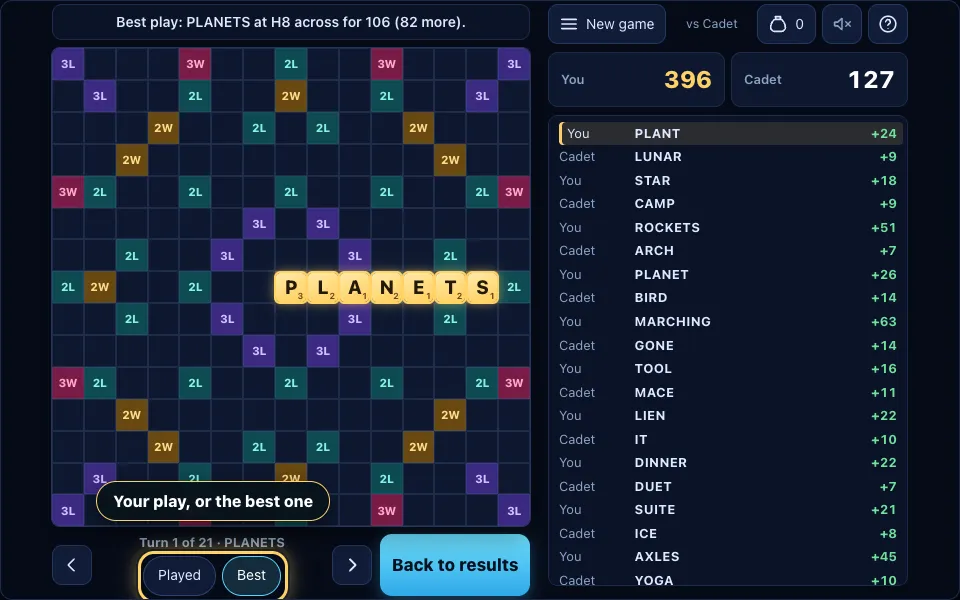
Look back at the game
When the game is over, press Review. Step through your turns and switch between Played and Best to see the strongest play each rack had.
The rules in full
- The game opens ready to play against Cadet, the friendliest computer player. Press New game to pick another level, the Daily Board or pass and play.
- On your turn, lay tiles from your rack of seven in one row or one column to spell a word. Drag a tile to a square, or tap a tile and then a square.
- The first word must cover the star in the middle, which doubles it. Every later play must touch a tile already on the board.
- Words read left to right or top to bottom. Every run of two or more letters your tiles make, across and down, must be a word.
- The Play button shows what your tiles will score. If a word is not in the word list, the message line names it. Nothing is lost: move the tiles and try again.
- Each letter scores the points on its tile. A Glow square (2L) doubles the tile on it and a Flare (3L) triples it. A Comet (2W) doubles the whole word and a Nova (3W) triples it. A coloured square counts only on the turn a tile is laid on it.
- Use all seven of your tiles in one turn for 50 extra points.
- A blank tile can be any letter. Choose the letter when you lay it; you can change it until you press Play. A blank scores 0.
- Press Play to end your turn. You draw from the bag until you hold seven tiles again.
- Stuck? Swap trades tiles of your choice for new ones while at least seven are left in the bag. Pass does nothing. Either one uses your turn.
- The game ends when the bag is empty and a player lays their last tile. That player gains the points left on every other rack, and the others lose the points on their own. It also ends after six turns in a row with no score (eight with four players). The highest score wins.
Word Tiles tips and strategy
- Look at the coloured squares before you look at your rack. A short word on a Nova usually beats a long word in open space.
- Lay a word alongside another so the touching letters make two-letter words. Every word scores, and the game knows 96 two-letter words.
- Put heavy letters such as Q, Z, J and X on a Glow or Flare square, ideally where they count in two words at once.
- Keep a balanced rack, about three vowels to four consonants. With all vowels or all consonants, a swap can be worth more than a tiny word.
- Hold on to an S or a blank until it buys you something. An S can pluralise a word on the board while starting a new one, and a blank is the easiest way to the 50 point bonus.
- Before you play, look at what you open up. A vowel left next to a Nova is a present for the next player.
- Near the end, press the bag button to see which tiles have not been played yet. Going out first hands you the points on every other rack.
- Use the review after each game. Seeing the best play for a rack you struggled with is the fastest way to improve.
What is Word Tiles? A crossword board game with letter tiles
Word Tiles belongs to the family of crossword board games: players draw letter tiles from a bag and take turns building words on a shared grid. Every word has to link to the words already down, so the board fills up like a crossword with no clues.
It takes two skills. One is vocabulary: seeing what your seven letters can spell. The other is placement: finding the spot where that word scores twice what it would anywhere else. This version is an original, with its own board, tile values and computer players.
Word Tiles rules: laying words and taking turns
On your turn you do one of three things: play a word, swap tiles or pass. A play uses one or more tiles from your rack, all in one row or column, joined into one unbroken word.
The first word must cover the star. After that every play has to connect: cross a word, extend one, or lie alongside one. Whichever it does, every new run of two or more letters must be a real word.
After a play you draw back up to seven tiles. Once the bag is empty the game runs on until one player lays their last tile, or until six turns in a row score nothing (eight in a four-player game).
Scoring: letter values, bonus squares and the 50 point bonus
Each tile shows its value in the corner. A, E, I, R and S are worth 1 and most other common letters 2 or 3. The heavy ones are Z at 7, X at 8, J at 9 and Q at 10. Blanks are worth 0.
There are 28 Glow squares (letter times 2), 16 Flare squares (letter times 3), 12 Comet squares (word times 2) and 8 Nova squares (word times 3). The star doubles the first word. A coloured square counts once, on the turn a tile lands on it.
You score every word your play makes. PLANT across the star with its L on a Glow square scores 24. All seven tiles in one turn adds 50: PLANETS starting on the star, with its last letter on a Comet square, scores 106.
Playing the computer: Cadet, Pilot, Captain and Commander
Cadet is the friendly one. It plays everyday words, often passes over its best move, and is the only level with hints: two a game. A hint makes one square glow as a good place to build. It never shows you the word.
Pilot uses the same everyday words but picks better scores. Captain knows the whole word list and plays strong moves, with the odd slip. Commander plays the best move it can find every turn and keeps a good rack for the next.
No level sees your tiles or the bag. The computer wins by finding words, not by peeking.
Pass and play for two to four players
Pass and play puts two, three or four people on one phone, tablet or laptop. Type your names and the game keeps everyone's score.
Between turns a hand-over screen covers the rack and names the next player. No tiles show until that player says they are ready, so you can pass the device across the sofa without anyone seeing your letters.
The rules are the same as against the computer, and you can review the finished game together to settle who really missed what.
The Daily Board: ten racks, one score
The Daily Board is a solo score attack. Everyone who plays on the same date gets the same ten racks of seven tiles, in the same order, on the same empty board.
You get a fresh rack every turn, so there is no bag, no swapping and nothing taken off at the end. Tiles you do not use are gone. If a rack beats you, press Skip and move on.
After ten turns your total is your score for the day. You can play again for practice, but your first finished run is the one that counts.
Review your game: the best move you missed
When a game ends, press Review. The board rewinds to your first turn and shows the rack you held and the word you played.
Press Best and the game lays out the highest-scoring play that rack had, and tells you how many more points it was worth. Step through the whole game with the arrows.
It is honest feedback. Sometimes the best play was a word you have never heard of. More often it was a word you know, on a square you did not look at.
Playing on a phone, tablet or keyboard
On a touch screen, drag a tile to a square, or tap a tile and then the square. You can also tap a square first to set an arrow, then tap tiles one after another to lay them along it. Tap a laid tile to take it back.
On a phone the board zooms in around your word while you lay it. Pinch or use the magnifier to zoom, and drag the board to move it.
With a keyboard, the arrow keys move a marker around the board and Space turns it between across and down. Type letters to lay tiles, hold Shift for a blank, press Backspace to take one back and Enter to play.
Which words count in Word Tiles?
The game checks every word against a list of about 168,000 English words, two to fifteen letters long. Plurals, verb forms and plenty of odd short words are in. Abbreviations such as TV and OK, and words that need a hyphen or an apostrophe, are out.
The list has 96 two-letter words, among them AA, JO, XI, XU and OX. Some two-letter words you may know from other word games are not on it, so let the message line be the judge.
You never lose a turn for trying. The game names a word it does not accept before the play goes through, which matters when one play makes three words at once.
Word Tiles FAQ
Is Word Tiles free to play?
Yes. Word Tiles is free to play in your browser, with no download and no account needed. A free Rocket Games account only adds your scores to the leaderboards.
How do you score points in Word Tiles?
Add up the letter values of each word you make. Glow and Flare squares multiply a letter, Comet and Nova squares multiply the whole word, and playing all seven tiles in one turn adds 50.
How many tiles are in the bag?
There are 104 tiles: 101 letters and 3 blanks. E is the most common with 12, and there is one each of J, K, Q, V, W, X and Z.
How do blank tiles work?
A blank can stand for any letter. You pick the letter when you lay it and can change it until you press Play. The blank itself scores 0.
How hard is the computer?
There are four levels. Cadet is gentle and gives two hints a game, Pilot and Captain are steps up, and Commander plays the best move it can find every turn. In our test games each level beat the one below it more than 95 times in 100.
Can two people play Word Tiles on one phone?
Yes. Pass and play is for two to four players on one device. A hand-over screen hides the tiles between turns so nobody sees another player's rack.
What is the Daily Board?
It is a ten-turn solo game with the same ten racks for everyone on the same date. You get a fresh rack each turn and play for the highest total.
Which words are allowed?
About 168,000 English words of two to fifteen letters, including 96 two-letter words. If a word is not accepted, the game names it before you lose anything.
Can I play Word Tiles on my phone?
Yes. The board zooms in while you lay a word, tiles can be dragged or tapped into place, and the game fits a phone held upright or sideways.
Does Word Tiles save my game?
Yes. A game in progress is saved in your browser after every move, so you can close the page and carry on later on the same device.
More games
Rocket Words
Guess the word in six launches. Daily missions with a streak shield, unlimited practice in 5 or 6 letters, archive, hints, expert mode and stats that travel with you.
PLAY →
Letter Landslide
Drag through the letters, spell a word and watch the rock give way. Clear whole lines to break through 108 levels, a Daily Landslide, a three-minute Rush and an endless Zen dig.
PLAY →
Mini Crossword
A fresh 5x5 crossword every day, solved in a minute or two. Free archive, practice puzzles, check and reveal, a timer and streaks.
PLAY →
Word Search
Free themed word search puzzles: a new daily grid, unlimited puzzles in 66 themes, three sizes, hints, a timer and best times.
PLAY →
Kindred
Sixteen words, four hidden groups of four. A new puzzle every day, a free archive, markers to think with and an explanation for every answer.
PLAY →
Hangman
Classic Hangman with a happier ending: guess the word letter by letter while each miss draws a rocket, a rope ladder and a dangling astronaut. Twelve categories from Easy to Hard, phrases, a Daily Hangman and two-player pass and play.
PLAY →