Tents and Trees: Free Online Camping Logic Puzzle
The camping logic puzzle: pitch a tent beside every tree, follow the row and column numbers, and never let two tents touch. A daily puzzle and numbered puzzles from 6×6 to 16×16, Easy to Expert, with hints that explain every step.
What is Tents and Trees?
Tents and Trees is the camping logic puzzle, free to play online in your browser on phone, tablet or computer. A meadow grid is dotted with little pine trees, and every tree needs a tent pitched right beside it. The numbers along the edge say how many tents go in each row and column, and no two tents may ever touch, not even corner to corner.
There is nothing to guess. Each puzzle here has exactly one answer, built and checked by a solver that reasons the way a person does, so every tent can be found by logic alone. Easy campsites take a few minutes; Expert ones on a 16×16 meadow ask for real what-if thinking.
Play a new Daily Tents and Trees every day, the same for everyone, or pick any of six sizes and four difficulties. Hints show the next step and explain why it works, tents light up with lanterns as you go, and the whole campsite glows with fireflies when you finish.
How to play Tents and Trees
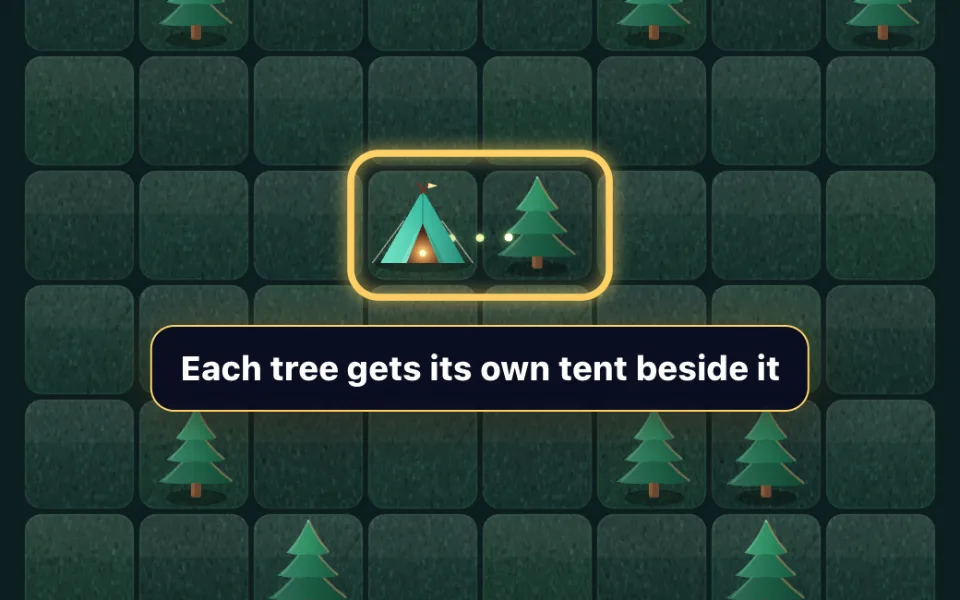
Pitch a tent by a tree
Tap a cell right beside a tree (above, below, left or right) to pitch its tent. A little string of light shows which tree the tent belongs to.
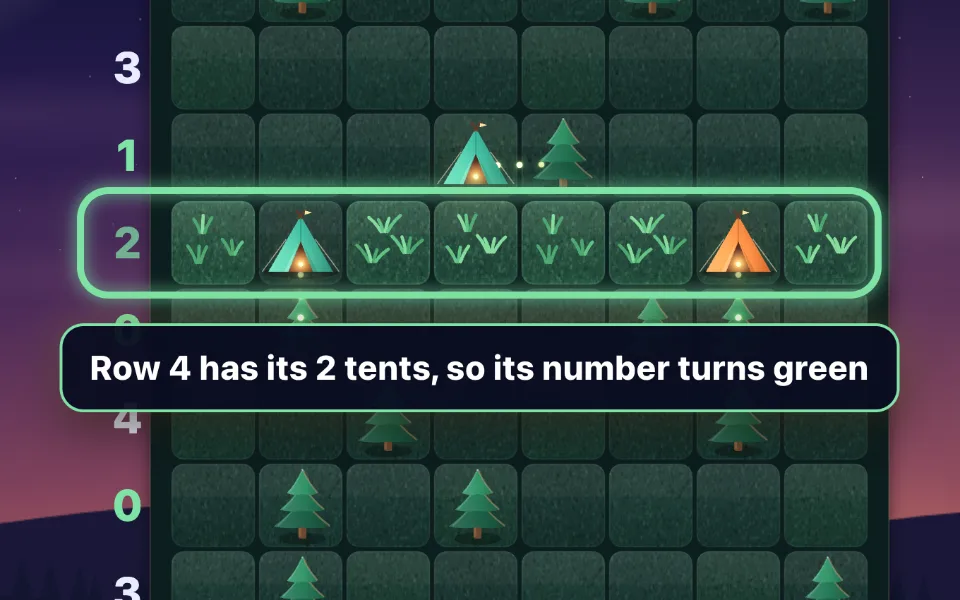
Follow the numbers
The numbers say how many tents each row and column holds. When a line has them all its number turns green, and tapping it fills the rest of the line with grass.
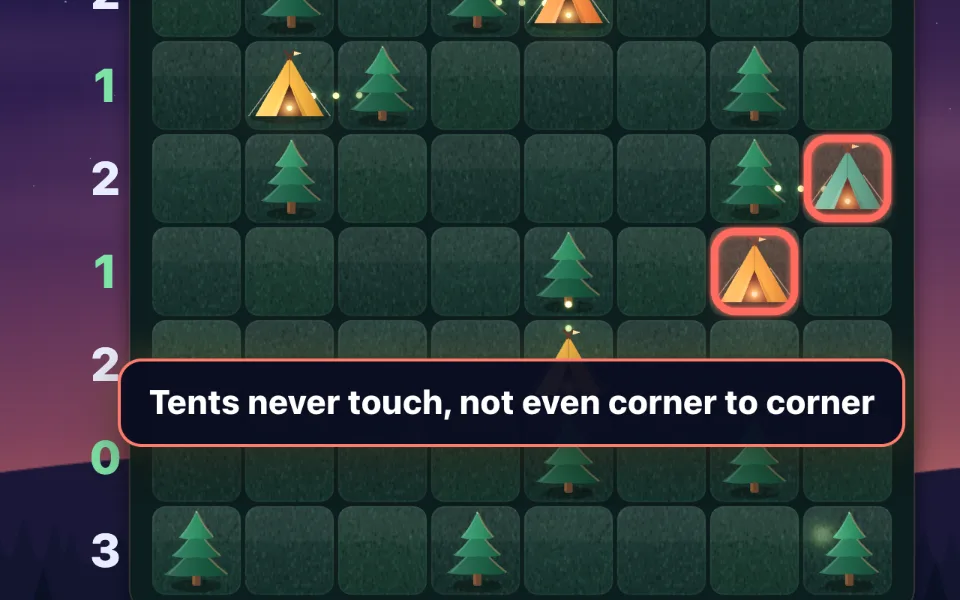
Tents never touch
No two tents may touch, not even corner to corner. If they do, both get a red ring so you can spot it straight away.
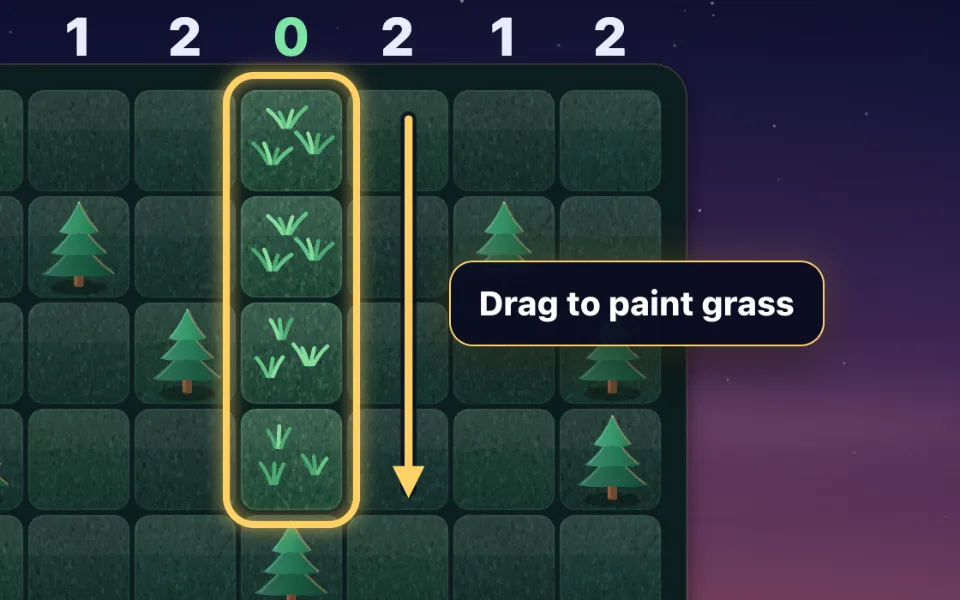
Paint grass
Mark the cells you know stay empty as grass: tap a cell twice, or drag across a stretch of cells to paint them all at once.
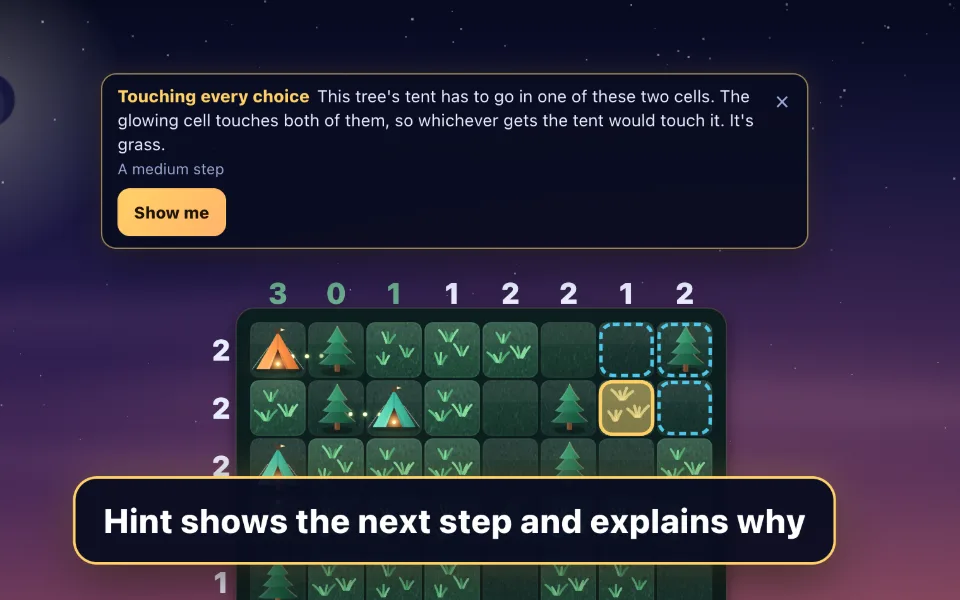
Ask for a hint
Stuck? Hint highlights the next logical step and explains why it works. Press it again, or tap Show me, to make the move.
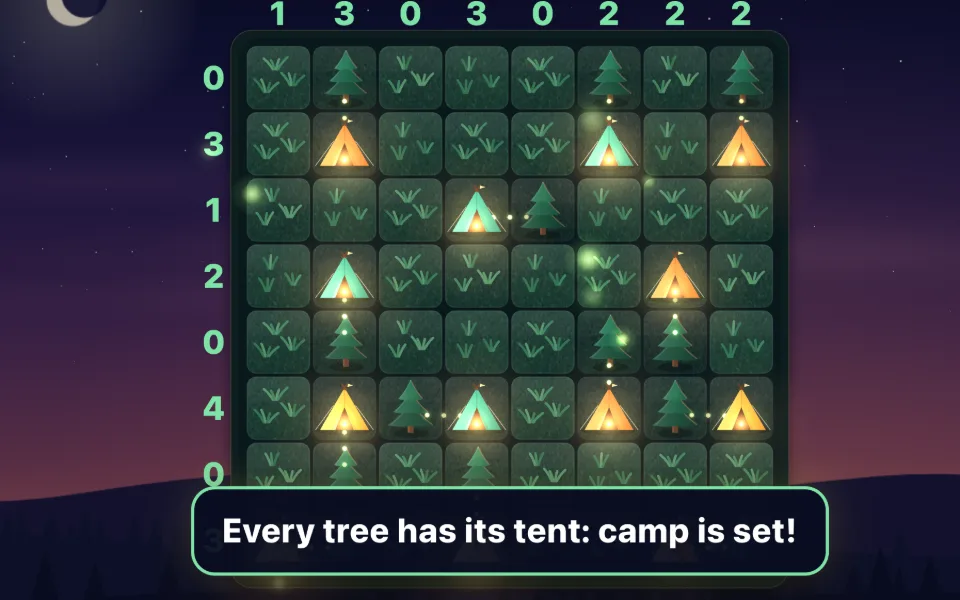
Set up camp
When every tree has its tent and every number is met, the lanterns light up one by one and the fireflies come out.
The rules in full
- The goal: pitch one tent for every tree. Each tent sits right beside its own tree, directly above, below, left or right of it, never diagonally.
- Every tree has exactly one tent of its own and every tent belongs to exactly one tree. A string of light between a tree and a tent shows how they pair up as you play.
- Tents never touch each other, not side by side and not corner to corner. Two touching tents get a red ring.
- The number beside each row and above each column says how many tents that line holds. It turns green once the line has them all, and red if it has too many or not enough room left for them.
- Tap or click a cell to pitch a tent, tap again to mark it as grass (a cell you know stays empty), and tap once more to clear it. In Settings you can make the first tap mark grass instead.
- Drag across cells to paint grass over many at once, or start a drag on grass to clear it. Right-click also marks grass, and tapping a finished row or column number fills the rest of it with grass.
- The puzzle is solved when every tree has its tent and every number is met. Grass marks are only notes for you; you don't need to fill them in.
- Undo, Redo and Restart are free. Hint shows the next logical step with an explanation, and pressing it again makes the move.
- With a keyboard, the arrow keys move, T pitches a tent, G marks grass, Space cycles a cell and H asks for a hint.
Tents and Trees tips and strategy
- Start with the zeros: a row or column whose number is 0 is all grass.
- Any cell with no tree directly beside it can never hold a tent, so mark it as grass straight away (or turn on the setting that does it for you).
- When a row has as many open cells left as it still needs tents, every one of them is a tent.
- As soon as you pitch a tent, the eight cells around it are grass. Marking them keeps the rest of the board clear.
- A tree in a corner or hemmed in by other trees often has only one free cell beside it. That cell is its tent.
- If a tree's tent can only go in two cells that meet at a corner, such as above it and to its right, the cell that touches both of them is grass.
- Watch the pairing lights. A tree whose neighbouring tents all belong to other trees still needs a tent of its own, and a cell whose trees are all taken is grass.
- On bigger boards, count a whole row: if it needs one tent and its open cells sit side by side, the cells in the rows above and below that touch them all are grass.
- Stuck on an Expert puzzle? Pick a cell and ask what would happen if it held a tent. If that leads to a broken rule, it's grass.
Where the Tents and Trees puzzle comes from
The tents puzzle is usually credited to the Dutch puzzle maker Léon Balmaekers, who is said to have created it around 1989 for the Dutch puzzle magazine Breinbrekers. It has travelled widely since then and goes by several names: Tents, Tents and Trees, Trees and Tents and Campsite are all the same puzzle.
It belongs to the same family as Sudoku and nonograms: a grid, a few numbers and a handful of simple rules that combine into surprisingly deep logic. It has also appeared at puzzle championships, where solvers race through large grids by eye.
This version is our own. The rules are the classic ones, and every campsite, the solver behind them and the way it explains its reasoning are made by Rocket Games.
Tents and Trees online: sizes, difficulties and fair puzzles
Choose a meadow from a quick 6×6 to a sprawling 16×16, at Easy, Medium, Hard or Expert. Every puzzle is numbered, so a friend who picks the same size, difficulty and number gets exactly the same campsite as you.
Each puzzle is made fresh by a generator and then solved by a logic engine that only ever makes moves a careful person could justify. A puzzle is kept only if that engine can finish it, which proves it has exactly one answer, and its difficulty is the hardest kind of step it needed.
Easy puzzles need only the basics: full rows, cells with no tree beside them, the cells around a tent, and trees with just one free spot left. Medium adds the cell that touches every place a tree's tent could go, and working out where a row's last tent can and can't go. Hard asks you to count whole rows and columns, and Expert needs what-if reasoning, where you test a cell and see the rules break further on.
Daily Tents and Trees puzzle
A new Daily Tents and Trees arrives every day at midnight, the same campsite for everyone. Monday's is a gentle 8×8 Easy, the week builds through 10×10 and 12×12 puzzles, Saturday is a 14×14 Hard and Sunday brings an Expert.
Solve it to grow your streak, see how your time compares on the day's board, and share your result. Missed a day? Every past daily is waiting in the calendar.
Tents and Trees strategy: from basics to what-ifs
Most solves start the same way: mark the zero lines and every cell with no tree beside it as grass, then pitch the tents that have only one possible spot. Each tent you place turns its eight neighbours to grass, which often leaves another tree with a single choice.
Next comes pairing. Once a tent can only belong to one tree, that pair is settled, and a cell whose neighbouring trees are all settled can't hold a tent. On larger boards the big idea is counting: if three trees must each put their tent in row 5 and row 5 needs exactly three, the rest of row 5 is grass.
When the obvious steps run out, use Hint. It always finds the easiest step available, tells you which rule it uses, and highlights the cells involved, so you learn the technique rather than just getting the answer.
Play Tents and Trees on your phone
Tents and Trees is built for touch. Tap to pitch a tent, tap again for grass, and drag your finger to paint grass across a whole stretch of meadow in one go. On a big board, pinch or tap Zoom for a closer look: the row and column numbers stay pinned to the edges while you move around with two fingers.
Your game saves itself as you play, so you can close the page and come back later to the same campsite. It works on phones, tablets and computers with nothing to download, and every puzzle can also be played with a mouse or entirely from the keyboard.
Tents and Trees FAQ
Is Tents and Trees free to play?
Yes. Tents and Trees is free to play online in your browser with no download and no account. Make a free account if you'd like your daily times on the leaderboards across your devices.
What are the rules of Tents and Trees?
Pitch one tent beside every tree, directly above, below, left or right of it. Each tree gets its own tent, tents never touch each other (not even diagonally), and the numbers beside each row and column say how many tents that line holds.
Can a tent be next to two trees?
Yes. A tent can sit beside more than one tree, but it belongs to only one of them, and every tree still needs a tent of its own. The pairing lights show which tree each tent is paired with.
Can tents touch diagonally?
No. Tents can't touch at all, so a tent's eight surrounding cells, corners included, are always empty.
Does every puzzle have only one solution?
Yes. Every puzzle is checked by a solver that only makes forced moves, and it is kept only if that solver can finish it. That proves there is exactly one answer and that you never need to guess.
What do the grass marks do?
Grass marks a cell you know is empty. It's a note for you and doesn't affect the answer: the puzzle is solved as soon as every tent is in place. You can paint grass by dragging, and settings can fill in grass for finished lines and for cells with no tree nearby.
How do hints work?
Hint finds the easiest logical step from where you are, highlights the cells involved and explains the reasoning in a sentence or two. Press it again, or tap Show me, to make the move. If something on the board is already wrong, the hint points that out first.
What's the difference between Easy, Medium, Hard and Expert?
The kind of thinking needed. Easy uses only simple steps, Medium adds the cell that touches every choice and a row's last tent, Hard adds counting the ways a whole row or column can fit its tents, and Expert needs what-if reasoning. Bigger boards at the same level simply take longer.
Is there a daily Tents and Trees puzzle?
Yes. A new Daily Tents and Trees arrives every day, the same for everyone, starting gentle on Monday and finishing with an Expert on Sunday. Your streak counts the days in a row you've solved it, and past days stay playable from the calendar.
Is Tents and Trees the same as the tents puzzle or Campsite?
Yes. Tents, Tents and Trees, Trees and Tents and Campsite are different names for the same logic puzzle with the same rules.
Can I zoom in on a big board?
Yes. When a board is too small to tap comfortably, as a 16×16 is on a phone, pinch it or tap Zoom for a closer look, and move around with two fingers. The row and column numbers stay pinned to the edges, and tapping Zoom again shows the whole campsite. On a computer, Ctrl and the mouse wheel or the + and - keys do the same.
Is my progress saved?
Yes. Your unfinished puzzles, best times, stats per size and difficulty and your daily streak are saved in your browser, so you can leave and pick up where you left off.
More games
Nonograms
Fill the grid from the number clues to reveal a hidden pixel picture. A daily puzzle, unlimited puzzles from 5×5 to 25×25 and an album of hundreds of pictures.
PLAY →
Rocket Bridges
The bridges logic puzzle: link numbered islands into one network. A daily puzzle and unlimited grids from 7×7 to 25×25, Easy to Expert, with explained hints.
PLAY →
Minesweeper
Classic Minesweeper with no-guessing boards, a safe first click, chording, best times and smooth controls for mouse, keyboard and touch.
PLAY →