Click ahead of a track to burst an interceptor there. Arrows + Space also work. P pause, M mute.Tap ahead of a track to burst an interceptor there. Between salvos, spend and work the line.
Brinkline: Free Missile Defense Strategy Game
A cold-war command terminal in glowing vector lines: break inbound tracks with interceptor bursts, spend between salvos, and talk the other side down before the brink.
What is Brinkline?
Brinkline is a free missile defense game you play in your browser. You sit at a watch terminal on a quiet shore. Across the water, the other side starts launching, and red tracks creep onto your radar.
You click or tap ahead of each track. A battery sends up an interceptor, it bursts where you pointed, and anything inside the burst is gone. Catch two tracks close together and the bursts chain for a bigger score.
Between salvos the board goes quiet and the strategy starts. You spend requisitions on radar, magazines and shelters, and you decide how to work the line to the other side: talk, stand at amber, strike first, or offer a stand-down.
Here is the twist. You do not get the best result by fighting every salvo. When trust is high and tension is low, a window opens. Stand down inside it and the night ends with every light still on.
How to play Brinkline
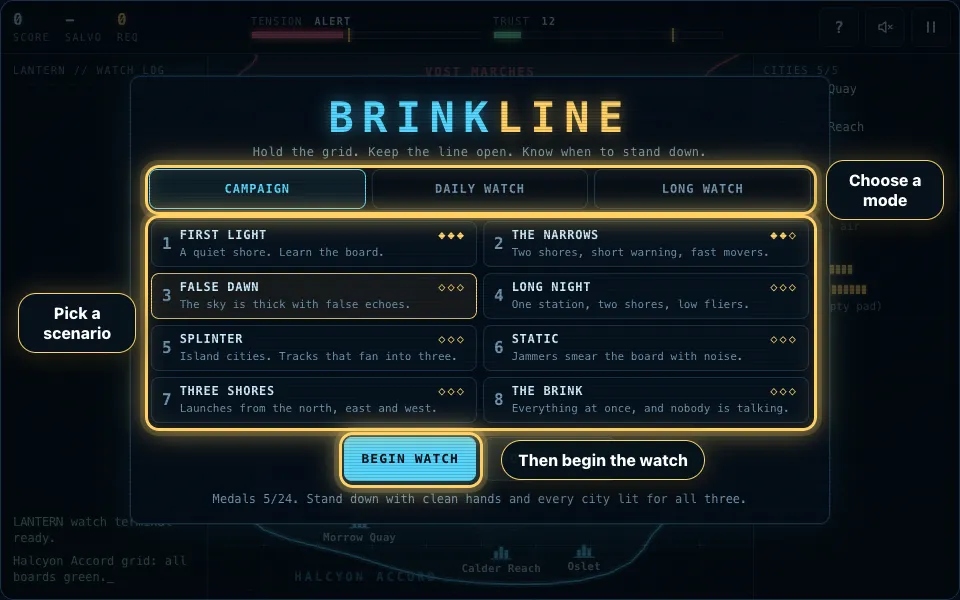
Pick a watch
Choose a campaign scenario, the Daily Watch or the endless Long Watch, then press Begin watch. Each scenario shows its twist and the medals you have earned on it.
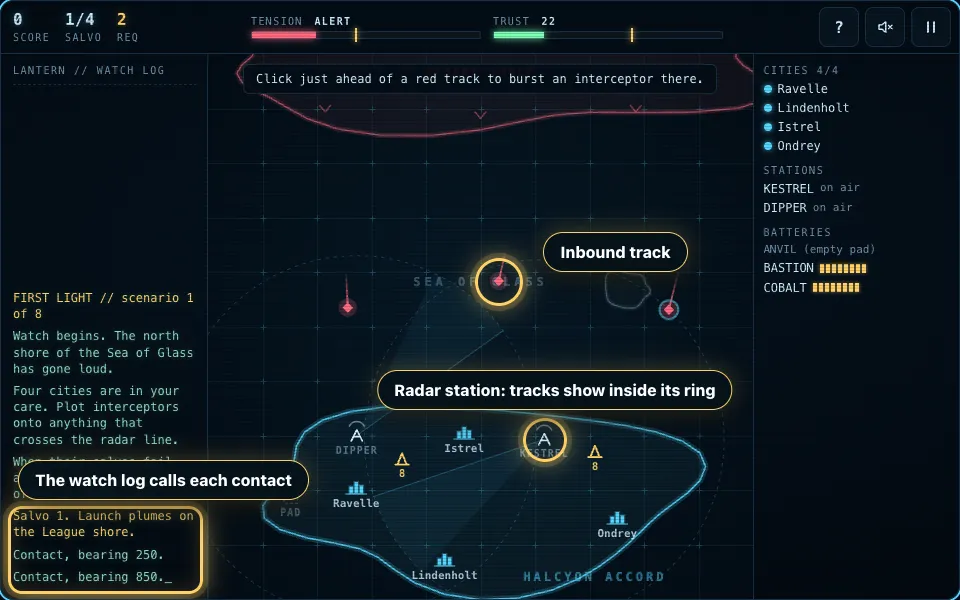
Read the radar
Your stations sweep the sky inside their rings. Red tracks appear as they cross a ring and head for a city, a station or a battery. The watch log on the left calls out each contact.
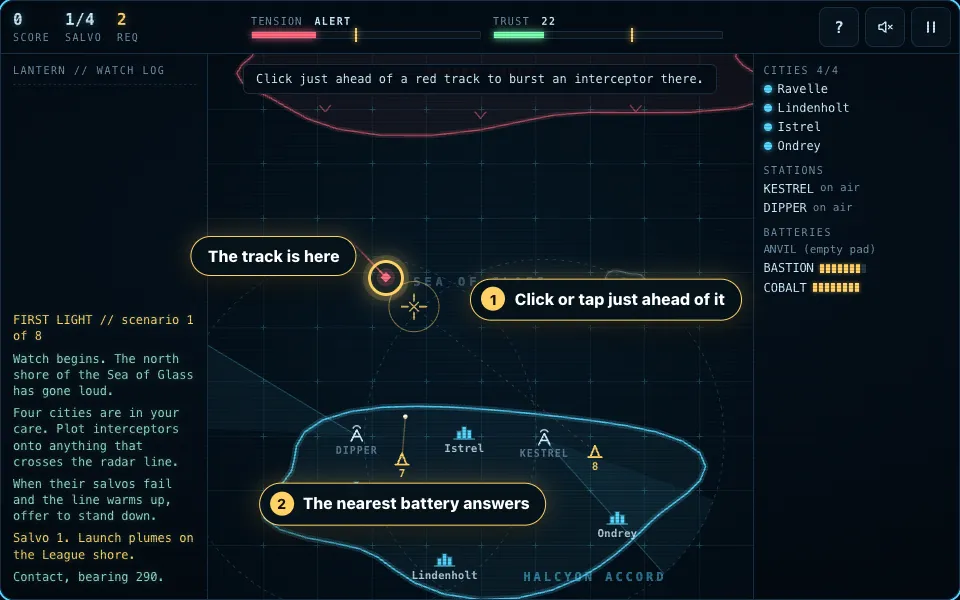
Burst ahead of the track
Click or tap a little in front of a track. The nearest ready battery sends an interceptor that bursts where you pointed. The yellow ring on the reticle is the size of the burst.
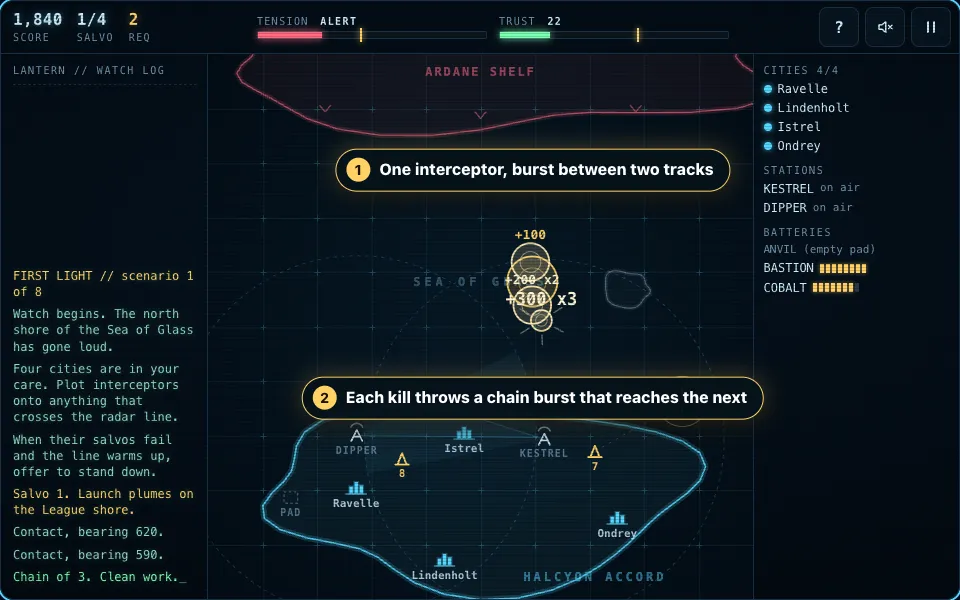
Chain the bursts
Every track a burst breaks throws a smaller burst of its own. Wait for tracks to bunch up, then drop one shot between them to chain x2, x3 and higher for extra points and spare interceptors.
Spend your requisitions
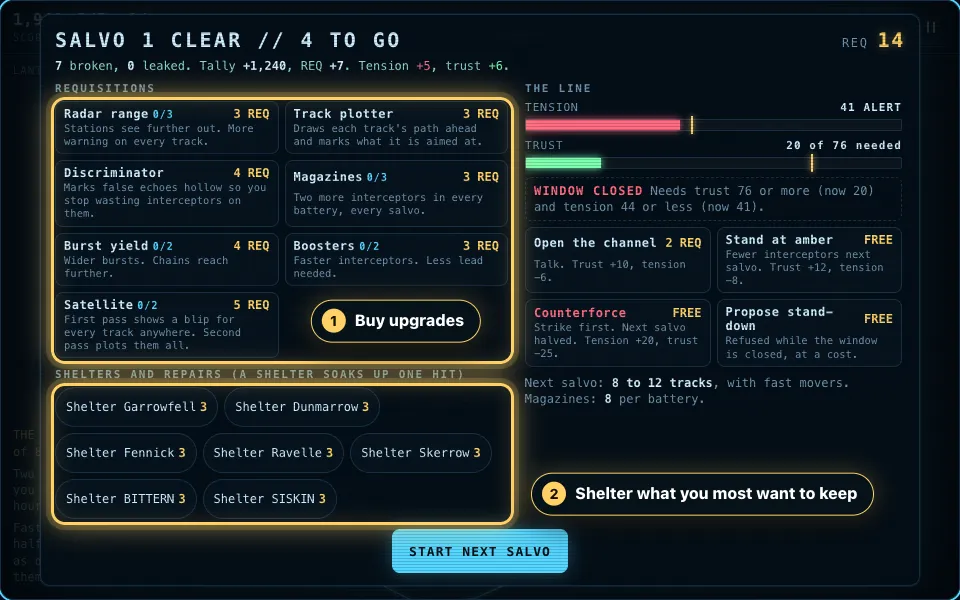
After each salvo the console opens. Buy radar range, a track plotter, bigger magazines or wider bursts, raise a new battery, and put shelters on the cities you most want to keep.
Work the line
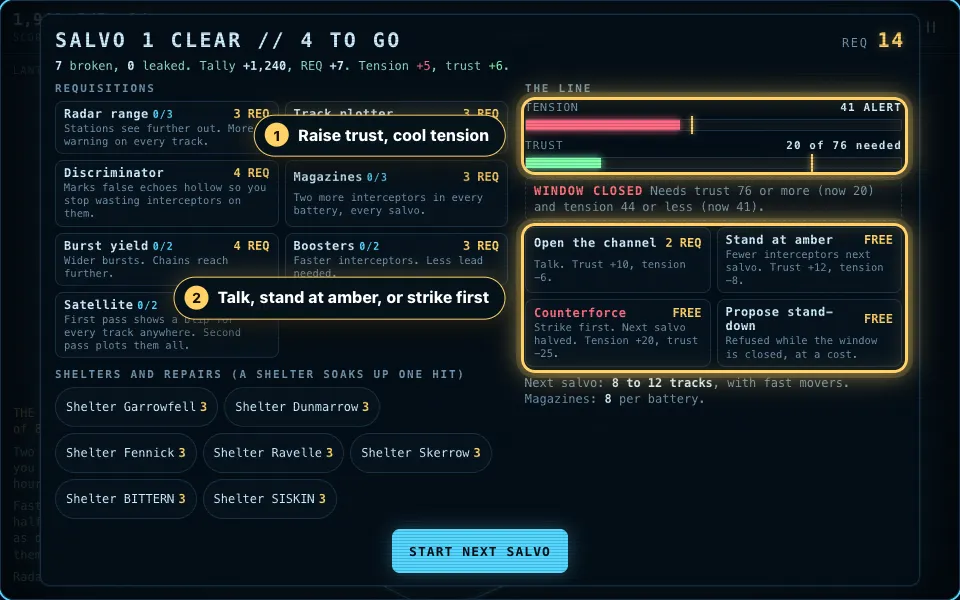
The line shows tension and trust. Opening the channel and standing at amber raise trust and cool tension. Counterforce thins the next salvo but pushes both meters the wrong way.
Stand down
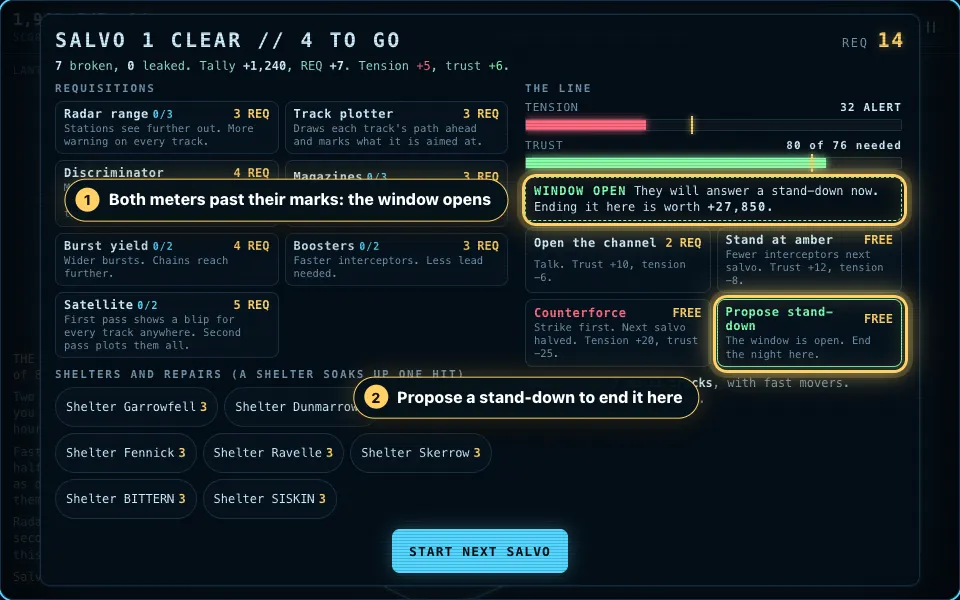
When trust passes its mark and tension sits under its mark, the stand-down window opens. Propose a stand-down then and the scenario ends at once with the accord bonus and the most medals.
The rules in full
- Pick Campaign, Daily Watch or Long Watch and press Begin watch.
- Watch the radar rings around your stations. Inbound tracks only show clearly once they cross a ring.
- Click or tap a little ahead of a red track. The nearest ready battery fires and the interceptor bursts at that spot.
- Lead fast movers further. The yellow circle on the reticle shows how wide the burst will be.
- Catch tracks close together. Each one a burst breaks throws a smaller burst of its own, so one shot can chain x2, x3 and more.
- Mind your magazines. Every battery has a small number of interceptors per salvo, shown beside it on the map.
- When the salvo is clear, spend requisitions (REQ) on upgrades, shelters, repairs and new batteries.
- Open The line. Talking and standing at amber raise trust and cool tension.
- When the stand-down window opens, propose a stand-down to end the scenario with the top result.
- If tension ever reaches 100 the exchange begins and the watch is lost, so do not let it climb.
Brinkline tips and strategy
- Aim where the track will be, not where it is. Slow tracks need a small lead, fast movers a big one.
- Do not fire the moment something appears. Two tracks that are about to cross are worth one shot, not two.
- A leftover interceptor is worth 20 points at the end of a salvo, and a lit city is worth 150. Clean shooting pays twice.
- Buy Radar range or the Track plotter first. Seeing a track early matters more than a bigger burst.
- Shelter the city that sits closest to the far shore. It gets the least warning and takes the first hits.
- Open the channel early. Two requisitions for trust +10 and tension -6 is the cheapest step toward the window.
- Stand at amber only when you can spare the interceptors. You fight the next salvo with a quarter fewer.
- A refused stand-down costs trust and draws a heavier salvo. Wait until the panel says WINDOW OPEN.
- Counterforce is a real option when a salvo would overrun you, but it costs the third medal and can tip tension over 100.
- Losing a city hurts three ways: fewer points, more tension and less trust. Guard cities before stations, and stations before batteries.
What kind of game is Brinkline?
Brinkline is two games that feed each other. During a salvo it is a fast aiming game: read the radar, lead the track, place the burst. Between salvos it is a small strategy game about money, risk and nerve.
Everything is drawn as glowing lines on a dark screen, like an old vector display. Cities are small squares of light. Tracks are thin red arcs. Nothing graphic is ever shown. If a city is hit, its light simply goes out.
The world is invented. You watch for the Halcyon Accord. The launches come from the Korvane League. The map, the names and the terminal that talks to you, LANTERN, exist only in this game.
How interception works
An interceptor takes a moment to fly, so you aim at the place a track is going. The closer the battery, the shorter the flight. Shots far from every battery need more lead.
A burst hangs in the air for a moment. Anything that flies into it is broken, and each broken track throws a smaller burst of its own. That is how chains happen, and each link multiplies the points.
If every battery is busy reloading, your click is queued and fires as soon as one is ready. If no battery can reach, or the rails are empty, the terminal tells you.
The tracks you will meet
Standard tracks fly a steady arc. Fast movers are paler, quicker and need a longer lead. Low fliers slip under the horizon and only show when they are close.
Splinters fan into three tracks partway across, so break them early. False echoes look real but vanish before they land, so shooting one wastes an interceptor. The Discriminator upgrade draws them hollow so you can leave them alone.
Jammers do not attack. They hang over the water and smear a haze across your radar until you burst them.
Requisitions: where to spend
You earn requisitions after every salvo: more for breaking most of the tracks, one extra for letting nothing through, one extra for a chain of three or better.
Radar range and the Satellite buy you time. The Track plotter draws where each track is heading. Magazines, Burst yield and Boosters make every battery stronger. An empty pad can be raised into a new battery.
Shelters cost little and soak up one hit each. Stations that were knocked off the air can be repaired. You will never afford everything, which is the point.
Tension, trust and the stand-down window
Tension is how close the night is to going wrong. It drifts up every salvo and jumps when a city or station is lost. At 100 the exchange begins and nobody wins. High tension also makes each salvo heavier.
Trust is how much the other side believes you want this to stop. Breaking a salvo cleanly raises it a little. Opening the channel and standing at amber raise it a lot.
Each scenario has two marks on the meters. When trust is at or above its mark and tension is at or below its mark, the window is open, and a stand-down will be accepted.
The four endings and the medals
Accord is the best ending. You stand down inside the window, the remaining salvos never fly, and you bank a large bonus for every one you spared. It earns two medals, or three if you never used counterforce and every city is still lit.
Line held means you fought every salvo and kept at least one city. It is a win worth one medal. Exchange and Grid dark are losses: tension reached 100, or the last light went out.
There are eight scenarios and 24 medals in all.
Campaign, Daily Watch and Long Watch
The campaign has eight scenarios, each with its own map and its own twist: a narrow strait with almost no warning, a sky thick with false echoes, a single radar station covering two shores, and a last night where nobody is talking.
The Daily Watch is one board that is the same for every player that day. It changes at midnight UTC and you can replay it as often as you like.
The Long Watch never ends in an accord. Salvos grow until the grid goes dark, and the score is how long you lasted. Cooling the line still thins every salvo, and dark cities can be relit at a price.
Controls on computer, phone and tablet
With a mouse, move the reticle and click. With a finger, tap the map. On a keyboard, the arrow keys or WASD move the reticle, Space or Enter fires, E jumps to the most urgent track, P pauses and M mutes.
The game pauses itself if you switch tabs. Your campaign is saved between salvos, so you can close the page and resume the same watch later.
It runs in portrait or landscape and fills the screen in fullscreen mode. Sound is a small synthesiser of blips and tones, and it stays off until you start.
Brinkline FAQ
Is Brinkline free to play?
Yes. Brinkline is free in your browser. There is no download, no account and nothing to buy.
How do I shoot down a track?
Click or tap slightly ahead of it. The nearest ready battery fires an interceptor that bursts at that spot, and anything inside the burst is broken.
How do I get the best ending?
Raise trust and lower tension until the panel says WINDOW OPEN, then choose Propose stand-down. For all three medals, never use counterforce and keep every city lit.
Why was my stand-down refused?
The window was closed. Trust was under its mark or tension was over its mark. A refusal costs trust and makes the next salvo heavier, so check the panel first.
What happens when tension reaches 100?
The exchange begins and the watch ends as a loss. Losing cities, losing stations and using counterforce all push tension up.
What does standing at amber do?
It takes a quarter of your interceptors off the rails for the next salvo. In return trust rises by 12 and tension falls by 8.
What are false echoes?
Radar ghosts. They look like real tracks but fade before they land. The Discriminator upgrade draws them hollow so you can ignore them.
Can I play Brinkline on a phone?
Yes. Tap the map to fire. The console between salvos splits into two tabs on small screens so every button stays easy to press.
Does the game save my progress?
Yes. Medals, best scores and settings are kept on your device, and a watch in progress is saved between salvos so you can resume it.
Is Brinkline based on a real conflict?
No. The map, the two sides and every place name are invented. The game is about a tense night that ends well if you let it.
More games
Tower Defense
Hold the Core across 12 maps and four worlds. Eight towers with branching upgrades, sixteen kinds of enemy, bosses, fast-forward and an endless mode on every map.
PLAY →
Belt Breaker
Thrust, drift and blast through a wrap-around rock belt. Rocks split, crystals buy upgrades, and every sector ends in a boss.
PLAY →
Starfall Sector
An arcade space shooter: squadrons swoop in, form up and dive at you. Salvage gun pods from derelict drones, beat six bosses and fly to the heart of the fall.
PLAY →
Deep Breach
A neon brick breaker that goes deeper into the system with every layer. 21 layers, three bosses, power-ups, code rain and an endless void below.
PLAY →
Payload
A neon two-paddle ball game: bat a blazing yellow ball between glowing white beams. Play the computer on four levels, a friend on the same screen, or anyone online.
PLAY →
Jetster
Fly a jet whose belly rocket fires down to push you up. Hold to thrust, release to fall, and survive the narrowing tunnel.
PLAY →