Shogi: Play Japanese Chess Online Free
Japanese chess, where captured pieces come back to fight for you.
What is Shogi?
Shogi is Japanese chess: a nine by nine board, twenty pieces a side and one rule that changes everything. A piece you capture becomes yours, and on a later turn you can drop it back onto the board as your own. Play it free here against the computer, with a friend on one screen or against another player online.
A board is ready the moment the page opens, with you playing Black against a beginner-level computer. Tap any piece and dots show every square it can reach, so you can learn the moves by playing.
New to the pieces? The International set marks each piece with a letter and little arrows for its moves, and you can switch to the Traditional kanji set whenever you like. The How to play button opens a guide that shows how each piece moves.
How to play Shogi
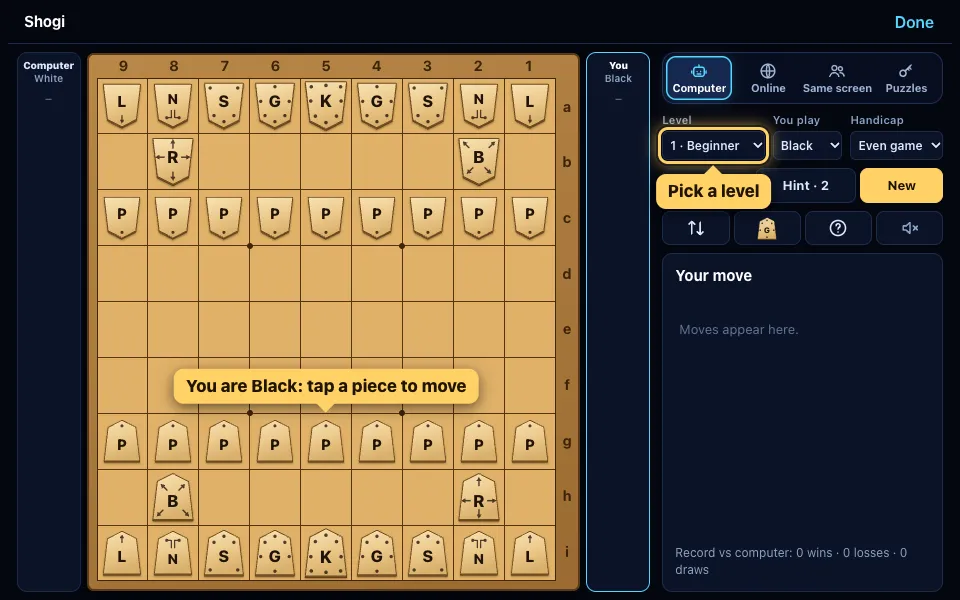
Start with the board
Black sits at the bottom and moves first. Each side has a king, a rook, a bishop, two golds, two silvers, two knights, two lances and nine pawns.
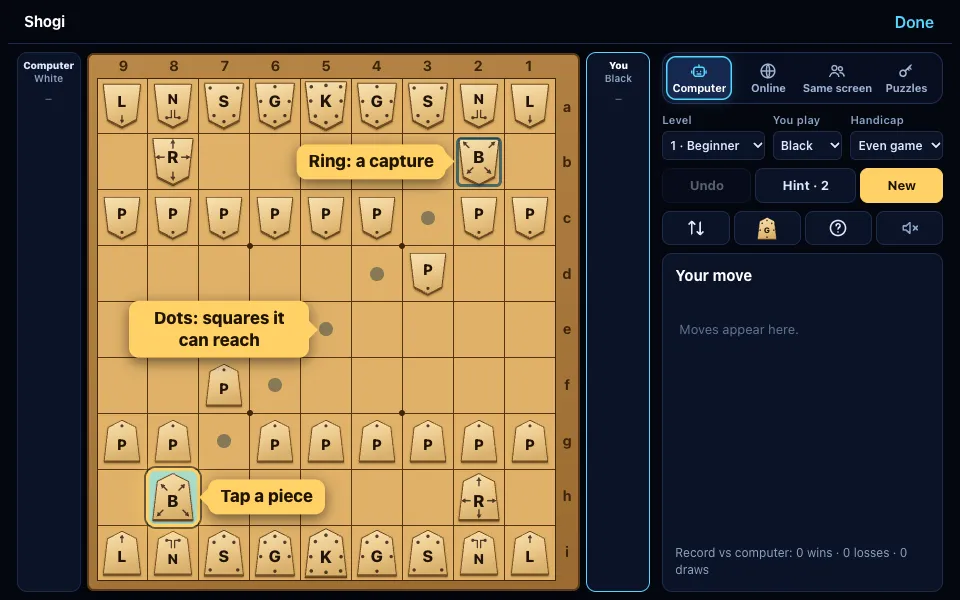
Tap a piece to see its moves
Pick up any piece and dots mark every legal square. A ring marks a piece you can capture. Tap a marked square to move there.
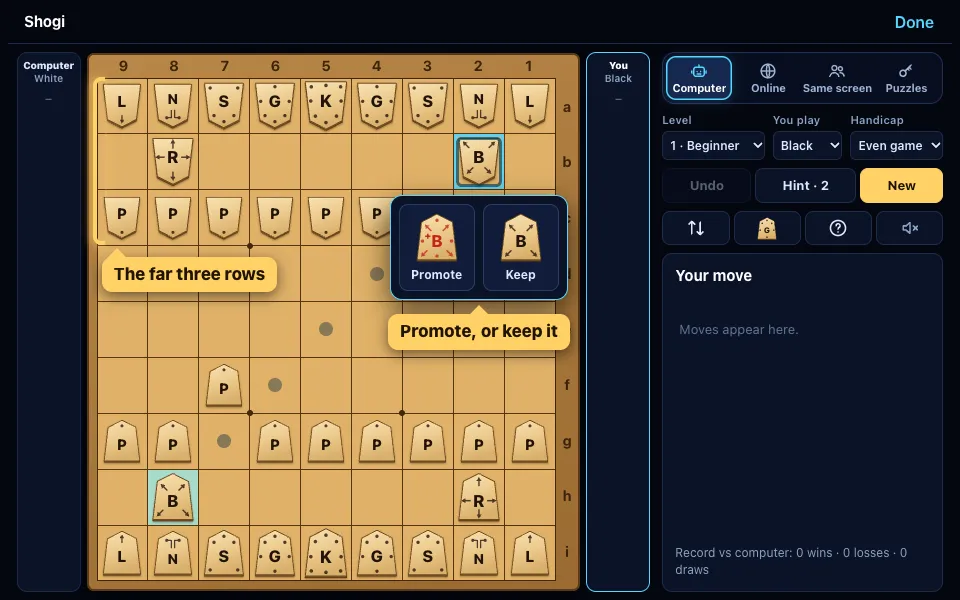
Promote in the far three rows
When a move touches the last three rows, choose Promote to flip the piece to its stronger red side, or Keep to leave it as it is.
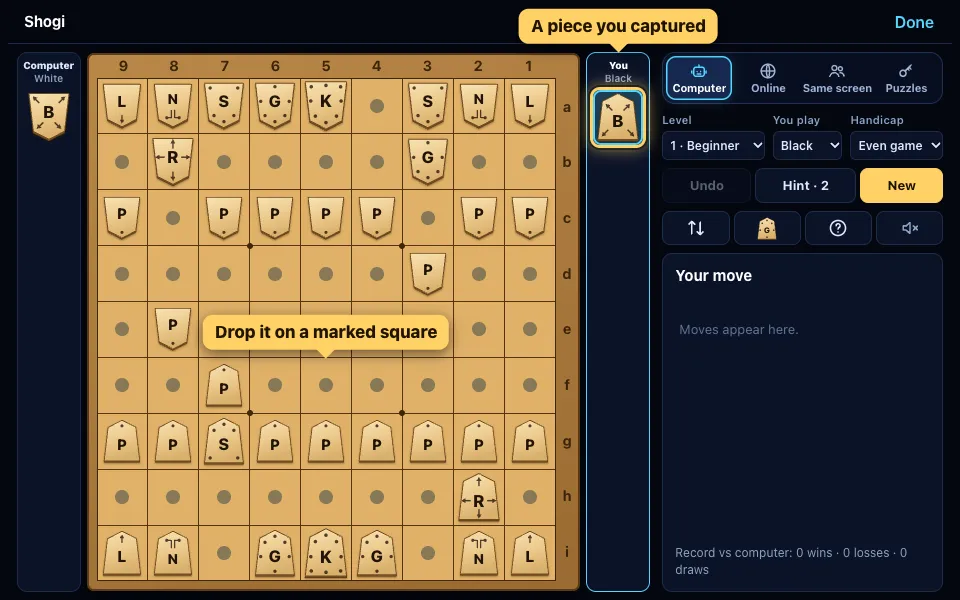
Drop a captured piece
Pieces you capture wait in your tray. Tap one and the board shows every empty square where it may be dropped as your move.
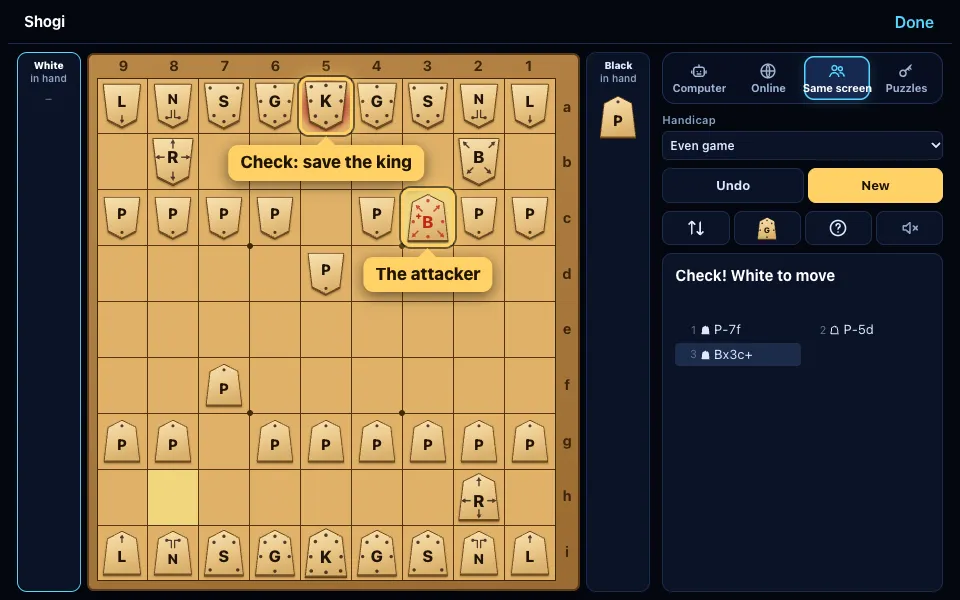
Chase the king
A king under attack glows red and must be saved at once. Trap it so that no move or drop helps, and that is checkmate.
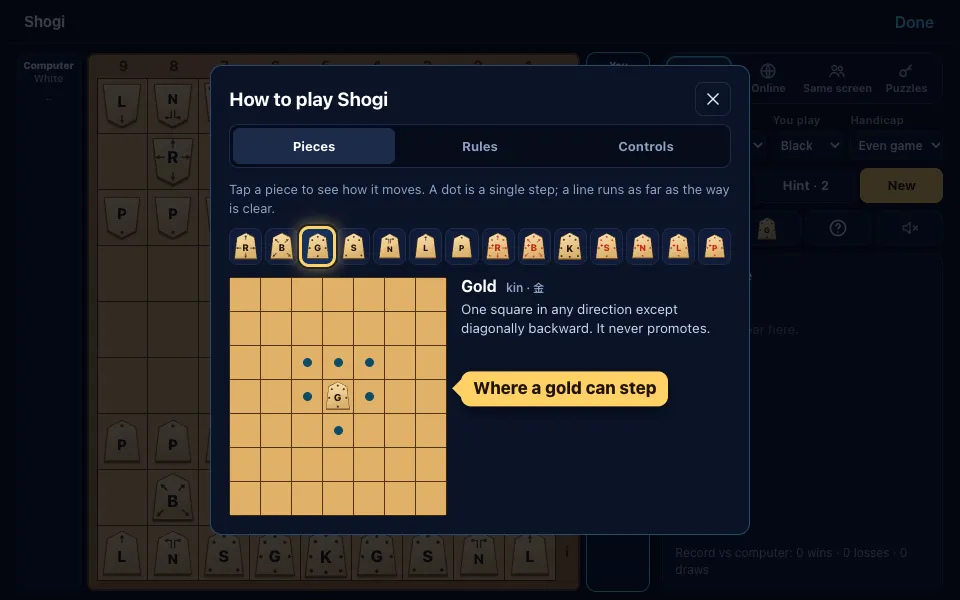
Look up any piece
Open How to play at any time. Tap a piece to see its moves on a small board: dots for single steps and shaded lines for long slides.
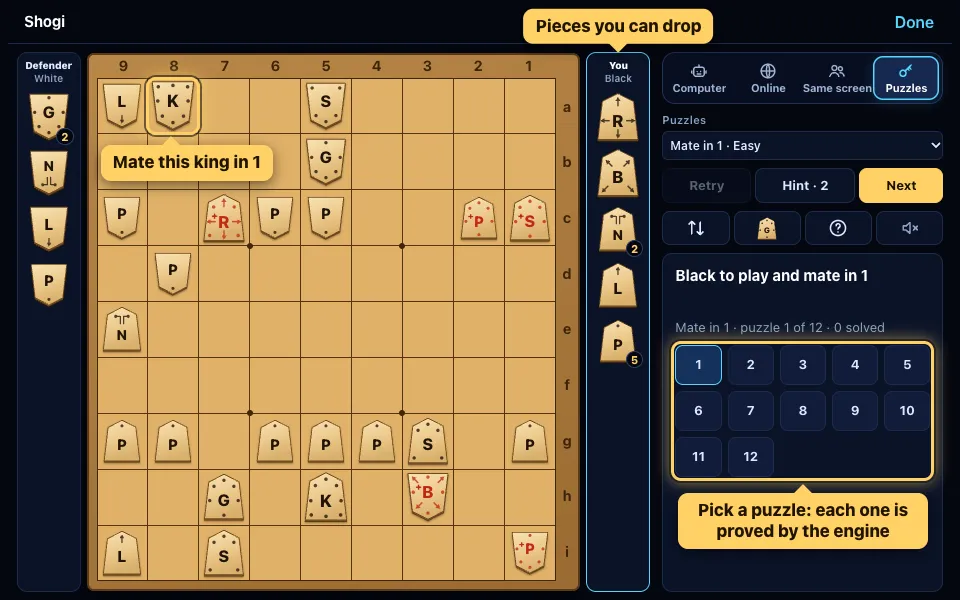
Train on mate puzzles
Switch to Puzzles for mate in 1 and mate in 3 problems. Every move must give check, and drops are often the answer.
The rules in full
- Black moves first and the players take turns. Your pieces point away from you, up the board.
- Tap one of your pieces to see where it can go, then tap a marked square. You can also drag the piece, or use the arrow keys and Enter.
- Land on an enemy piece to capture it. It goes to your tray beside the board and is now yours.
- Instead of moving, you may drop a piece from your tray on any empty square. It always arrives unpromoted.
- Three limits apply to drops: no second unpromoted pawn of yours on the same file, no piece where it could never move again, and no pawn drop that gives checkmate.
- The three rows furthest from you are the promotion zone. A piece that moves into, inside or out of the zone may promote: you choose Promote or Keep.
- A pawn or lance reaching the last row, or a knight reaching the last two rows, must promote because it could not move otherwise.
- When your king is attacked you are in check and must answer at once: move the king, capture the attacker, or block with a move or a drop.
- You win by checkmate, when the enemy king is attacked and no move or drop can save it. A player with no legal move at all also loses.
- If the same position comes up four times the game is a draw, unless one side gave check on every move of the cycle: then that side loses.
- If both kings escape into enemy territory, a player who meets the 27-point rule can declare a win.
Shogi tips and strategy
- Count the pieces in both trays before every move. A piece in hand can land almost anywhere, so most attacks in shogi arrive from the sky.
- Keep your king away from the centre and wrap two golds and a silver around it. A bare king is mated quickly once drops begin.
- Your rook and bishop do the attacking. Open a road for each of them early by pushing the pawn in front of the rook and the pawn beside the bishop.
- A pawn in hand is worth more than it looks. Drop it in front of the enemy king's guards to pull them out of place.
- You do not have to promote a silver or a knight. A silver can step backward diagonally and a knight can jump, and both lose that when they turn to gold.
- Golds cover the most squares at close range, so mates often end with a gold dropped next to the king.
- If a drop is refused, the note under the status line says which drop rule you ran into.
Shogi rules: the board and how the pieces move
Shogi is played on a board of nine files and nine ranks. All the squares are one colour, and both players use the same pieces: a piece belongs to whoever it points away from.
The king steps one square in any direction. The rook slides any distance in a straight line and the bishop any distance diagonally. A gold moves one square in any direction except diagonally backward. A silver moves one square diagonally or one straight ahead.
The knight jumps two squares forward and one to the side, and only forward. The lance slides straight ahead. The pawn steps one square ahead and, unlike a chess pawn, captures the same way it moves.
There is no castling, no double pawn step and no en passant. Squares are named by file number and rank letter, so 7f is the seventh file, sixth rank, and the move list beside the board uses those names.
Drops: captured pieces change sides
Nothing leaves a game of shogi for good. A captured piece goes into its captor's hand, and placing it back on the board counts as a whole move. That is why the game rarely thins out into a quiet endgame, and why draws are rare.
A dropped piece is always unpromoted, even if it was promoted when it was taken. It can promote later by moving normally.
Three rules limit drops. You may not have two unpromoted pawns on one file. You may not drop a pawn or lance on the last rank, or a knight on the last two, where it would never move. And a dropped pawn may not give checkmate, although it may give check, and a pawn that moves may mate.
Promotion in shogi
The last three ranks on your opponent's side are your promotion zone. Any move that starts or ends there lets you promote, and promotion is shown by a red mark on the piece.
A promoted rook becomes a dragon and adds one-square diagonal steps. A promoted bishop becomes a horse and adds one-square straight steps. A promoted silver, knight, lance or pawn moves exactly like a gold. Kings and golds never promote.
Promotion is usually right, but it is a choice. The chooser appears only when both options are legal, and a piece that would otherwise be stuck promotes on its own.
Check, checkmate, repetition and impasse
You may never leave your own king under attack, and the game does not let you: an illegal move is refused with a short note saying why. Checkmate ends the game, and so does having no legal move.
A position that occurs four times with the same player to move and the same pieces in hand is a draw. Perpetual check is the exception: a player who checks on every move of the repetition loses.
Impasse is handled by the 27-point declaration rule. When your king is inside the promotion zone and not in check, with at least ten of your other pieces in the zone, count 5 for each rook or bishop and 1 for every other piece, in the zone or in your hand. Black needs 28 points and White 27. If you qualify on your turn, a Declare a win button appears. The computer declares too.
There are no clocks. As a backstop, a game that reaches 500 moves is a draw.
Play shogi against the computer: four levels
The computer thinks in the background, so the page stays smooth, and it plays by exactly the same rules as you.
Beginner looks one move ahead and often misses things, which makes it a fair first opponent for someone who has just learned the moves. Easy and Medium look further and blunder less. Hard searches as deep as it can in about two seconds and will punish loose pieces and thin king shelters.
You can take moves back against the computer as often as you like. Hints are limited: two a game on Beginner, one on Easy and Medium and none on Hard. Your wins, losses and draws are kept on your device, and an unfinished game is waiting when you come back.
Handicap shogi
Shogi has a long tradition of handicap games, where the stronger player starts without some pieces so that both sides have a real fight. Choose from nine handicaps, from a single lance up to ten pieces.
In a handicap game the pieces come off White's side and White moves first. Play Black to receive the handicap while you learn, or play White to give one and test yourself.
Handicaps are available against the computer and on one screen. Online games are always even.
International or traditional shogi pieces
Both sets are drawn as proper five-sided pieces that point at the enemy. The International set shows a letter you may know from chess notation, with small marks for the directions the piece moves, so you can read the board on your first day.
The Traditional set uses the kanji found on wooden pieces, with promoted sides in red. Switch sets with one button at any time.
Shogi mate puzzles
Mate puzzles, known as tsume shogi, are how players sharpen their finishing. You play Black, every move you make must be check, and the defender always picks the answer that holds out longest.
There are twelve mate in 1 puzzles and eight mate in 3 puzzles here. Each was found by our own engine and checked to have exactly one winning first move. The easy set gives two hints a puzzle, which point to the piece but never the square; the hard set gives none.
Play shogi online or on one screen
Same screen mode turns the page into a board for two people sitting together, with undo and optional handicaps. Flip the board at any time.
Choose Online to play another person. Share a link or a short code with a friend, or take a quick match. Moves are checked on the server with the same rules engine, so both players always see the same legal game.
It works with a mouse, a touch screen or a keyboard, on a phone or full screen on a desktop, with nothing to install.
Shogi FAQ
Is this shogi game free?
Yes. Shogi is free to play in your browser with no download and no account. Make a free account if you want your wins on the leaderboards.
How is shogi different from chess?
The biggest difference is drops: captured pieces join your side and can be placed back on the board. The board is nine by nine, most pieces move a shorter distance, almost every piece can promote, and there is no castling.
Can I play shogi without reading kanji?
Yes. The International piece set uses letters and move marks instead of kanji, and it is the default. You can switch to the Traditional set at any time.
Who moves first in shogi?
Black moves first in an even game. In a handicap game White, the side that gave up pieces, moves first.
What is the two pawn rule?
You may not drop a pawn on a file where you already have an unpromoted pawn. A promoted pawn on the file does not count.
Can a game of shogi end in a draw?
Rarely. A fourfold repetition without perpetual check is a draw, and so is a game that reaches 500 moves. Impasse is settled by the 27-point declaration rule.
Can I undo a move?
Yes, against the computer and in same screen games. Undo is not available online, and wins on Hard reach its leaderboard only when no moves were taken back.
Does shogi work on a phone?
Yes. The board fits a phone held upright, with large touch targets, tap or drag to move, and a full screen button.
More games

Xiangqi
Chinese chess with cannons, a river and a palace. Play the computer at five levels, a friend on one screen or an opponent online, with every legal move shown.
PLAY →
Rocket Chess
Play chess online against a friend or another player, the computer at four levels, or a friend on the same screen. Full rules, hints and undo.
PLAY →
Chess Variants
Chess960, King of the Hill, Three-Check, Atomic, Horde and Crazyhouse against the computer at four levels, a friend on one screen, or online with a clock.
PLAY →
Chess Puzzles
A daily chess puzzle with a streak, Rocket Rush against the clock, a rated ladder that tracks your puzzle rating, and practice by theme: mates, forks, pins and more.
PLAY →
Rocket Checkers
Play checkers online against a friend or another player, the computer at four levels, or a friend on the same screen. Real rules, forced captures and multi-jumps.
PLAY →
Rocket Reversi
Flip your opponent's discs and own the board. Play Reversi against the computer at four levels, a friend online by link, a random player, or on one screen.
PLAY →