Math Meridian: Live Math Battles on a World Globe
Live mental-maths races on a spinning globe of real players: the same problem for everyone, one answer each, fastest right answer wins.
What is Math Meridian?
Math Meridian is a live maths race on a globe. Every glowing dot is a person connected right now, and when a match starts everyone in the room gets the same problem at the same moment. Work it out, type the answer, and be right before the others.
The problems come from ten topics and seventy kinds of question, from quick sums to fractions, percentages, equations, sequences, probability, geometry and logarithms. Each one is made fresh by the server, so nobody can learn the answers, and difficulty is matched to the people in the room.
You get one answer per problem. A right answer scores 100 points plus up to 50 for speed, two hints are there if you want them, and after every problem you see the worked solution. Win matches and your rating climbs.
Not in the mood for company? Solo practice starts in one tap, with no clock and a level that follows how you are doing, and the Daily Five gives everyone the same five problems each day.
How to play Math Meridian
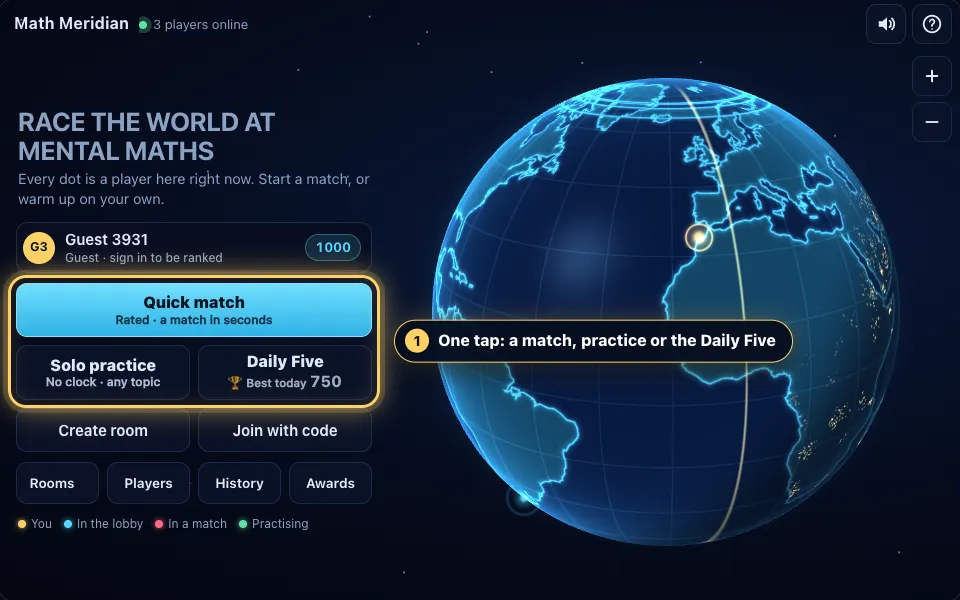
Start from the globe
Every dot on the globe is a player connected right now. Tap Quick match to race others straight away, Solo practice to warm up with no clock, or the Daily Five for today’s five problems.
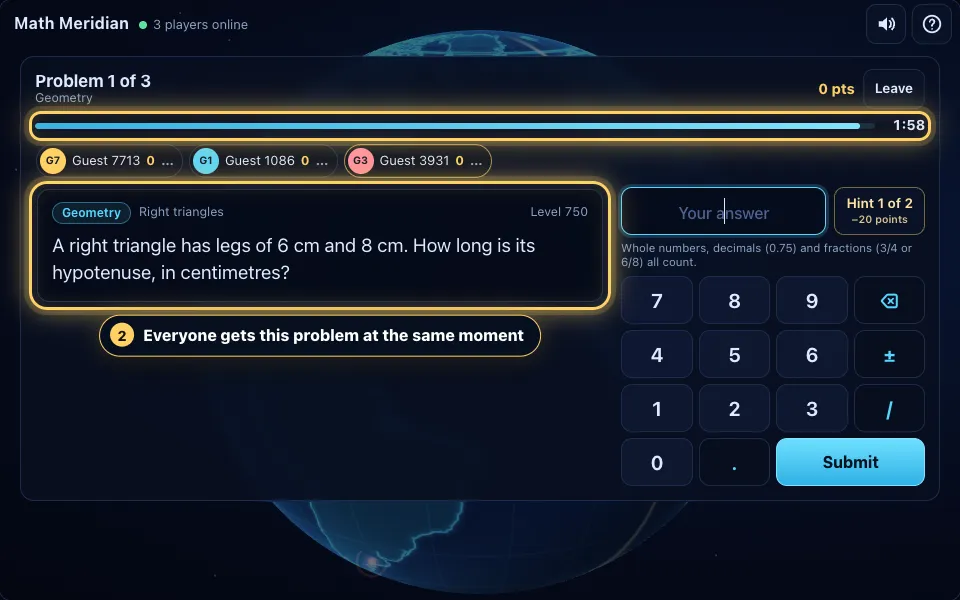
Read the problem
When the countdown ends, everyone in the room gets the same problem at the same moment. The bar above it is the clock, and the chips show how each player is doing.
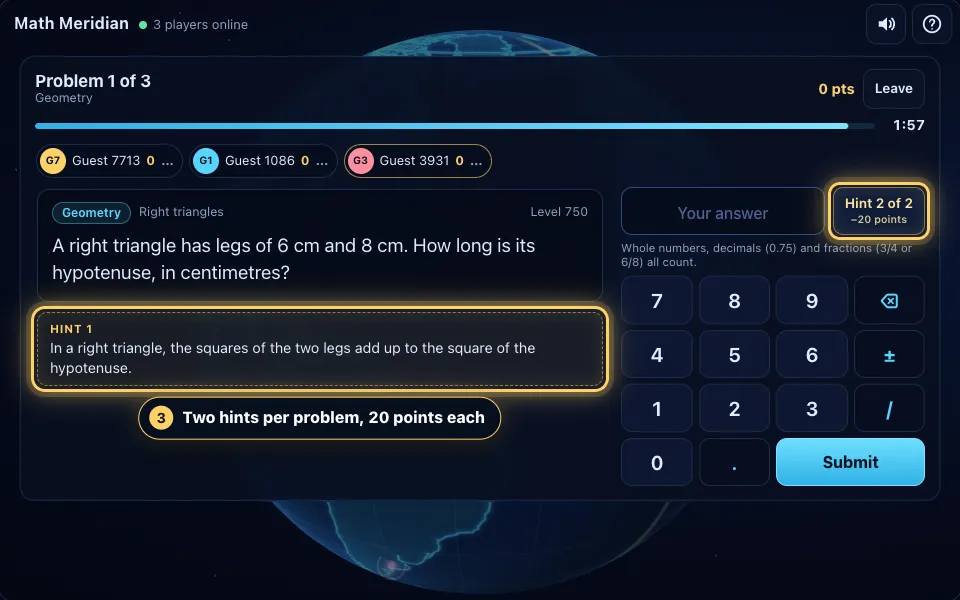
Ask for a hint if you need one
Each problem has two hints, opened one at a time and only when you tap the button. In a match each one costs 20 points on that problem, so use them when you are truly stuck.
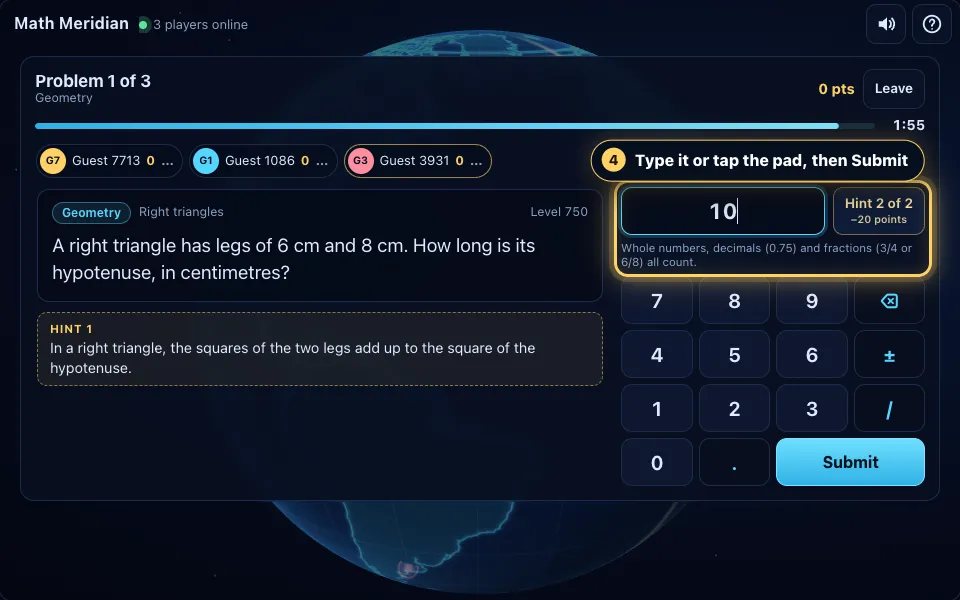
Type your answer and submit
Type with your keyboard or tap the number pad, then press Submit or Enter. Whole numbers, decimals and fractions all count, and you get one answer per problem.
Learn from the reveal
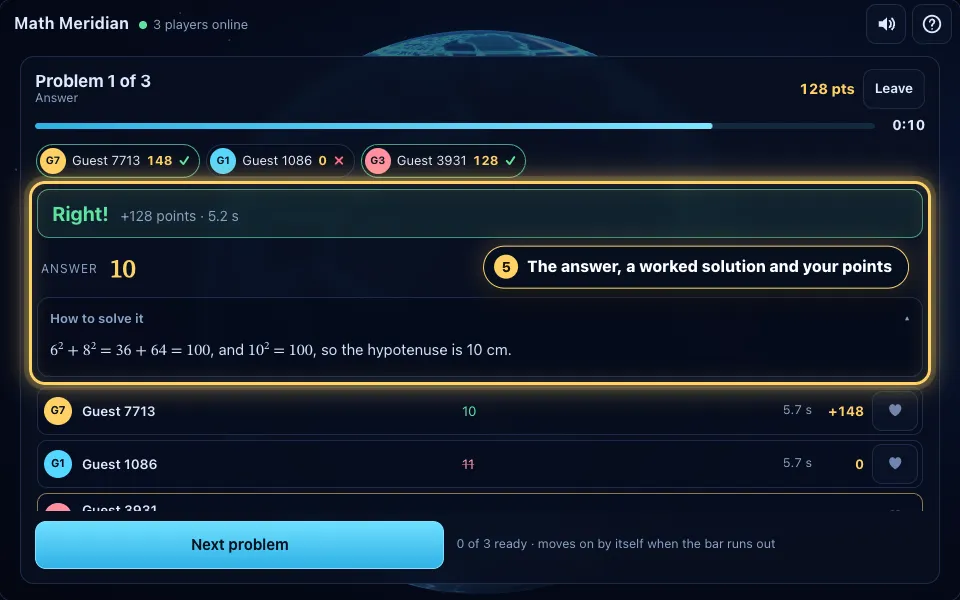
When everyone has answered or time runs out, the reveal shows whether you were right, the answer, a worked solution and every player’s points for that problem.
See who won
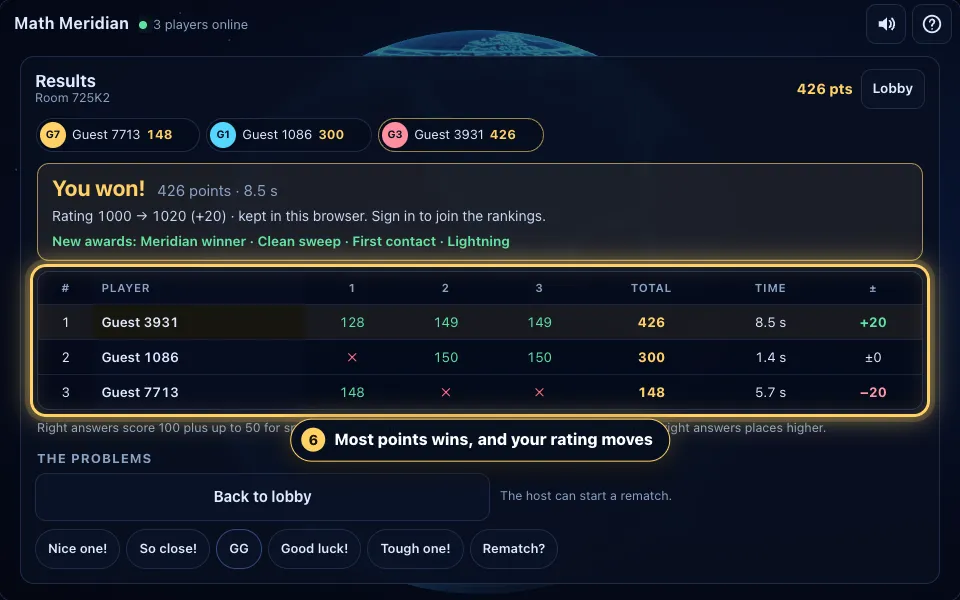
After the last problem the results table shows every player’s points on every problem, their time and their rating change. The host can start a rematch from here.
The rules in full
- Pick a way to play from the lobby: Quick match, Solo practice, the Daily Five, or a room of your own.
- Quick match seats you with other players straight away. If nobody else is around after a few seconds, clearly labelled computer pacers fill the empty seats so there is always a game.
- In a room, the host chooses 3, 5, 10 or 15 problems and 0:30, 1:00, 2:00 or 3:00 for each one. Everyone taps Ready, then a short countdown starts the match.
- Each problem shows its topic, its level and a clock. Type your answer in the box with the number pad or your keyboard and press Submit or Enter.
- You get one answer per problem. Once it is in, it is locked, so check it before you send it.
- A right answer scores 100 points plus up to 50 for speed, so 150 at most. A wrong answer, or no answer before the clock runs out, scores 0.
- Two hints are available on every problem, but only if you ask. In matches and the Daily Five each hint costs 20 points on that problem.
- When everyone has answered or the clock ends, the reveal shows the right answer, a worked solution and how each player did.
- After the last problem the most points wins. If two players are level, the one who used less time on their right answers finishes ahead.
- Rated matches move your rating up or down. Late arrivals watch the match and can take a seat for the next one.
Math Meridian tips and strategy
- Read the whole question before you start. Many word problems hide the one number that matters in the last line.
- Fractions do not need to be simplified: 6/8 counts the same as 3/4. Save the seconds and send the first right form you have.
- Answers are checked exactly, so 0.33 is not 1/3. When a result does not end neatly as a decimal, type it as a fraction.
- Speed points only go to right answers. A careful answer in twelve seconds beats a wrong one in four.
- A hint costs 20 points but a wrong answer costs everything. If you are stuck halfway, the first hint is often worth it.
- Use Solo practice on one topic at a time. Its level rises when you answer quickly and falls when you miss, so it finds your edge fast.
- On a keyboard you can type digits anywhere on the game and press Enter. The minus key flips the sign.
A live math battle on a world globe
The first thing you see is the Earth turning slowly in the dark, with glowing coastlines, a night side dotted with city lights and a soft blue rim of atmosphere. Every dot on it is a player connected at this moment, coloured by what they are doing: in the lobby, in a match or practising. Your own dot is gold.
Drag the globe to turn it, pinch or use the buttons to zoom, and tap any dot to see who it is, their rating and what they are up to. When players share a match, an arc links their dots, and a dot flares each time someone gets a problem right.
Dots are placed only roughly. The server rounds a connection’s location to a degree or two before anyone sees it, and the page never asks your browser where you are. If your device cannot draw 3D, a flat world map shows the same dots and cards.
Scoring, hints and ties
Every right answer is worth 100 points. On top of that come up to 50 speed points, which shrink as the clock runs down, so the best score on any problem is 150. A wrong answer or no answer scores nothing.
Two hints wait under every problem. The first usually names the method and the second takes you most of the way. In matches and the Daily Five each hint you open takes 20 points off that problem, and the reveal shows who used them.
Most points after the last problem wins. Players level on points are split by the time they spent on their right answers, less time first. The results table shows every problem for every player, so you can see exactly where a match was won.
Ten topics, seventy kinds of problem
Problems come from ten topics: arithmetic, fractions, percent and ratio, algebra, number theory, sequences, counting and chance, geometry, powers and logs, and word problems. Inside them are seventy families, from times tables and order of operations to simultaneous equations, remainders, combinations, areas, compound interest and logarithms.
Every problem is generated on the spot from a random seed and set at a level between about 200 and 3000. Fractions, powers and roots are typeset properly, so the question reads like it would on paper, even on a small phone.
Each family is checked by a second, independent method in our tests, so the answer the game marks as right really is right.
Ratings and difficulty
Your rating starts at 1000 and moves after every rated match, using an Elo-style formula that compares you with every other player in the room. Beat stronger players and you gain more; lose to weaker ones and you drop more. New players move faster for their first ten matches. A match only counts once its first problem is finished.
Ratings fall into bands, from Starter and Climber through Solver, Sharp, Expert and Master to Grandmaster. Quick matches and rooms on automatic difficulty are rated, and the server picks problems near the level of the people playing. A host can instead set a manual level range with a histogram of the problems it will draw from; those friendly matches are not rated.
Guests can play everything and keep a rating in their browser for a month. Signed-in players keep theirs for good, appear in the Top rated table and get a full match history with a rating graph.
Rooms, quick matches and watching
Quick match is the fastest way in: you join a waiting match or start one, and after a short wait any empty seats are filled by computer pacers, each one clearly labelled. Pacers answer at a human pace and sometimes miss or run out of time. They have no rating of their own, and a result against a pacer counts half as much as one against a person.
Create room makes a room of up to eight players. An invite room is joined with its code or link; a public room also appears in the Rooms list for anyone to join. The host sets the number of problems, the time for each and the difficulty, and starts when everyone is ready.
Anyone who arrives after the start watches the match live and takes a seat for the rematch. There is no free-text chat: players cheer each other with quick phrases such as “Nice one!” and “GG”, and can send a heart for an answer they liked.
The Daily Five and solo practice
The Daily Five is the same five problems for everyone, new each day at midnight UTC. You get two minutes per problem and one go per day, scored like a match, for up to 750 points. Signed-in players go on the Daily Five board and build a streak of days in a row.
Solo practice has no clock and no rating. It comes in sets of ten, and its level rises when you answer quickly and falls when you miss, so it settles where you are challenged but not lost. Pick Mixed topics or drill one topic, each with its own level.
Practice keeps a streak of right answers in a row; hints are free here but a hinted answer does not add to the streak. A streak of three or more goes on the Longest practice streak board, and eighteen awards mark milestones along the way.
Typing answers on a phone or a keyboard
Answers can be whole numbers, decimals or fractions: 0.75, 3/4 and 6/8 all count when the answer is three quarters. Fractions do not have to be in lowest terms. Answers are checked exactly, so 0.33 is not accepted for 1/3. When a problem has a unit, it is shown beside the box, and the percent sign is optional.
On a phone the game uses its own number pad with keys for the fraction bar, the decimal point and plus or minus, so the system keyboard never pops up over the problem. The whole problem, the answer box and Submit stay on screen together, even on small phones and with the phone turned sideways.
On a computer you can type straight away: digits, the slash and the point go into the box from anywhere on the game, Backspace deletes, minus flips the sign and Enter sends. If your connection drops or you reload the page mid-match, you come straight back to the same problem.
Math Meridian FAQ
Is Math Meridian free?
Yes. Every mode is free to play in your browser, with no download. You can play as a guest; signing in keeps your rating and puts you on the boards.
Can I play Math Meridian on my phone?
Yes. It is built for phones as well as computers, with its own number pad so the keyboard never covers the problem, and the whole play area fits even small screens.
How is a match scored?
A right answer scores 100 points plus up to 50 for speed. Each hint costs 20 points on that problem, and a wrong answer or no answer scores 0. Most points wins.
What answer formats are accepted?
Whole numbers, decimals and fractions. 3/4, 6/8 and 0.75 all count for three quarters, and fractions do not need simplifying, but answers are exact, so 0.33 does not count for 1/3.
How does the rating work?
Everyone starts at 1000. After each rated match your rating moves by an Elo-style amount that depends on where you finished and how strong the others were.
What if nobody else is online?
There is always a game. Quick match fills empty seats with labelled computer pacers after a few seconds, and Solo practice and the Daily Five never need anyone else.
How many players can be in a match?
Up to eight players in a room, plus people watching. Quick matches seat four.
What is the Daily Five?
Five problems that are the same for everyone each day, with two minutes for each and one go per day. Signed-in players go on the Daily Five board.
Does the globe show my real location?
Only roughly. The server rounds the location of your connection to a degree or two before showing a dot, and the game never asks your browser for your location.
Is there chat?
No free-text chat. Players can send a few friendly preset phrases, like Nice one! or GG, and a heart for someone’s answer.
More games
Sudoku
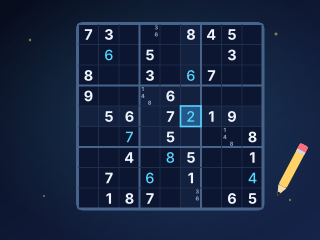
A fresh daily Sudoku plus unlimited puzzles from Easy to Expert, graded by the techniques they need. Notes, hints that explain themselves, undo and a timer.
PLAY →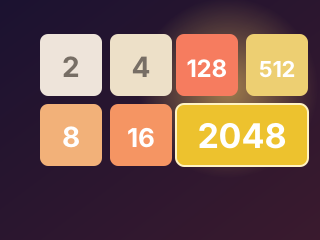
2048
The original open-source 2048, hosted here with no ads. Slide tiles, merge pairs, reach 2048 and keep going.
PLAY →
Type Tune
A free typing test where every key plays music: type classical masterpieces note by note, from easy words for 5-year-olds to Virtuoso, plus an adaptive trainer, lessons, an arcade and races.
PLAY →
Cat Sudoku
Sudoku with nine silly cats in place of the numbers. Kitten 4×4, 6×6 and full 9×9 boards, a daily puzzle and cats that purr when you get a row right.
PLAY →
Mini Crossword
A fresh 5x5 crossword every day, solved in a minute or two. Free archive, practice puzzles, check and reveal, a timer and streaks.
PLAY →