Futoshiki: Free Online Inequality Puzzles, New Every Day
The Japanese inequality puzzle: fill every row and column with each digit once while every < and > sign holds. A Daily Futoshiki, endless puzzles from 4×4 to 9×9 and from Easy to Extreme, pencil notes and hints that explain the logic.
What is Futoshiki?
Futoshiki is a Japanese number puzzle, free to play online here on your phone, tablet or computer. Like Sudoku, every row and every column holds each digit exactly once. Unlike Sudoku, there are no boxes: instead, small signs sit between some of the cells, and every one of them must hold. A < sign between two cells means the left one is smaller, just as in maths.
A new Daily Futoshiki arrives every day, the same puzzle for everyone, starting gentle on Monday and deepening to an Extreme puzzle on Sunday. Beyond the daily, you can play as many fresh puzzles as you like at six sizes from 4×4 to 9×9 and five levels from Easy to Extreme.
Every puzzle has exactly one solution and can be solved by logic alone, never by guessing. Notes, auto notes, row and column highlighting, clash warnings, undo and redo are all built in. The hint button doesn't just give an answer: it shows the next step and explains, in plain words, why it has to be true.
How to play Futoshiki
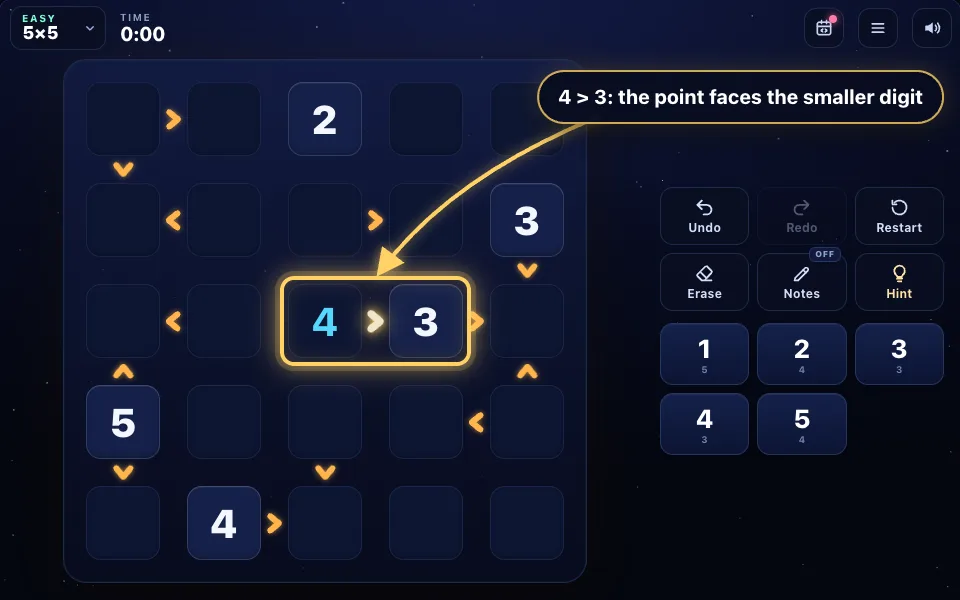
Read the signs
A sign between two cells always points at the smaller digit: 4 > 3 across, ∧ and ∨ up and down. Every sign has to be true when the grid is full.
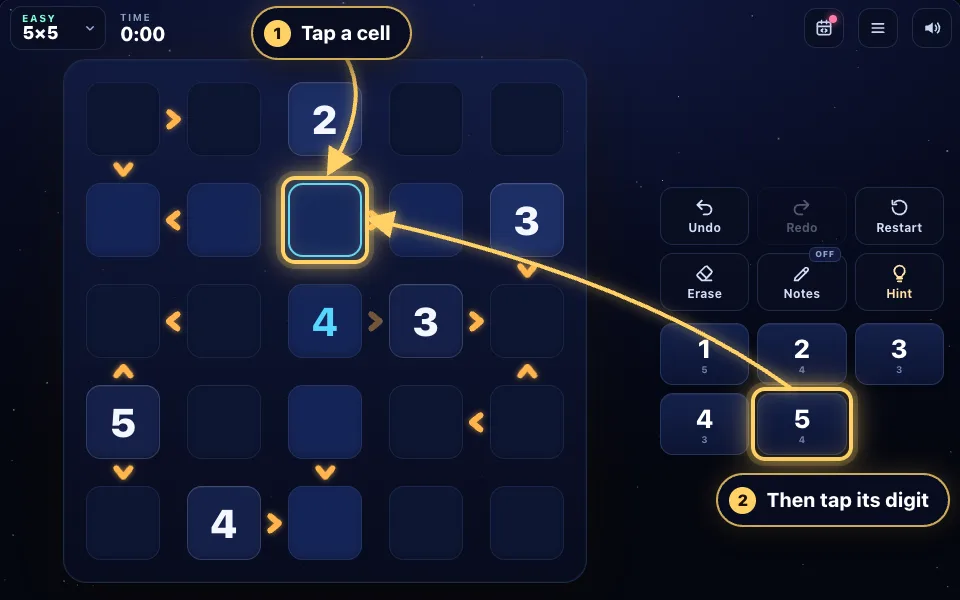
Pick a cell, then its digit
Tap or click an empty cell, then tap a number on the pad or type it. Each row and each column needs every digit from 1 to the board's size exactly once.
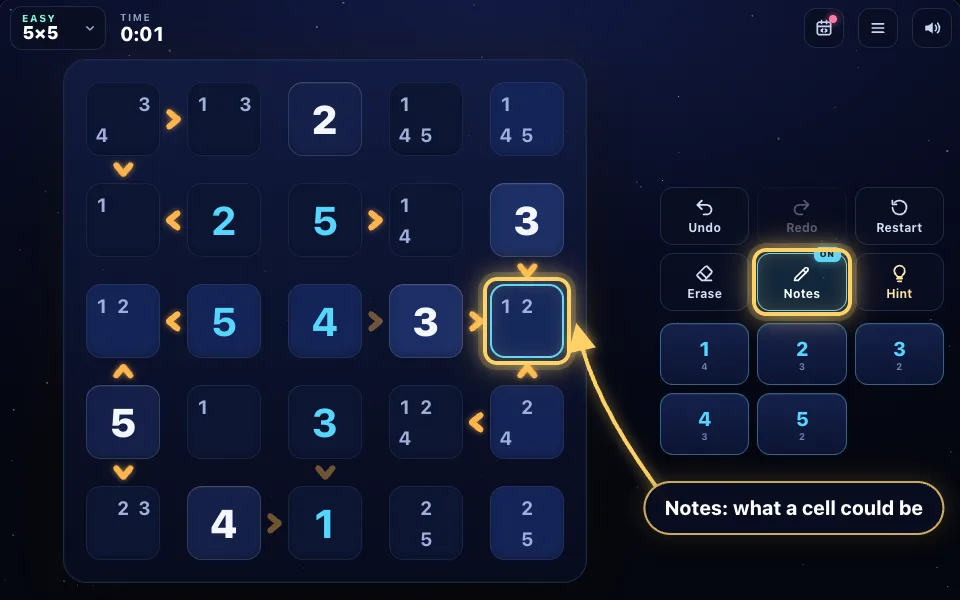
Pencil in notes
Turn on Notes to write the digits a cell could still be. Placing a digit tidies it out of the notes in its row and column, and Auto notes can fill them all in for you.
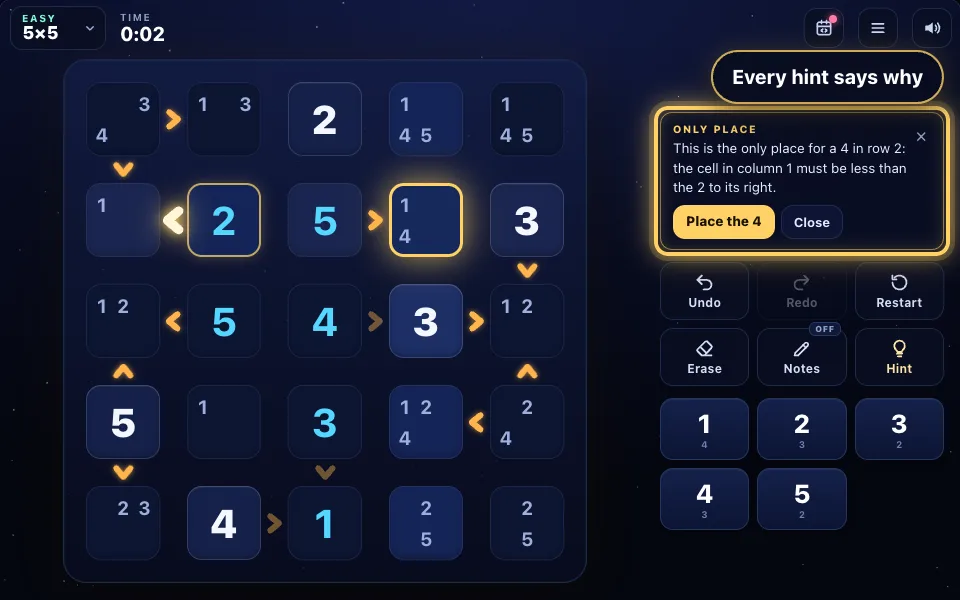
Ask for a hint that explains
Stuck? Hint finds the next logical step, lights up the cells and signs it uses and says why in plain words. Press it again to place the digit.
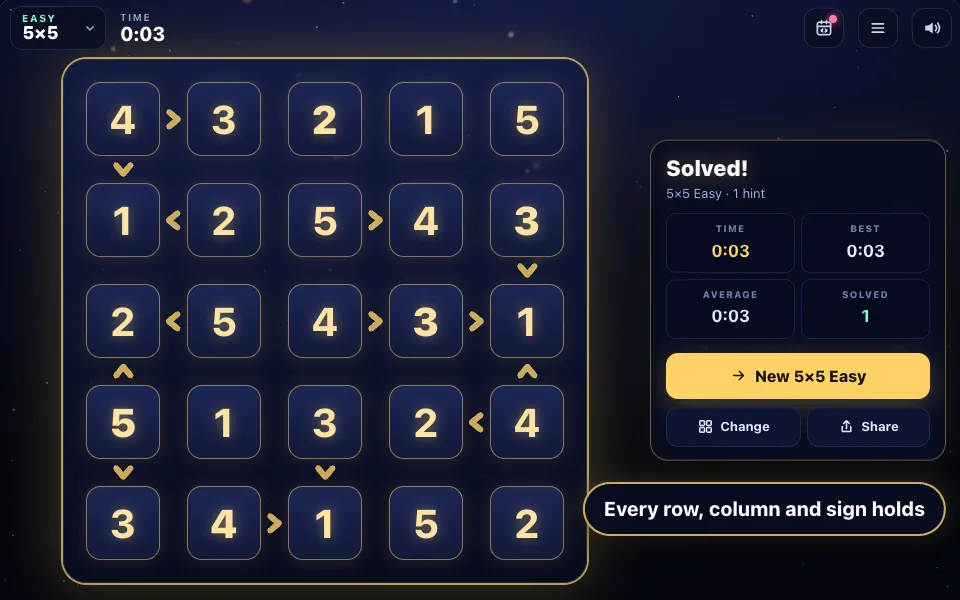
Fill every row and column
When the last digit goes in and every row, column and sign holds, the grid lights up. Your time, best and average are saved for that size and level.
The rules in full
- The goal: fill every empty cell so that each row and each column holds every digit from 1 to the size of the board exactly once. A 6×6 uses 1 to 6.
- Signs sit between some neighbouring cells. The point of the sign always faces the smaller digit: 2 < 5 across, and ∧ or ∨ up and down. Every sign must be true when you finish.
- Tap or click a cell, then tap a number on the pad or type it. Its row and column light up, along with every cell holding the same digit, and the same number again clears it.
- Turn on Notes (or press N) to pencil in the digits a cell could still be. A long press on a number writes it as a note whatever mode you're in, and Auto notes can fill every cell's candidates for you.
- When a digit repeats in a row or column, or two digits break a sign, they turn red. You can switch these warnings off in Settings if you'd rather find mistakes yourself.
- Stuck? Hint shows the next logical step, lights up the cells and signs it uses and explains it in words. Press it again to place the digit.
- Undo, Redo, Erase and Restart are always free. Fill the last cell correctly and the grid lights up: your time, best and average are saved for that size and level.
- With a keyboard: arrows move, 1 to 9 fill, Shift with a digit writes a note, Backspace erases, Ctrl+Z undoes and H asks for a hint.
Futoshiki tips and strategy
- Start at the signs. A cell that is greater than a neighbour can never be 1, and a cell that is smaller can never be the top digit. Those two facts are often enough to find the first digits of an Easy puzzle.
- Follow chains. When three cells are linked by rising signs, a < b < c, the first can be at most 3 on a 5×5 and the last at least 3. Long chains pin digits almost by themselves.
- Look for the only place. If a row still needs a 5 and every other empty cell in it is ruled out, the 5 goes in the last one, even if that cell could hold other digits.
- Use notes once the easy moves run out. Candidates make pairs visible: two cells in a row that can only be 2 or 4 take both digits, so nothing else in that row can be 2 or 4.
- A sign next to a placed digit is the strongest clue on the board. A cell that must be greater than a 4 on a 5×5 board has to be 5.
- Watch the ends of the range. The top digit can never sit on the small side of a sign and the 1 can never sit on the big side, so in a grid full of signs each has only a few places left in a row.
- When a hint says What if, it means trying one digit leads to a broken rule a few steps later. On Extreme puzzles, look for cells with only two candidates and test one.
- Leave the clock hidden if you'd like to play calmly. Your times are still recorded for your stats.
What is Futoshiki? The inequality puzzle from Japan
Futoshiki (不等式) means “inequality” in Japanese, and that's the whole idea of the puzzle. It was devised in Japan in 2001 by the puzzle author Tamaki Seto and spread around the world a few years later, when newspapers in Britain began printing it beside their daily Sudoku.
In English it is sometimes called More or Less, or inequality Sudoku. The grid is a Latin square, so every row and column holds each digit once, but where Sudoku uses boxes, Futoshiki uses signs. A handful of given digits and a scatter of < and > signs is enough to fix every other cell.
Futoshiki rules, sizes and what this version offers
The rules never change: each row and column holds the digits 1 to N once, and every sign between two cells must be true. Here you can play six board sizes, from a quick 4×4 to a demanding 9×9, at five levels: Easy, Medium, Hard, Expert and Extreme.
Every puzzle is built fresh from a random Latin square. The game scatters inequality signs, then a logical solver adds only the given digits the level's techniques need and takes away every one it can do without. A final check proves there is exactly one solution, so you'll never meet a puzzle that needs a guess.
Your unfinished puzzle is saved as you play, so you can close the tab and pick it up later. Stats keep the puzzles you've solved, your best time and your average for every size and level.
Futoshiki strategy: from single signs to chains and pairs
Begin with what each sign rules out. A cell on the big side of a sign can't be 1, and a cell on the small side can't be the largest digit. A sign beside a digit that's already placed is even stronger: a cell that must be less than 3 can only be 1 or 2.
Then follow the chains. When signs line up, a < b < c < d, each step narrows the next, and the cell at the bottom of a long chain is pushed towards 1 while the top is pushed towards N. Combine that with the digits already in each row and column and singles appear: cells with only one digit left, and digits with only one place left in a line.
Harder puzzles ask for pencil marks. Pairs and triples (two cells sharing the same two candidates, say) clear those digits from the rest of their row or column. X-Wings do the same across two rows at once. The Extreme level asks for what-if reasoning: test a candidate, follow the consequences, and rule it out when something breaks.
Five difficulty levels and the Daily Futoshiki
Levels here are graded by the logic a puzzle needs, not just by how many digits it shows. Easy puzzles fall to singles and signs beside placed digits. Medium needs inequality chains. Hard needs pairs, Expert needs triples or X-Wings, and Extreme needs at least one what-if step. A 4×4 grid is too small for the deepest ideas, so it offers Easy, Medium and a Hard that asks for one short what-if.
The Daily Futoshiki is the same puzzle for everyone on the same date. Monday's is a gentle 5×5 Easy; the week builds through 6×6 and 7×7 puzzles to an 8×8 Expert on Saturday and a 7×7 Extreme on Sunday. Solve it to grow your streak, and open the calendar to catch up on any day you missed.
Futoshiki hints that explain the logic
A hint here is a lesson, not a spoiler. It looks at the board as it is now, finds the next step a careful solver would take near the cell you're on, and says why it must be true: “This cell must be 4: it is greater than the 3 to its left and 5 is already in its row.”
The cells and signs behind the reasoning light up, so you can see the step for yourself before you place the digit. If a digit you've entered is wrong, the hint points it out first. Hints are always available and counted on the result card.
Playing Futoshiki on your phone or with a keyboard
On a phone, the board fills the width of the screen with a number pad and the tools right below it, sized for your thumb. Tap Full screen, or turn your phone sideways, for the biggest grid.
On a computer, the pad and tools sit beside the board and the whole game plays from the keyboard, hints and auto notes included. The clock pauses while a menu is open or the tab is hidden, and the board describes each cell and its signs to screen readers.
Futoshiki FAQ
What is Futoshiki?
Futoshiki is a Japanese logic puzzle played on a square grid. Fill each row and column with the digits 1 to N once each, so that every inequality sign between neighbouring cells is true. Its name means inequality.
How do the signs work in Futoshiki?
The point of the sign faces the smaller number, just as in maths. 3 < 5 across means the left cell is smaller; ∧ between two cells in a column means the top cell is smaller, and ∨ means it is larger.
Is this Futoshiki free to play online?
Yes. Every puzzle and the Daily Futoshiki are free in your browser, with no download and no account. Make a free Rocket Games account if you want your solves on the leaderboards and your results on every device.
Does every Futoshiki puzzle have exactly one solution?
Yes. Every puzzle is checked by an exact solver and by a logical one, so it has exactly one solution and can be reached step by step without guessing.
How is Futoshiki different from Sudoku?
Both fill rows and columns with each digit once, but Futoshiki has no 3×3 boxes and works at any size. Its clues are the inequality signs between cells, which makes it feel more like a chain of small comparisons than a search for missing digits.
What size and level should I start with?
A 5×5 Easy is a good first puzzle: small enough to see the whole board, big enough for the signs to matter. Move to 6×6 Medium once chains of signs feel natural.
What is the Daily Futoshiki?
One puzzle a day, the same for everyone on the same date. Monday's is a 5×5 Easy and the puzzles deepen through the week to a 7×7 Extreme on Sunday. Solving it each day builds your streak, and the calendar lets you play past days.
How do hints work?
A hint finds the next logical step from your board, lights up the cells and signs it uses and explains the reasoning in words. Press Hint again, or tap Place, to put the digit in. If one of your digits is wrong, the hint shows you that first.
What does What if mean on an Extreme puzzle?
Some Extreme puzzles need a short trial: put a candidate in a cell, follow the singles and signs it forces, and if a row, a column or a cell runs out of options, that candidate was wrong. The hint tells you which rule breaks.
Is there a Futoshiki leaderboard?
Yes. The Daily Futoshiki has its own board for the day's fastest solves, and there are boards for the fastest 6×6 Easy, 7×7 Medium, 7×7 Hard, 8×8 Expert and 9×9 Extreme puzzles, plus the most dailies solved. Solves that lean on hints don't rank, and Expert and Extreme times need no hints at all.
Can I use notes or auto notes?
Yes. Notes mode pencils small digits into a cell, and a long press on a number writes a note at any time. Turn on Auto notes in Settings to start every puzzle with each possible digit filled in, or fill them in whenever you like from Settings (A on a keyboard). Tidy notes clears a digit from its row and column as you place it.
Is my game saved if I leave?
Yes. Your unfinished puzzle, your daily progress, your streak and your stats for every size and level are saved in your browser, so you can come back and carry on.
More games
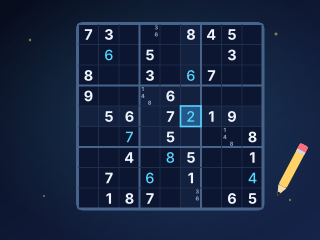
Sudoku
A fresh daily Sudoku plus unlimited puzzles from Easy to Expert, graded by the techniques they need. Notes, hints that explain themselves, undo and a timer.
PLAY →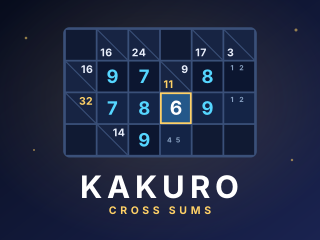
Rocket Kakuro
Kakuro cross sums: a daily puzzle and unlimited grids from 6×6 to 14×14, Easy to Expert. A combination helper, notes, explained hints and undo.
PLAY →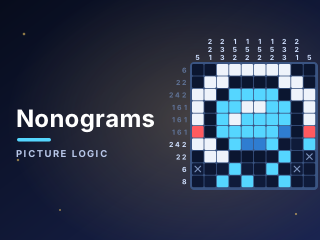
Nonograms
Fill the grid from the number clues to reveal a hidden pixel picture. A daily puzzle, unlimited puzzles from 5×5 to 25×25 and an album of hundreds of pictures.
PLAY →