Cryptograms: Crack the Code, Reveal the Quote
Crack a letter-swap cipher to reveal a famous quotation. A Daily Cryptogram, more than 700 public domain quotes and proverbs at four levels, smart hints, a quote book and streaks.
What is Cryptograms?
Cryptograms are quotations written in code, and here you can play cryptogram puzzles free in your browser on a phone, tablet or computer. Every letter of a famous line has been swapped for another letter, the same way all the way through. Crack the cipher and the words appear.
Tap a letter, then type what you think it really stands for, and every copy of it fills in at once. Short words, apostrophes and double letters give you footholds, and each letter you get right opens up the rest. When the last one lands, the quote lights up word by word and you find out who said it and where, usually with a short note on the line.
There's a new Daily Cryptogram every day, the same for everyone, with a streak and a calendar of past days. Beyond the daily you can play puzzle after puzzle at four levels, from Easy quotes with a few letters revealed to Expert ones with no spaces at all. They are drawn from a book of more than 700 public domain quotations and proverbs, from Shakespeare and Jane Austen to Aesop's fables.
How to play Cryptograms
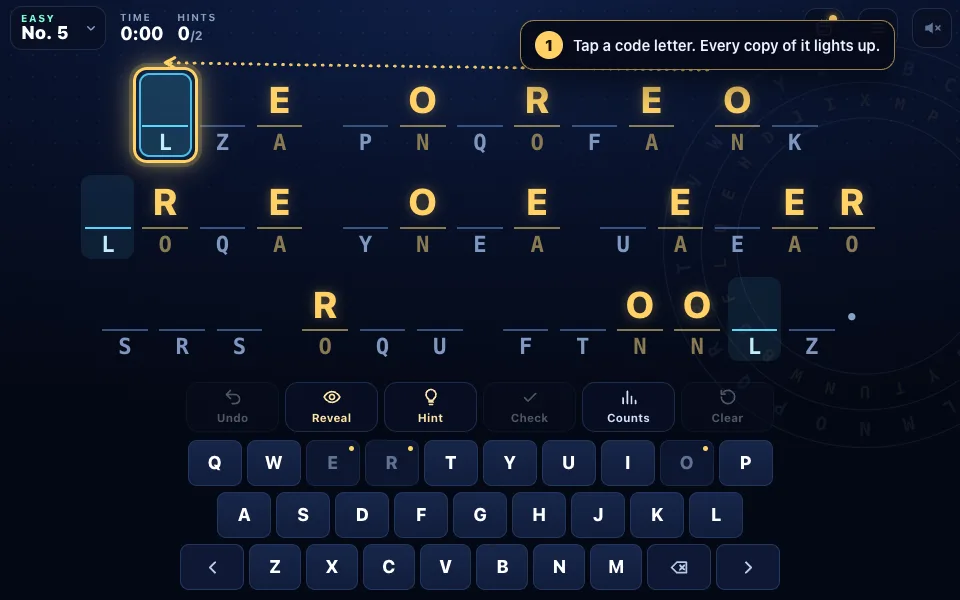
Pick a code letter
Tap or click any letter in the quote. The small letters are the code, and every copy of the one you pick lights up.
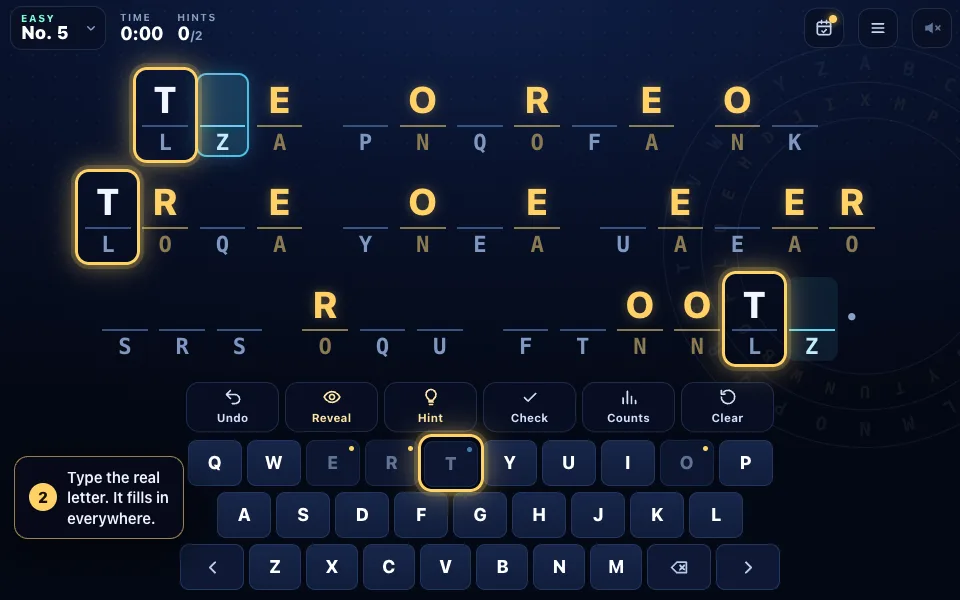
Type what it stands for
Type the real letter, or tap it on the keyboard, and it fills in everywhere that code letter appears. Gold letters are revealed for you.
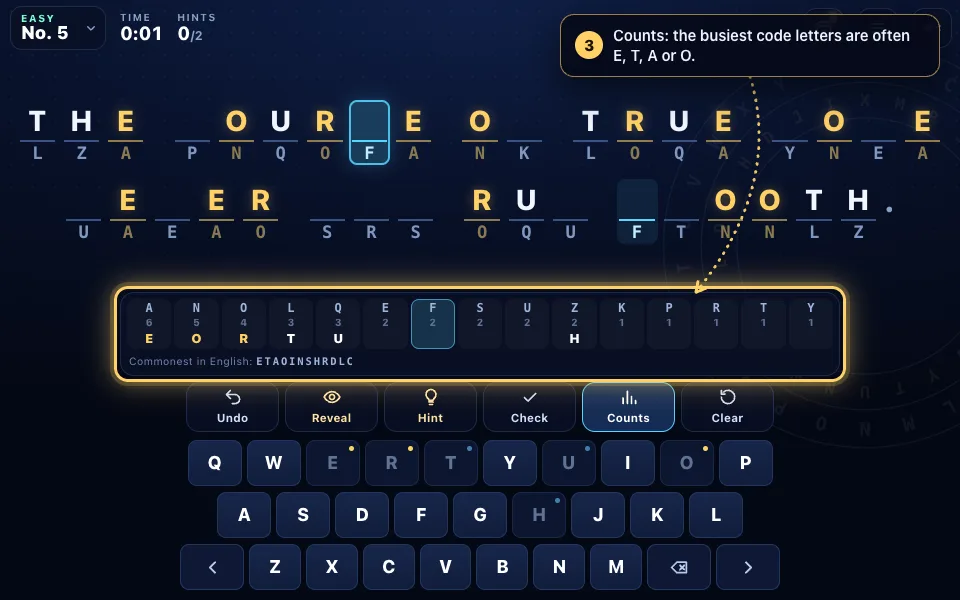
Find footholds
Start with short words and patterns. Counts shows how often each code letter appears; the busiest are often E, T, A or O.
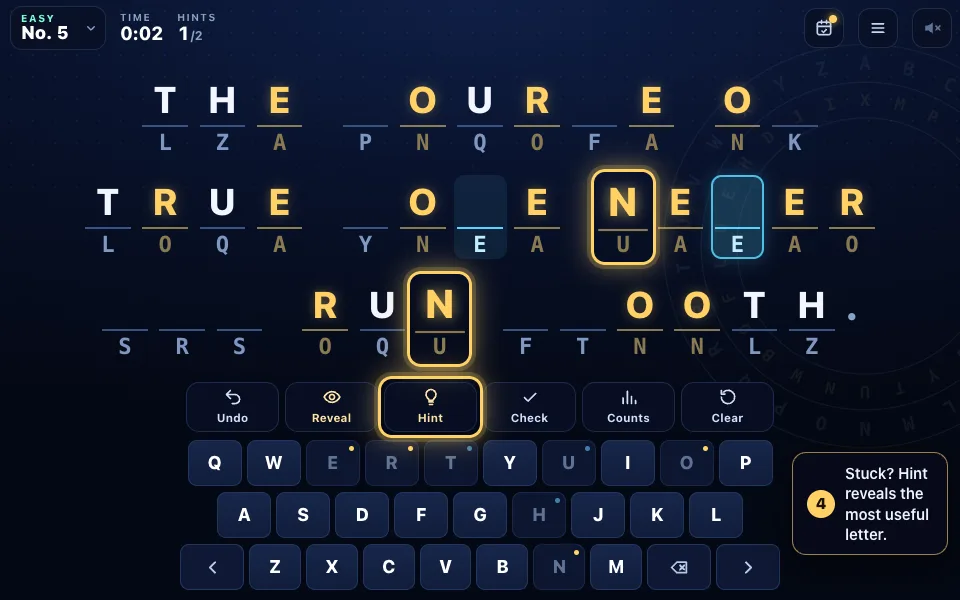
Take a smart hint
Stuck? Hint reveals the letter that unlocks the most words, or puts a wrong one right. Easy allows two hints, Medium and Hard one.
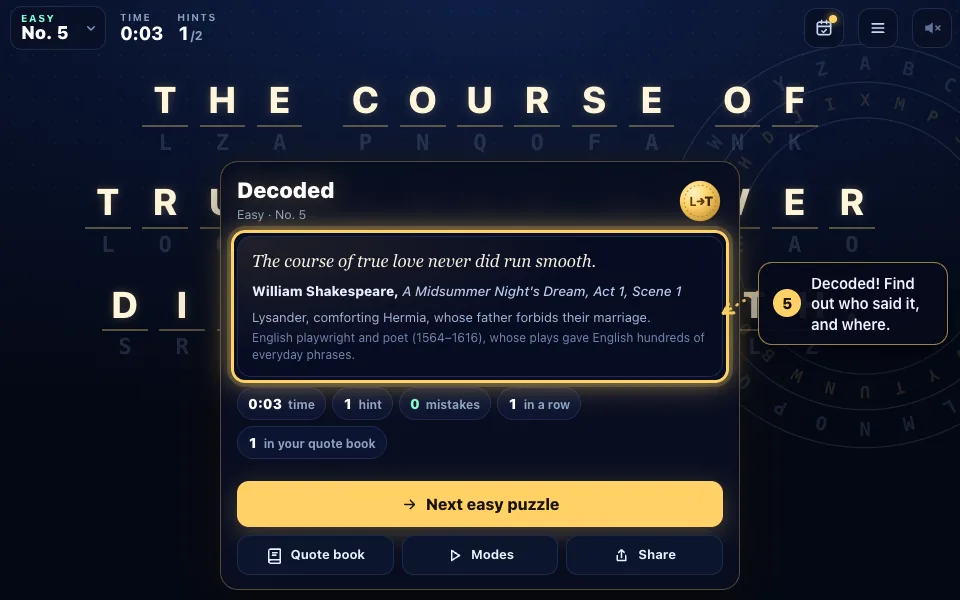
Decode the quote
When every letter is right the quote lights up, with who said it, the work it comes from and, usually, a short note.
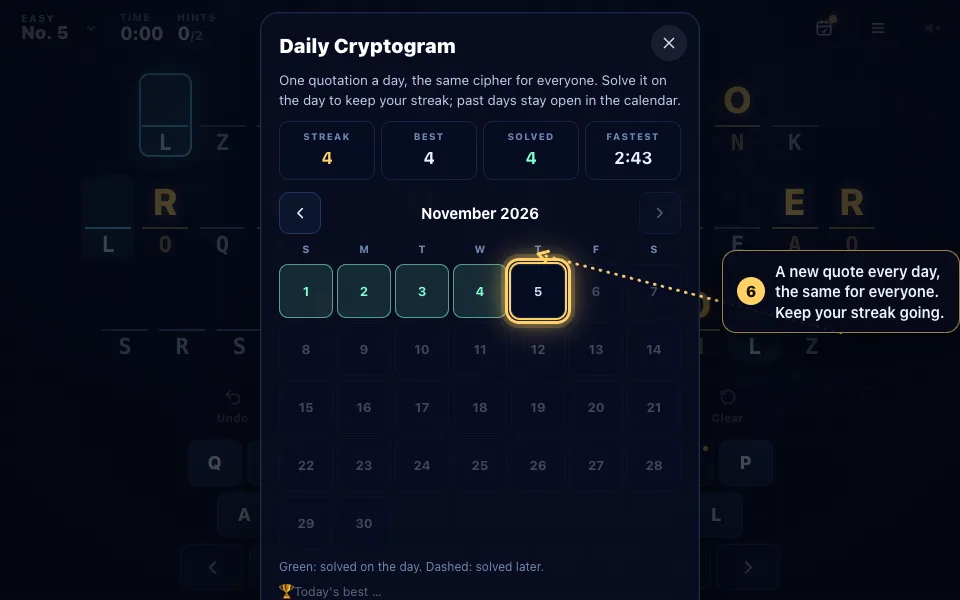
Keep a daily streak
A new Daily Cryptogram arrives every day, the same for everyone. Solve it on the day to grow your streak.
The rules in full
- The goal is to decode the quotation. Each letter has been replaced by another, the same way everywhere in the puzzle, and no letter ever stands for itself.
- Tap or click a letter in the puzzle to select it. The small letter under each space is the code, and every copy of the selected code letter lights up.
- Type the letter you think it stands for, or tap it on the on-screen keyboard. It fills in everywhere that code letter appears, and the cursor jumps to the next empty letter.
- Each real letter can only be used once. Typing a letter you've already placed elsewhere moves it here. Backspace clears a letter and Undo takes back your last change.
- Gold letters are revealed. Easy puzzles start with a few of them, Medium with one, and Hard and Expert with none. Expert also takes away the spaces and punctuation and writes the letters in groups of five.
- Hints depend on the level: two a puzzle on Easy, one on Medium and Hard, and none on Expert. Reveal shows the letter you've selected; Hint picks the most useful letter for you, and puts a wrong letter right first.
- Choose how checking works in Settings: wrong letters turn red as you type, only when you press Check, or never, for purists.
- The puzzle is solved when every letter is right. The quote appears in full with its author, the work it comes from and, for most quotes, a short note, and it goes into your quote book.
- With a keyboard, just type. The arrow keys and Tab move between letters, Backspace clears, ? gives a hint, ! reveals the selected letter and Ctrl+Z undoes.
Cryptograms tips and strategy
- Start with one-letter words: in English they are almost always A or I.
- A single letter after an apostrophe is usually S, T or D, as in IT'S, DON'T and I'D. Two letters after one are often LL, RE or VE.
- The commonest three-letter words are THE and AND. A three-letter word that turns up again and again is very likely THE.
- Open Counts to see how often each code letter appears. E, T, A and O are the most frequent letters in English, so try them on the busiest code letters first.
- Look at word patterns. A four-letter word whose first and last letters match could be THAT, and a double letter in the middle of a word is often LL, EE, SS, OO or TT.
- Long words often end in -ING, -ION, -ED or -LY. If a word ends in the same three code letters as another, try one of those endings on both.
- Don't be afraid to guess: you can clear any letter or undo. With checking set to When I ask, Check shows only which letters are wrong.
- On Expert, hunt for THE and AND across the groups of five. Once you find where a few words break, the rest falls into place.
What is a cryptogram?
A cryptogram is a short text written in a simple substitution cipher: every letter is swapped for another, and the same swap is used throughout. People have hidden messages this way since ancient times. The Roman historian Suetonius wrote that Julius Caesar shifted each letter three places along the alphabet.
As a puzzle, the cryptogram took off in the nineteenth century. Edgar Allan Poe challenged magazine readers to send him ciphers to crack, and his 1843 story “The Gold-Bug” shows a hero solving one by counting which signs appear most often. Later, newspapers began printing one every day, usually a famous saying, which is why a quote cryptogram is often called a cryptoquote.
When the spaces between words are taken out as well, puzzle makers call it a patristocrat. That's the Expert level here: the letters come in groups of five, with no punctuation to lean on.
How to solve cryptogram puzzles
Every cryptogram is a set of small logical steps. Find a foothold, such as a one-letter word or a letter after an apostrophe, and try the likeliest answer. Each letter you place shows up in other words, and those part-filled words suggest the next letter.
Letter frequency is the other great tool. E is the commonest letter in English, followed by T, A, O, I and N, and the Counts panel shows how often each code letter appears in the puzzle. In a long quote the busiest code letter is very often E.
Patterns finish the job. Repeated letters, words that share endings and the shape of short words all narrow the choices, and before long the quote starts to read itself.
Easy, Medium, Hard and Expert cryptograms
Easy cryptograms are short quotes and proverbs with a few letters revealed in gold and two hints to lean on, a gentle way to learn the tricks. Medium puzzles are longer, with one letter given and one hint. Hard puzzles are the longest quotes in the book, with nothing revealed and a single hint.
Expert cryptograms remove the spaces and punctuation altogether, the classic patristocrat, and you crack them with no hints at all. Every level keeps a puzzle in progress for you, so you can switch between them and carry on where you left off.
Each puzzle has a number, and the same number at the same level is the same quote and cipher for everyone, so you can send a friend the exact puzzle you just cracked.
The Daily Cryptogram, streaks and the quote book
A new Daily Cryptogram arrives every day at midnight where you are, the same quote and cipher for everyone. Solve it on the day to grow your streak, and open past days from the calendar any time.
Every quote you decode goes into your quote book with its author and source, so you can look back over everything you've cracked or search it by name. Stats keep your solves, fastest and average times at each level, clean solves with no hints and no wrong letters, and your best runs.
Public domain quotes, proverbs and fables
Every quotation in Cryptograms is in the public domain. There are traditional proverbs from England and around the world, nursery rhymes and weather lore, and lines from writers and speakers who died long ago: Shakespeare's plays, Benjamin Franklin's Poor Richard's Almanack, Jane Austen's novels, Mark Twain, Oscar Wilde, Ambrose Bierce's The Devil's Dictionary and the morals of Aesop's fables.
Each quote is credited to the work it comes from, and famous sayings that the named person probably never said are left out. That's why “I'm not young enough to know everything” is credited here to J. M. Barrie, who wrote it for The Admirable Crichton, and not to Oscar Wilde. Most puzzles end with a short note too: who is speaking in the play, what a proverb means, or the story behind the line.
Playing cryptograms on your phone
Cryptograms is made for touch as much as for a keyboard. Tap a letter in the quote, then tap a key on the built-in keyboard; the arrow keys beside it hop to the next empty letter. The letters shrink or grow to fit your screen, and Full screen gives the puzzle every pixel.
Your progress saves as you go, so you can close the page halfway through a quote and pick it up later on the same device. There's no account needed, no timer pressure and nothing to download.
Cryptograms FAQ
Is Cryptograms free?
Yes. Every cryptogram is free to play in your browser, with no download, no account and no ads.
How do cryptograms work?
Each letter of a quotation is swapped for a different letter, using the same swap all the way through. If Q stands for E once, every Q in the puzzle is an E. Work out the swaps and you can read the quote.
What is the difference between a cryptogram and a cryptoquote?
A cryptoquote is a cryptogram whose hidden text is a quotation, often with the author's name. Every puzzle here is a quote, so the two words mean the same thing on this page. The author is shown once you've solved it, so it doesn't give the game away.
Can a letter stand for itself?
No. In every puzzle each letter is replaced by a different one, so a code letter A is never a real A. That rule is a useful clue in its own right.
How do the hints work?
Easy puzzles allow two hints, Medium and Hard one, and Expert none. Reveal shows the true letter for the code letter you've selected. Hint chooses for you: it puts right a wrong letter you've placed, or else reveals the letter that would complete or nearly complete the most words. Hints used are counted in your stats. Truly stuck? Show the answer, in the puzzle menu, reveals the whole quote, and that puzzle counts as unsolved.
What is the Daily Cryptogram?
One quote a day, with the same cipher for everyone, changing at midnight on your own clock. Solving it on the day keeps your streak going, and you can play any past day from the calendar.
What is an Expert cryptogram, or patristocrat?
A patristocrat is a cryptogram with the spaces and punctuation taken out, written in groups of five letters. Without word breaks you can't spot short words directly, so it's the hardest way to play.
Can I turn off mistake checking?
Yes. In Settings, choose when wrong letters show in red: as you type, only when you press Check, or never. With Never, the puzzle simply finishes when every letter is right.
Are the quotes real?
Yes. Every quote comes from a named work, such as a play, novel, essay, speech or letter, or is a traditional proverb or rhyme. Lines that are famously misattributed are left out, and all of them are in the public domain.
Is my progress saved?
Yes. Each level keeps its puzzle in progress, and so does each daily you start, along with your stats, streaks, daily calendar and quote book, all saved in your browser on this device.
Can I play with a keyboard?
Yes. Click the puzzle and type. The arrow keys move between letters, Tab jumps to the next empty one, Backspace clears, ? gives a smart hint, ! reveals the selected letter and Ctrl+Z undoes.
More games
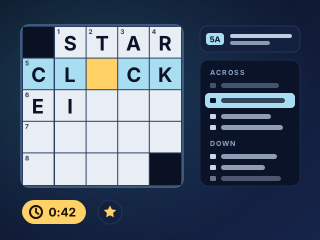
Mini Crossword
A fresh 5x5 crossword every day, solved in a minute or two. Free archive, practice puzzles, check and reveal, a timer and streaks.
PLAY →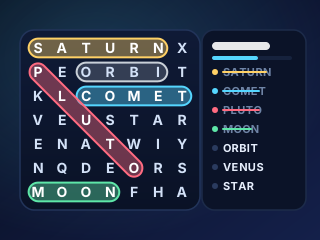
Word Search
Free themed word search puzzles: a new daily grid, unlimited puzzles in 66 themes, three sizes, hints, a timer and best times.
PLAY →
Kindred
Sixteen words, four hidden groups of four. A new puzzle every day, a free archive, markers to think with and an explanation for every answer.
PLAY →