Binary Puzzle: Takuzu and Binairo Online
Fill the grid with 0s and 1s: no three in a row, equal counts in every line, no twin lines. A daily puzzle, grids from 6×6 to 14×14 at four levels, digits or glowing tokens, and hints that explain the next step.
What is Binary Puzzle?
Binary Puzzle is the logic puzzle of 0s and 1s, also known as Takuzu or Binairo, free to play in your browser on phone, tablet and computer. You fill a square grid so that every row and column holds as many 0s as 1s, no three of the same sit next to each other, and no two rows or columns are alike.
Every puzzle here is made fresh by our own generator and checked by a step-by-step logic solver, so it has exactly one solution and never needs a guess. Pick a grid from a quick 6×6 to a sprawling 14×14 and a level from Easy to Expert, or play the Daily Binary Puzzle: the same grid for everyone, with a streak to keep and a calendar of past days.
Play with classic digits or with two glowing tokens, one round and one square, so colour is never the only clue. Tap to cycle a cell, drag to fill a run, and lean on live line counts, rule-break highlights, undo and redo. When you're stuck, a hint shows the next logical step and explains it in plain words.
How to play Binary Puzzle
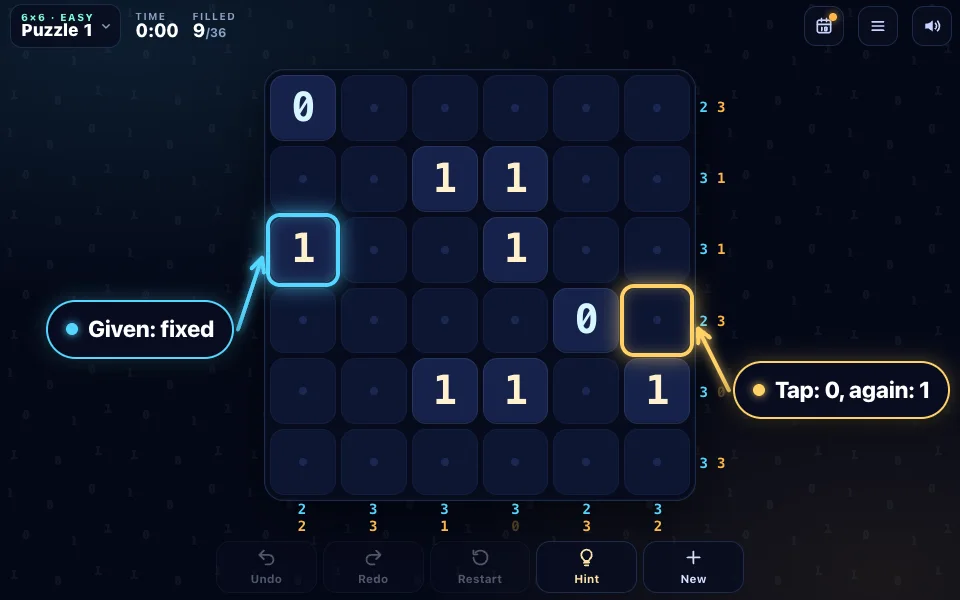
Fill the grid with 0s and 1s
Every empty cell takes a 0 or a 1. Cells on a lighter plate are given and stay put; tap an empty cell once for a 0, again for a 1, and once more to clear it.
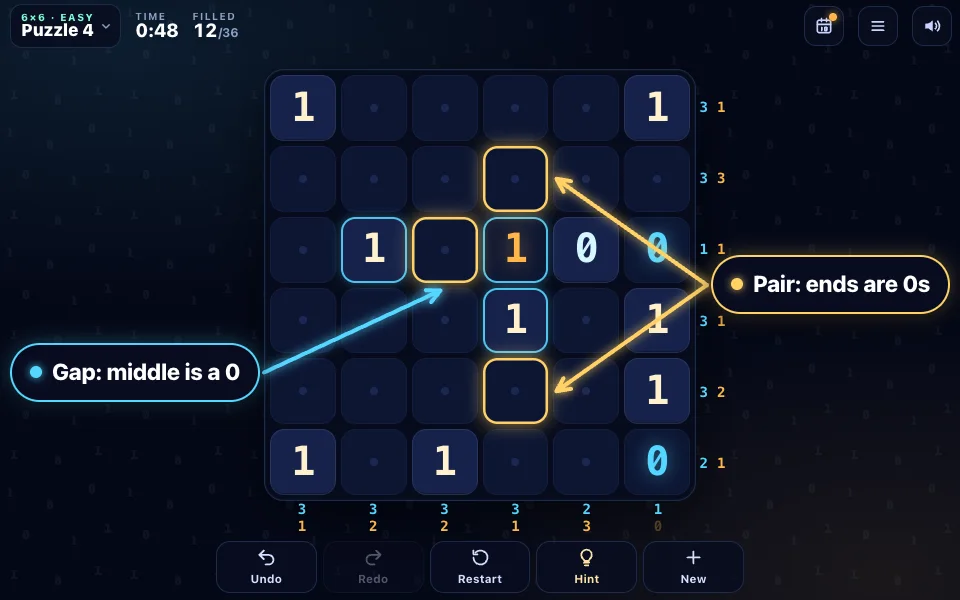
Spot pairs and gaps
Two of the same side by side force the other value at both ends of the pair. Two of the same with one cell between them force the other value into that gap.
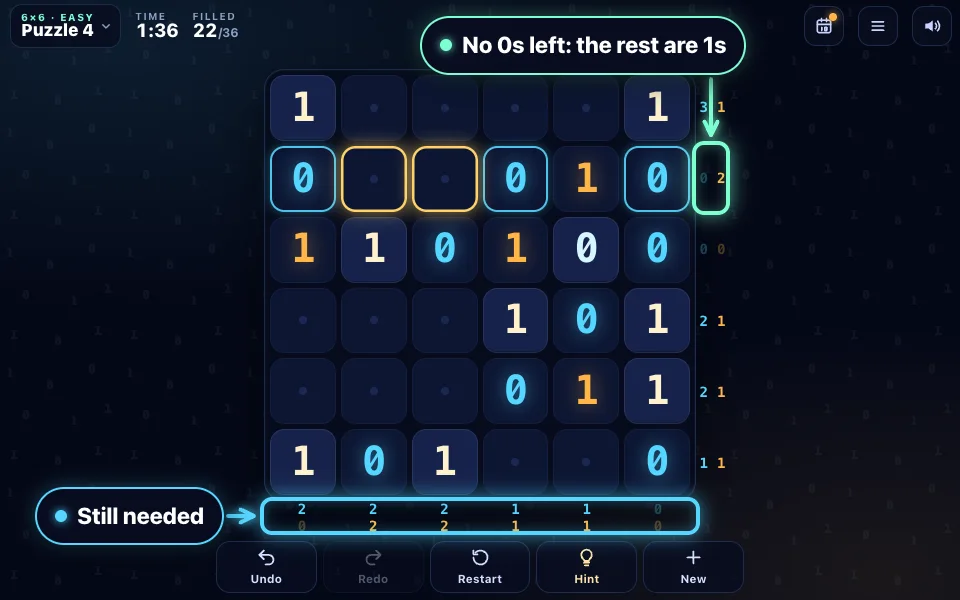
Balance every line
Every row and column holds as many 0s as 1s. The counts beside the grid show what each line still needs: once a line has all its 0s, its empty cells are all 1s.
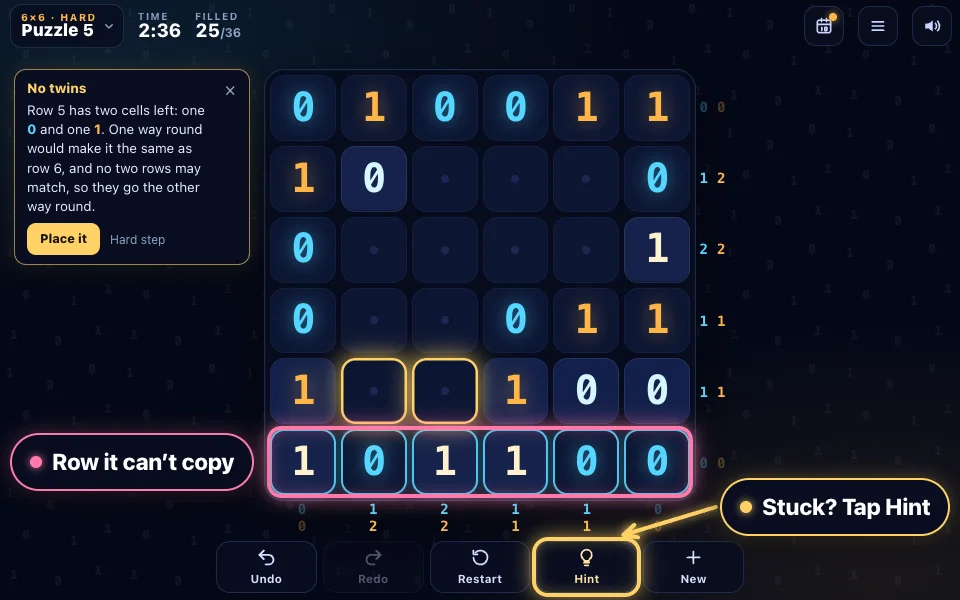
No twin lines, and a hint when stuck
No two rows and no two columns may be the same. Whenever you are stuck, tap Hint: it marks the next logical step and explains it in plain words.
Solve it and keep going
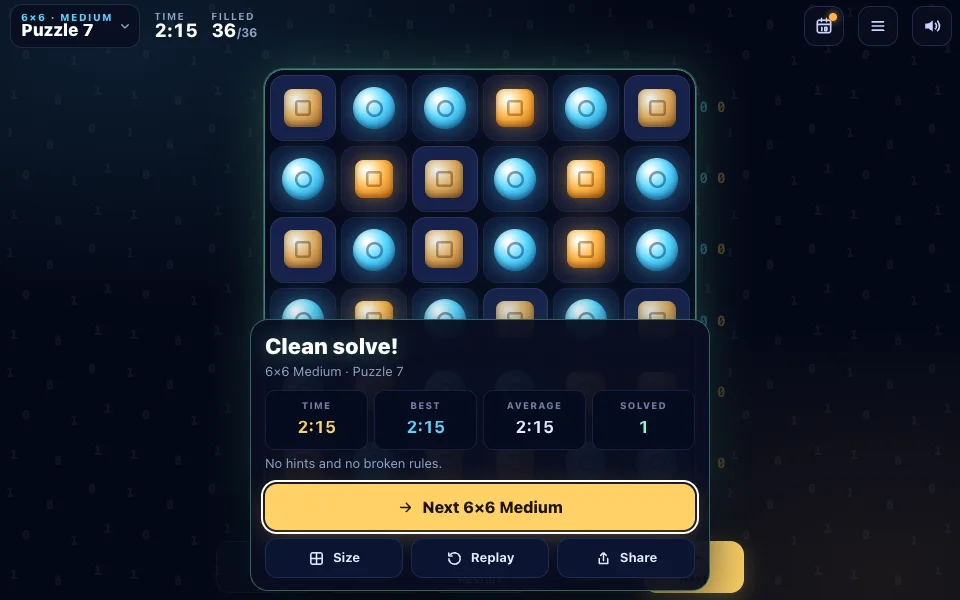
Fill the last cell without breaking a rule and the grid lights up. Take the next puzzle, try another size or level, or play the Daily Binary Puzzle to grow your streak.
The rules in full
- The goal: fill every empty cell with a 0 or a 1. Cells on a lighter plate are given at the start and can't be changed.
- Rule one: no more than two of the same value next to each other, across or down. 0 0 1 is fine; 0 0 0 is not.
- Rule two: every row and every column holds as many 0s as 1s, so a 10×10 line has five of each.
- Rule three: no two rows are the same, and no two columns are the same.
- Tap or click a cell to cycle it: empty, 0, 1, empty. Hold it (or right-click) to cycle the other way, and drag across cells to give them all the same value.
- The small numbers beside each row and under each column show how many 0s and 1s that line still needs. Broken rules turn red, so a slip never goes unseen.
- Undo and Redo step through your moves, and Restart clears every cell you've filled (Undo brings them back). Hint shows the next step logic allows from where you are, explains why, and can place it for you.
- With a keyboard, the arrow keys move, 0 and 1 fill a cell, Space cycles it and Backspace clears it.
- Fill the last cell without breaking a rule and the puzzle is solved.
Binary Puzzle tips and strategy
- Start with pairs. Two of the same side by side means the cells at both ends of the pair hold the other value.
- Look for gaps. Two of the same with one empty cell between them means the middle cell is the other value.
- Count as you go. Once a line has all its 0s, every empty cell left in it is a 1, and the counts beside the grid do the sums for you.
- When a line needs just one more of a value, test where it could go. Any spot that would leave three of the other value side by side is ruled out.
- Work the busiest lines first: the more cells a line already has, the fewer ways it has left to finish.
- Near the end, compare nearly finished lines with finished ones. If two cells are left and one arrangement would copy another line, it has to be the other arrangement.
- On Expert grids, try a value in a tight spot and follow the easy rules from there. If that leads to a clash, the cell holds the other value.
- A hint shows only the next step, never the whole answer, so you keep the rest of the solve for yourself.
What is a binary puzzle?
A binary puzzle is a grid logic puzzle that uses only two symbols, usually 0 and 1. It is best known as Takuzu or Binairo, and you'll also see it called a 0 and 1 puzzle, a binary logic puzzle or simply a binary grid. One of its best-known names, Binairo, comes from Belgium, and the same idea has spread through puzzle books, newspapers and apps under several names.
Whatever the name, the rules are the same three: no three of the same value in a row, the same number of each value in every line, and no two lines alike. Some versions use colours, circles or Xs and Os instead of digits. The logic doesn't change, which is why this version lets you play with digits or with tokens.
Binary puzzle rules, sizes and what this version offers
The grid is always square and even-sized, so every line can split exactly in half. Here you can play 6×6, 8×8, 10×10, 12×12 and 14×14 grids. A 6×6 takes a couple of minutes; a 14×14 Expert is a long, absorbing solve.
You choose how it looks and feels. Play with 0 and 1 in a clean monospaced style, or switch to glowing blue circles and gold squares, with a shape for each value so colour-blind players never have to rely on colour. You can set which value comes first when you tap, hide the line counts or the rule-break highlights for a purer challenge, and hide the clock if you'd rather not see it.
Every grid is numbered. Share a puzzle's link and a friend gets exactly the same grid, so you can compare times on the same puzzle.
Binary puzzle strategy: from pairs to what-if chains
Most solving starts with three quick checks. A pair of the same value forces the other value at both ends. A gap, the same value either side of an empty cell, forces the other value into the middle. And a line that already has all of one value is finished with the other.
The next step up is counting more carefully. When a row needs just one more 1, every other empty cell in it will be a 0, so the last 1 can't go anywhere that would leave three 0s together. Harder grids ask you to see that every way a line can still be finished agrees on a cell, and to use the no-twins rule when a line is two cells from copying another.
The toughest grids need a short what-if: suppose a cell holds a 1, follow the pairs, gaps and counts from there, and if that breaks a rule, the cell must be a 0. The hint button teaches each of these as you meet it.
Four difficulty levels and the Daily Binary Puzzle
Each level is defined by the hardest step its solution needs, not by how many cells are given. Our solver always uses the simplest step available, so a puzzle is only graded Expert if it truly needs an Expert step.
Easy grids fall to pairs, gaps and full counts. Medium adds lines that need just one more of a value. Hard adds whole-line reasoning and the no-twins rule, and Expert adds what-if chains.
The Daily Binary Puzzle is the same grid for everyone, set by your local date. Monday's is a gentle 8×8, the week builds through 10×10 and 12×12 grids, and Sunday brings a 14×14 Expert. Solve it to grow your streak, open past days from the calendar, and see the fastest times on the day's board.
Play binary puzzles on your phone or computer
Binary Puzzle is built for touch as much as for a mouse. Tap a cell to cycle it, hold to go back, and drag a finger along a row to fill several cells at once. Full screen gives the grid every pixel, and the layout adapts when you turn your phone.
On a computer, click and right-click, or play entirely from the keyboard. The grid works with screen readers too: every cell announces its row, column and value. Unfinished puzzles, settings, stats and your daily streak are saved in your browser, so you can close the tab, or break off for the daily, and pick up exactly where you left off.
Binary Puzzle FAQ
Is Binary Puzzle free?
Yes. Binary Puzzle is free to play in your browser with no download and no account. Make a free Rocket Games account if you want your solves on the leaderboards and kept on every device.
What are the rules of a binary puzzle?
Fill every cell with 0 or 1. No more than two of the same value may sit next to each other in a row or column, every row and column holds as many 0s as 1s, and no two rows or two columns may be the same.
Is Takuzu the same as Binairo?
Yes. Takuzu, Binairo, binary puzzle and 0 and 1 puzzle are different names for the same puzzle with the same three rules. Some publishers use colours or symbols instead of digits, but the logic is identical.
Does every binary puzzle have only one solution?
Every puzzle here does. Our generator only keeps a grid once its logic solver can finish it step by step from the given cells, which proves there is exactly one solution.
Do I ever need to guess?
No. Every grid can be solved by logic alone. On Expert grids some steps are what-if checks, where you follow one value a few cells and see it break a rule, but that is reasoning, not a guess.
How are the difficulty levels decided?
By the hardest technique the solution needs. Easy uses pairs, gaps and full counts; Medium adds lines that need one more of a value; Hard adds whole-line reasoning and the no-twins rule; Expert adds what-if chains.
What is the Daily Binary Puzzle?
A new puzzle every day, the same for everyone by local date. It is gentle early in the week and builds to a 14×14 Expert on Sunday. Solve it to keep your streak going, and play earlier days from the calendar.
How do hints work?
A hint looks at your grid as it is now and shows the next step logic allows, with the cells that prove it and a short explanation. If one of your cells doesn't match the solution, the hint points that out first. Best times count only solves without hints.
Can I play with colours instead of 0s and 1s?
Yes. In Settings, switch the look to tokens: glowing blue circles and gold squares. Each value has its own shape as well as its own colour, so the puzzle never depends on telling colours apart.
What do the numbers beside the grid mean?
They show how many 0s (blue) and 1s (gold) each row and column still needs. A number fades once that value is complete, and turns red if the line has one too many.
Is my progress saved?
Yes. Unfinished puzzles, with their undo history and time, are saved in your browser along with your stats, settings and daily streak. Leave the page, or switch to the daily and back, and you carry on where you were.
More games
Sudoku
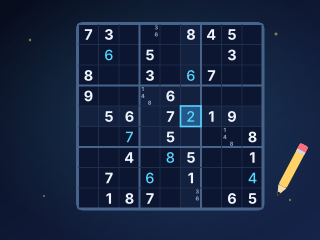
A fresh daily Sudoku plus unlimited puzzles from Easy to Expert, graded by the techniques they need. Notes, hints that explain themselves, undo and a timer.
PLAY →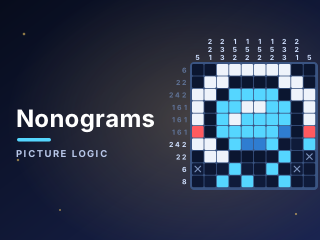
Nonograms
Fill the grid from the number clues to reveal a hidden pixel picture. A daily puzzle, unlimited puzzles from 5×5 to 25×25 and an album of hundreds of pictures.
PLAY →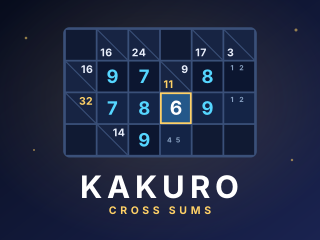
Rocket Kakuro
Kakuro cross sums: a daily puzzle and unlimited grids from 6×6 to 14×14, Easy to Expert. A combination helper, notes, explained hints and undo.
PLAY →